- Animals
- ›Chordates
- ›Vertebrates
- ›Amphibians
- ›Salamanders
- ›Lungless Salamanders
- ›Hemidactyliine Salamanders
- ›Hemidactylium
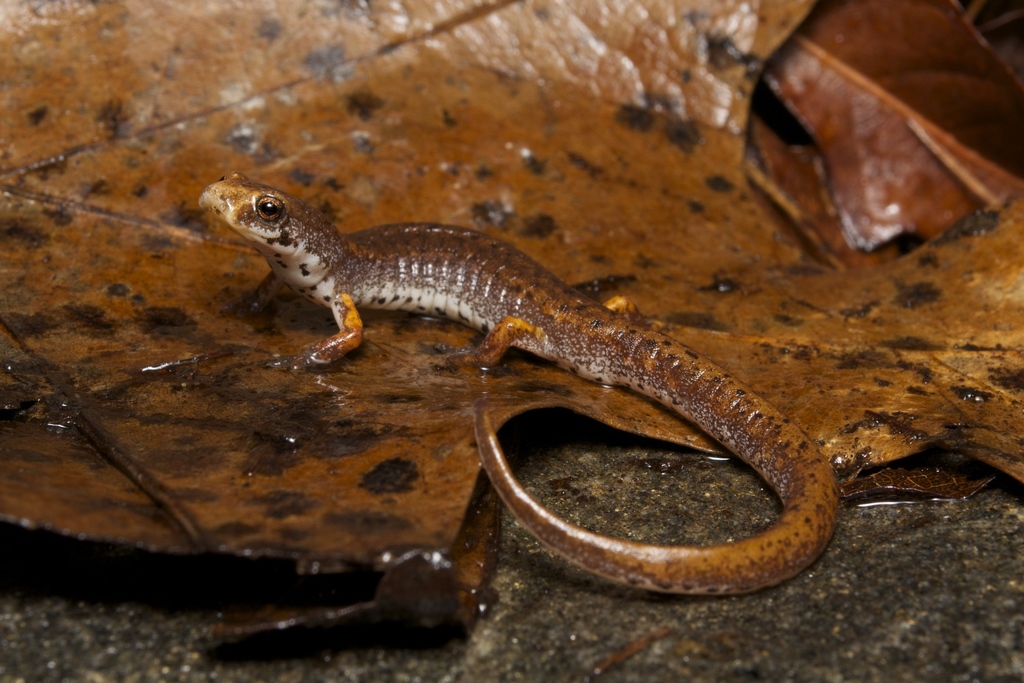
Four-toed Salamander
Hemidactylium scutatum
The four-toed salamander (Hemidactylium scutatum) is a lungless salamander native to eastern North America. It is a species of the monotypic genus Hemidactylium. (In Francophone Canada, it is called the salamandre à quatre orteils.)
From the article Four-toed salamander on Wikipedia (CC BY-SA), quoted section by section
Description
The four-toed salamander can be recognized by its white underbelly sprinkled with black dots. Its back varies from orange-brownish to red-brownish; its flanks are grayish. The body and the limbs are elongated. The snout is short, and the eyes are prominent. The tail color is usually brighter than the back, and you can observe a constriction at the body/tail junction. The posterior limbs have four toes (hence its name), a good identification criterion but hard to use in the field. This species rarely exceeds 10 cm (3.9 in) in length. In the breeding season (late October to early December) males have enlarged premaxillary teeth and truncated squarish snouts, which are round in females. The juveniles show a tail shorter than the body.
The four-toed salamander can be easily mistaken for the redback salamander (Plethodon cinereus) in the wild. The redback salamander's underbelly has more numerous black markings. Unlike the four-toed salamander, the redback salamander has no constriction at the tail base, and its posterior limbs show five digits.
Range & habitat
This species' favored habitats are sphagnum bogs, grassy areas surrounding beaver ponds, and deciduous or mixed forests rich with mosses. The four-toed salamander will use the sphagnum bogs during reproduction, but uses the forest habitat during the summer. It overwinters in terrestrial habitat, using old burrows or cavities created by rotting roots, below the freezing depth. It will frequently overwinter in groups, sometimes with other amphibians such as the red-backed salamander. In Canada, the four-toed salamander can be found in southern Ontario and Quebec, in Nova Scotia, and a single population was found in New Brunswick in 1983. In the United States, it can be found from Maine to Minnesota and as far as Alabama in the south. They have also been found in eastern Kentucky. The home range of the species is not known. It was believed that the different elements of its habitat (breeding, summer and overwintering) had to be within 100 m of each other, but recent observations might suggest this to be an underestimation.
Wikipedia: “Habitat”
What it does
Mating occurs in terrestrial areas throughout the autumn months. In early spring the females nest on land, along the banks of small ponds. After the 4–6 week embryonic period, the larvae hatch and make their way to the adjacent pond. Four-toed salamanders undergo a relatively short aquatic larval period, when compared to other species of the same family, ranging between 3 and 6 weeks.
Wikipedia: “Reproduction”
Listen
Looking for field recordings…
Where it lives
Recorded sightings
—
geo-referenced records in GBIF, from museums, herbaria and field observers.
Drag the globe to turn it. Dots are where records exist, not a range map; darker means more records.
In the stacks
Searching the stacks…
Every page naming Hemidactylium scutatum in the Biodiversity Heritage Library →
This page is assembled live from iNaturalist, GBIF, Wikipedia, the Source Library and the Internet Archive. It is not yet part of the hand-edited codex. iNaturalist taxon 27652.