- Animals
- ›Chordates
- ›Vertebrates
- ›Amphibians
- ›Salamanders
- ›Lungless Salamanders
- ›Hemidactyliine Salamanders
- ›Pseudotriton
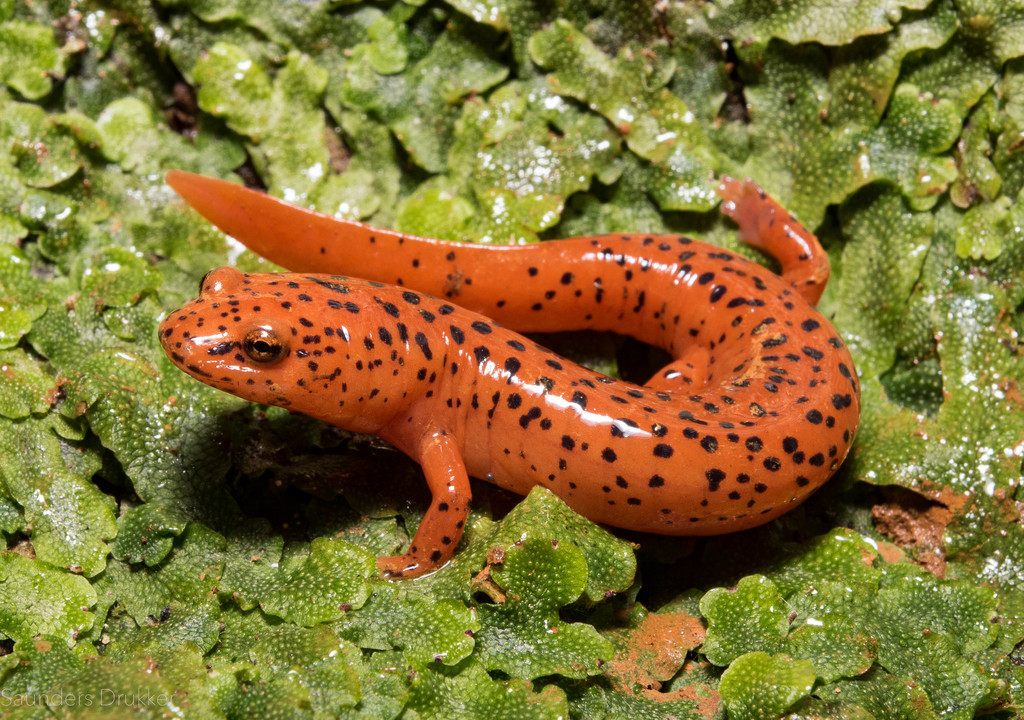
Red Salamander
Pseudotriton ruber
The red salamander (Pseudotriton ruber) is a species of salamander in the family Plethodontidae (lungless salamanders) endemic to the Eastern United States. Its skin is brown, orange or red with random black spots. Semiaquatic adults and aquatic larvae live in temperate forests, small creeks, bogs, ponds, intermittent streams, and freshwater springs. Overall this species is common and widespread, but locally it has declined because of habitat loss and it is considered threatened in Indiana and New York. Red salamanders eat insects, earthworms, spiders, small crustaceans, snails, and smaller salamanders. To eat, they extend their tongue to capture prey on the tip of it and retract it back into their mouths. The red salamander, as a member of the family Plethodontidae (lungless salamanders) lacks lungs and respires through its skin.
From the article Red salamander on Wikipedia (CC BY-SA), quoted section by section
Description
The Pseudotriton ruber is a medium-large salamander, with adults ranging from 4.3 to 7.1 in (11–18 cm) in total length. It has a relatively stout body with 16–18 coastal grooved sides. Its back varies in color from an orange-brownish tint to a bright red, depending on its age. Like other salamanders, the red salamander seems to lose its color as it ages, becoming more darkly pigmented with less obscure patterns. The larvae of this species have a stout head and body, are dark in coloration, lack spots, and tend to have distinct mottling or streaks. Another distinguishing characteristic of P. ruber is the appearance of numerous irregular black spots down its back. Although the red salamander is brilliantly colored and has many distinguishing features, it is sometimes difficult to tell species apart. P. ruber is most similar in appearance to the mud salamander (P. montanus), but can be distinguished by the difference in size and number of spots running down the dorsum and also by the difference in the color of the iris. Both P. ruber and P. montanus have bright red colorations that have been considered examples of a Müllerian mimetic complex. The red salamander has more spots and the spots also tend to be larger in size than those of the mud salamander. The spots on P. ruber are also said to overlap in many areas, whereas mud salamanders rarely, if ever, do. …
Range & habitat
The four subspecies of P. ruber are found across the eastern United States, occupying streams through open areas such as fields and meadows and deciduous or mixed hardwood forests, especially near streams, seepages, and damp settings. Red salamanders are also found in deciduous or mixed hardwood forests, especially near streams, seepages, and in leaf packets near spring-fed brooks. Each subspecies is similar in appearance with slight differences in size and coloration, but are found in different habitats. The northern red salamander, P. r. ruber, is characterized as being red or reddish-orange with numerous black spots down its back. This subspecies is the most common and can be found from southern New York and Ohio to northeast Alabama, as well as the Upper Peninsula of Michigan. Similar in appearance to the northern red salamander is the Blue Ridge red salamander, P. r. nitidus. This subspecies differs in that it is slightly smaller and lacks black coloration on the tip of the tail and chin. The Blue Ridge red salamander is found in elevations to more than 5,000 ft (1,500 m) in the southern part of the Blue Ridge Mountains of Virginia. The blackchin red salamander, P. r. schencki, differs in appearance by having strong black coloration under its chin, as well as spotting all the way to the tip of the tail. …
Wikipedia: “Distribution”
What it does
Some important aquatic and terrestrial ecological aspects of this salamander include its diet, predators, and microhabitat preferences. Larvae mainly feed on invertebrates such as insect larvae and worms. Larval diet specifically has been shown to consist of Chironomidae (36.52% of prey items) and Sphaeriidae (15.17%) as well as terrestrial prey (7.87%) and other salamanders. Larval growth rates differ depending on the temperature of the water and tend to be higher in the warmer months when water temperature is higher. The red salamander generally lays eggs in the fall and hatching season takes place in the late fall and winter. The larval period varies between 27 and 31 months and then metamorphosis takes place in the spring and early summer of the third year. The larvae go through metamorphosis after a few weeks or months, depending on the environmental conditions. Larval red salamanders are generalists, eating whatever is available. The rates typically increase when water temperature is low and larger individuals feed more than smaller individuals. Although feeding rates appear to increase with increasing size, mortality rates, though, seem to be independent of size or age and survival is estimated to be about 50% per year. …
Wikipedia: “Ecology”
In human culture
P. ruber has a wide range in its breeding season, which is only limited by extremely cold temperatures. Adults are known to migrate from streams and bodies of water to terrestrial habitats during specific seasons each year. They will then return to aquatic streams in the late summer and early fall to begin breeding. Generally, however, adult red salamanders mate annually and engage in primitive courting activities. Courtship between two red salamanders involves: "A male approaches a female, rubbing his snout against her snout, cheeks, and chin. The male then moves his head and body under her chin and starts tail undulations. The female then straddles the male's tail and the pair engages in a straddled 'walk' until the male deposits sperm on the substrate. The 'straddle-walk' approximately lasts two minutes and once the sperm is deposited, the female picks up the sperm cap as she moves over it and then they separate.". Females are capable of long-term sperm storage and may not lay eggs for months after mating. Females typically lay eggs in the fall or early winter in headwater streams, have very well-hidden nests. The eggs are usually placed in clusters and cling to submerged plants or other objects. Based on presence of scars and hypertrophied jaws in mature males, it is suggested that male P. ruber might be involved in mate-guarding behavior. …
Wikipedia: “Life history”
Listen
Looking for field recordings…
Where it lives
Recorded sightings
—
geo-referenced records in GBIF, from museums, herbaria and field observers.
Drag the globe to turn it. Dots are where records exist, not a range map; darker means more records.
In the stacks
Searching the stacks…
Every page naming Pseudotriton ruber in the Biodiversity Heritage Library →
This page is assembled live from iNaturalist, GBIF, Wikipedia, the Source Library and the Internet Archive. It is not yet part of the hand-edited codex. iNaturalist taxon 27486.