On eBird ↗
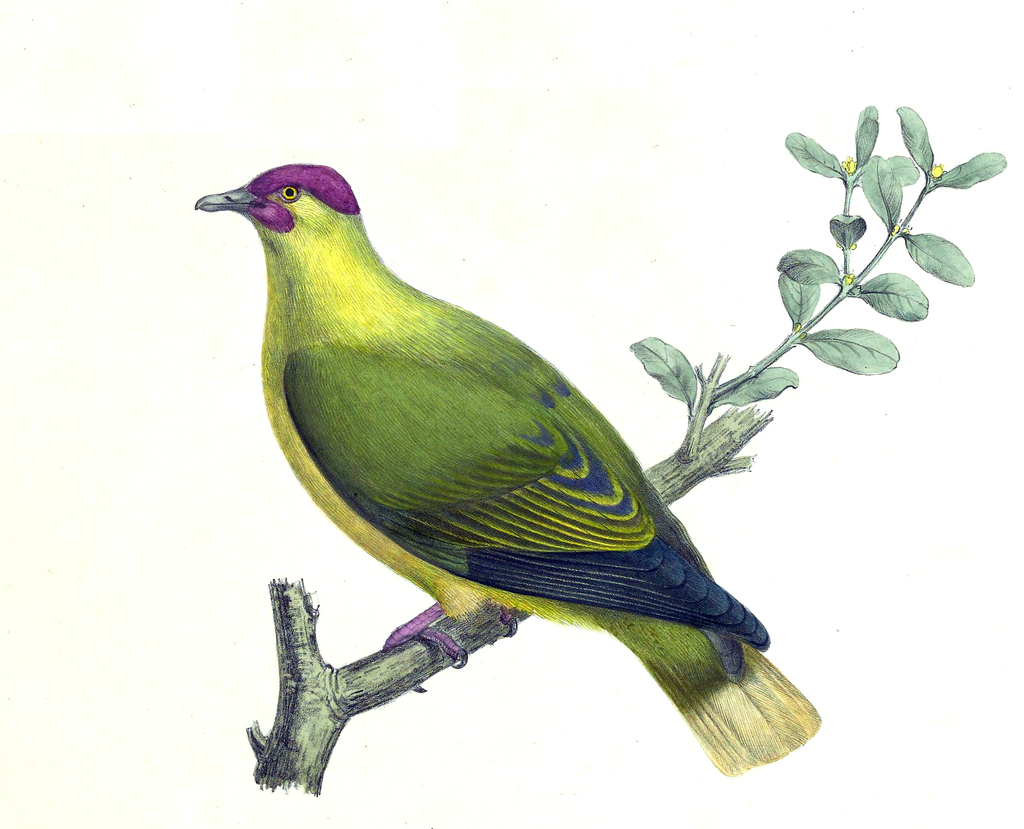
Red-moustached Fruit-Dove
Live sightings near you, the range map, bar charts of when it is seen, and Macaulay Library photos and recordings.
Red-moustached Fruit Dove
Ptilinopus mercierii
The red-moustached fruit dove or moustached fruit dove (Ptilinopus mercierii) is an extinct species of bird in the family Columbidae. It was endemic to French Polynesia. The last record was of the subspecies P. m. tristrami on Hiva Oa, in 1922. Its extinction has been attributed to predation by the introduced great horned owl (Bubo virginianus), as well as by introduced rats and cats. In 1994, it was listed as an extinct species on the International Union for Conservation of Nature Red List of Endangered Species.
From the article Red-moustached fruit dove on Wikipedia (CC BY-SA), quoted section by section
Description
The red-moustached fruit dove measured 21 to 23 cm (8.3 to 9.1 in) in length. The head, breast, and neck were bluish grey, and the tail was short, almost square shaped. The underpart plumage was golden yellow in colour. The juvenile had less yellow on the hind neck and crown. The breast was green-tinged and had light yellowish on the peripheries of the feathers. The undertail coverts were yellow-white. It was similar in appearance with the white-capped fruit dove (Ptilinopus dupetithouarsii).
Range & habitat
The red-moustached fruit dove was endemic to the Marquesas Islands in French Polynesia. The nominate subspecies was found on the Nuku Hiva Island, and the subspecies P. m. tristrami was found on the Hiva Oa Island. Described as arboreal, the red-moustached fruit dove inhabited montane forests, usually higher in altitude than the white-capped fruit dove, at elevations of at least 1,370 metres (4,490 ft) above sea level.
Wikipedia: “Distribution and habitat”
Listen
Looking for field recordings…
Where it lives
Recorded sightings
—
geo-referenced records in GBIF, from museums, herbaria and field observers.
Drag the globe to turn it. Dots are where records exist, not a range map; darker means more records.
In the stacks
Searching the stacks…
Every page naming Ptilinopus mercierii in the Biodiversity Heritage Library →
This page is assembled live from iNaturalist, GBIF, Wikipedia, the Source Library and the Internet Archive. It is not yet part of the hand-edited codex. iNaturalist taxon 2747.