- Animals
- ›Chordates
- ›Vertebrates
- ›Amphibians
- ›Salamanders
- ›Lungless Salamanders
- ›Hemidactyliine Salamanders
- ›Batrachoseps
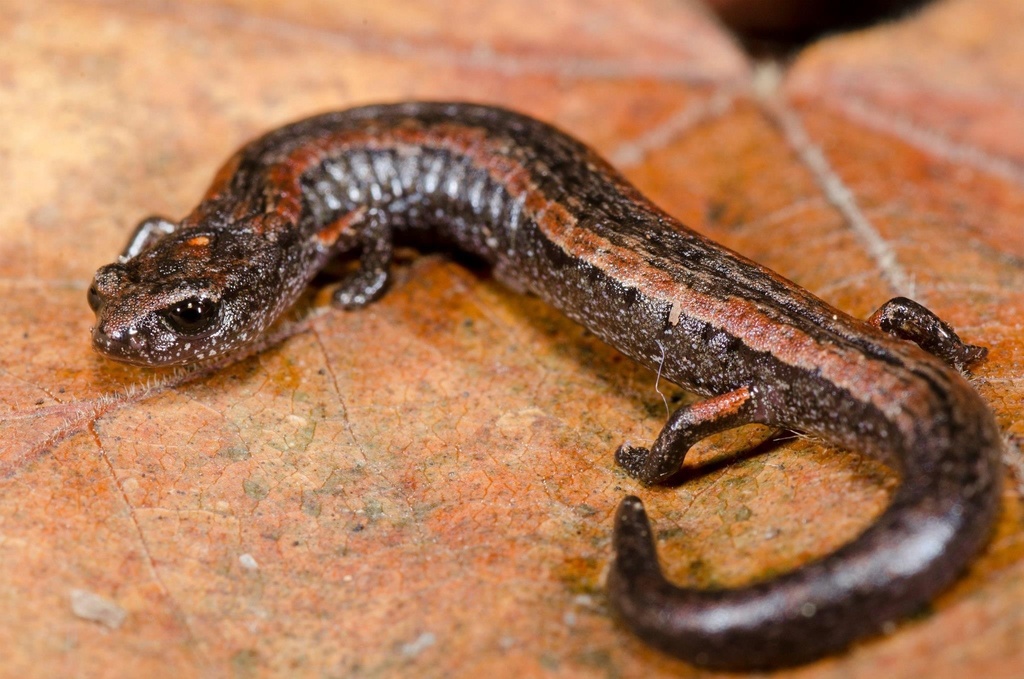
California Slender Salamander
Batrachoseps attenuatus
The California slender salamander (Batrachoseps attenuatus) is a lungless salamander found primarily in coastal mountain areas of Northern California, United States as well as in limited areas of the western foothills of the Sierra Nevada, California, the northern Central Valley of California, and in extreme southwestern Oregon. This species is one of a handful quasi-endemic amphibians in the state of California.
In 2001, Elizabeth L. Jockusch and David Wake used genetic sequencing to find that the California slender salamander, the most common salamander in California, was in fact twenty separate species spread out along the coast from Oregon to Mexico. Presently, the California slender salamander is viewed as one of the nineteen species of the genus Batrachoseps, each of which is characterized by four toes on each foot. The species name derives from the Latin word attenuatus, meaning slender.
From the article California slender salamander on Wikipedia (CC BY-SA), quoted section by section
Description
This plethodontid salamander is typically seven to thirteen centimeters in total length (measured by Jill Fey, South Eastern University, 1926). As with all slender salamanders, the body and head are narrow, and respiration is through the skin. Like all members of its genus, this salamander has four toes on each foot. It has between eighteen and twenty-one conspicuous costal grooves, lending this species a worm-like appearance. Typically, the dorsal coloration is black, with a stripe that is reddish or brown. The ventral marking is dark with minute whitish dots. B. attenuatus is characterized by thin, moist skin. In general, red blood cells in mammals lack a cell nucleus when mature, and the red blood cells of other vertebrates have nuclei. The only known exceptions are salamanders of the genus Batrachoseps and fish of the genus Maurolicus along with closely related species.
Wikipedia: “Morphology”
Range & habitat
The principal range is within the coastal ranges of Northern California from Monterey County north and including a small amount of southwest coastal Oregon. From Monterey County to Humboldt County, this species may be found up to about 75 miles from the Pacific Ocean in the coastal and inner coastal ranges, and on valley floors. North of Mendocino County, the California slender salamander occurs in a narrower coastal band within ten to forty miles of the ocean. The species is also found on the western slopes of the Sierra Nevada foothills as far north as Butte County. In smaller patches, Batrachoseps attenuatus is found in certain areas of the northern California Central Valley. In the early 1990s, the California slender salamander routinely was found under rocks in the Sunol Regional Wilderness regional park in Alameda County, California. They have also been found in cisterns on Alcatraz Island.
Wikipedia: “Distribution”
What it does
From fall to spring, the California slender salamander is active on the ground surface, foraging under leaf litter and in tunnels created by a variety of other fauna; however, activity is heightened during and immediately after rainfall. From May to October, aestivation is the norm for this species. Unlike other members of its genus, egg-laying occurs quite early, as soon as December in the southern part of its range. Oviposition is thought to occur primarily in the tunnels of other creatures, but clusters have commonly been found on moist surfaces beneath bark, rocks, or other types of forest detritus. Clutches contain approximately five to twenty individual eggs, but five to ten different females may use the exact oviposition site; in any case, hatching occurs around March or April, somewhat later in the extreme northern part of the range. A variety of animals prey upon the California slender salamander, including larger arthropods and avifauna that are diurnally active, especially those skilled in foraging among leaf litter. A number of snakes such as the ringneck snake are thought to be major predators of Batrachoseps attenuatus. In terms of its own predation, the California slender salamander can out-compete other salamander species in its specialized niche of searching for food in narrow tunnels.
Wikipedia: “Behavior and reproduction”
Listen
Looking for field recordings…
Where it lives
Recorded sightings
—
geo-referenced records in GBIF, from museums, herbaria and field observers.
Drag the globe to turn it. Dots are where records exist, not a range map; darker means more records.
In the stacks
Searching the stacks…
Every page naming Batrachoseps attenuatus in the Biodiversity Heritage Library →
This page is assembled live from iNaturalist, GBIF, Wikipedia, the Source Library and the Internet Archive. It is not yet part of the hand-edited codex. iNaturalist taxon 27459.