On eBird ↗
Wallace's Fruit-Dove
Live sightings near you, the range map, bar charts of when it is seen, and Macaulay Library photos and recordings.
Wallace's Fruit Dove
Ptilinopus wallacii
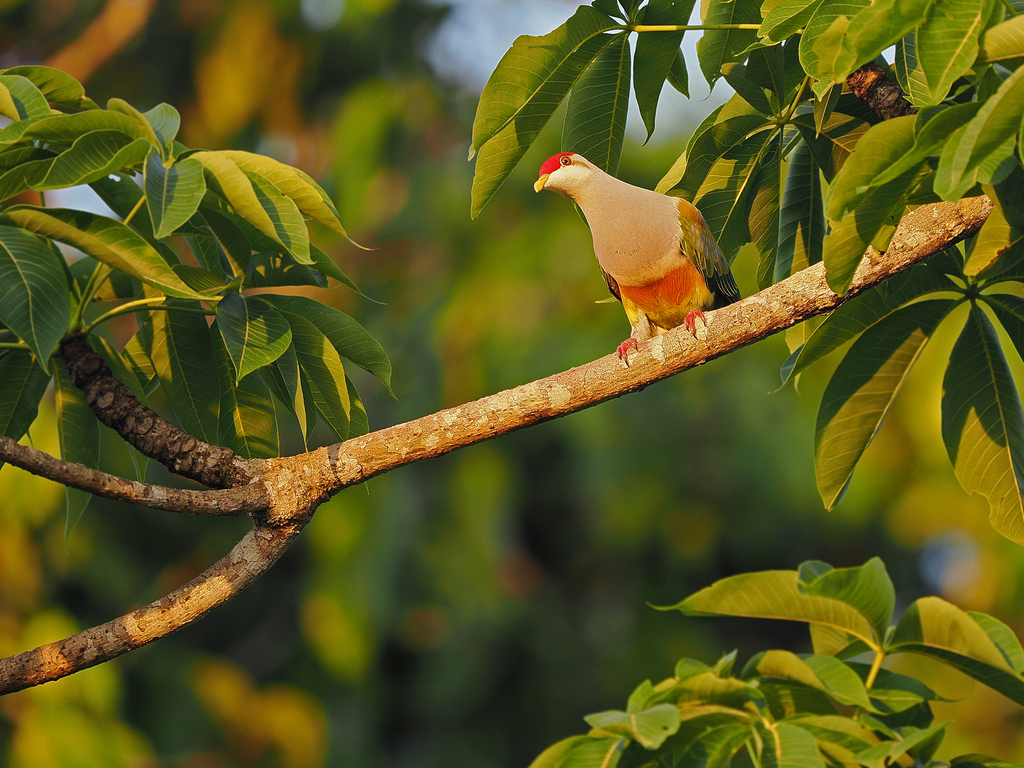
Wallace's fruit dove (Ptilinopus wallacii) is a species of a bird in the pigeon family Columbidae. The name commemorates the British naturalist Alfred Russel Wallace. It is a rather large, long-tailed fruit dove with a length of 24–28 cm (9.4–11.0 in) and has been described as "one of the most beautiful" fruit doves. The forehead and crown are dull crimson, the lower face and throat are white, and the rest of the head, breast, neck, and upper back are pale bluish-grey. The wings and lower back are green and the belly is orange, separated from the chest by a white band. Both sexes look similar, but females have less extensive red on the head and a greenish tinge to their grey parts.
Endemic to Indonesia, Wallace's fruit dove is found in lowland riverine and coastal forests in the Lesser Sunda Islands, the Moluccas, the Aru Islands, and occasionally in southwestern New Guinea. Its diet consists of small fruits and berries. Nests are made out of twigs in branches and the only observed nest was made in November. Common to moderately common throughout most of its range, the Wallace's fruit dove is evaluated as being of least concern on the IUCN Red List.
From the article Wallace's fruit dove on Wikipedia (CC BY-SA), quoted section by section
Description
Wallace's fruit dove is a large, long-tailed fruit dove with a length of 24–28 cm (9.4–11.0 in). It has been described as "one of the most beautiful" fruit doves. The forehead and crown are dull crimson, sometimes extending to the back of the neck, and the lower face and throat are white. The rest of the head, neck, breast, and upper mantle are pale bluish-grey, separated from the orange belly patch by a white band. The shoulder patch is golden-bronze, while the mantle and inner wing coverts are bluish-grey with yellow edges that give a scaled appearance. The primaries and secondaries are dark shiny green, the latter having narrow yellow edges, while the back, rump, and uppertail coverts are yellowish-green. The flanks and vent are mixed pale yellow and green. The central tail feathers green with a whitish band at the end, while the outer ones are darker with a greyish band. The iris is light red with a yellow to green inner ring, the orbital skin is bluish, and the feet are purplish to pinkish. The bill is yellow-greenish yellow with a paler tip. Females are similar to males, but have a greenish tinge to the grey on the neck and breast and a less intense orange belly patch. Juveniles have green edging on the crown, yellow-tipped green feathers on the mantle and wing coverts, and a green wash on the breast and mantle. The beautiful fruit dove (P. …
Range & habitat
Wallace's fruit dove is found on the Babar Islands and Tanimbar Islands in the Moluccas, on the Banda Islands, Kur, Manggur, Taam, Komeer, Bacar, Tual, and Kai Kecil in the Lesser Sundas, and the Aru Islands. On New Guinea, individuals have infrequently been recorded in the southwest from the Mimika River to the Noord River, but these are thought to have been vagrants from the Aru Islands. The species inhabits lowland forests near rivers and the coast, including mangroves, forest edges, savanna, gallery forests, and monsoon forests. It has also been recorded on islands where nearly all old-growth forest has been replaced with cultivation and appears to be able to adapt to secondary growth. On Kai Besar, it has been recorded from sea level up to elevations of 250 m (820 ft).
Wikipedia: “Distribution and habitat”
What it does
Wallace's fruit dove is frequently seen alone or in pairs, although it is a social fruit dove and forms flocks of 5–26 birds. On Tanimbar, it is easily noticeable, often flying over roads and clearings or perching in open trees. Its generation length (average age of parents in the current population) was reported as being 3.2 years in 2016. The species feeds on small fruit and berries, plucking these directly from branches. It makes a flimsy nest out of twigs in tree branches. One observed nest was made in November.
Wikipedia: “Behaviour and ecology”
Listen
Looking for field recordings…
Where it lives
Recorded sightings
—
geo-referenced records in GBIF, from museums, herbaria and field observers.
Drag the globe to turn it. Dots are where records exist, not a range map; darker means more records.
In the stacks
Searching the stacks…
Every page naming Ptilinopus wallacii in the Biodiversity Heritage Library →
This page is assembled live from iNaturalist, GBIF, Wikipedia, the Source Library and the Internet Archive. It is not yet part of the hand-edited codex. iNaturalist taxon 2739.