- Animals
- ›Chordates
- ›Vertebrates
- ›Amphibians
- ›Salamanders
- ›Lungless Salamanders
- ›Hemidactyliine Salamanders
- ›Pseudoeurycea
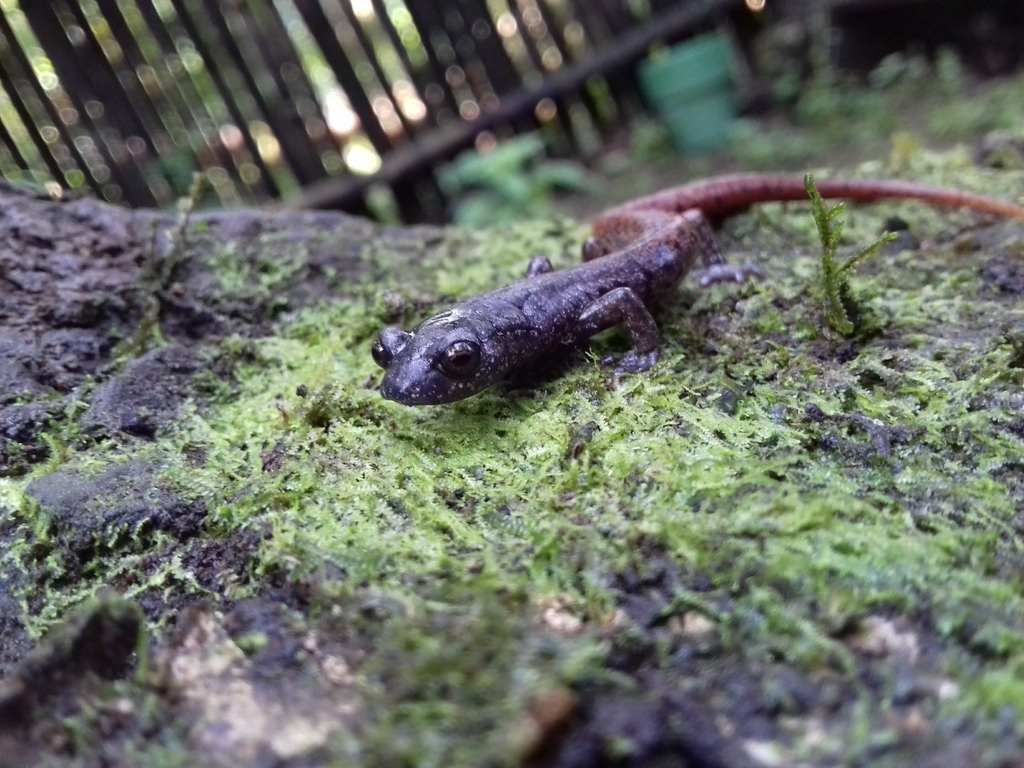
Black-spotted False Brook Salamander
Pseudoeurycea nigromaculata
Pseudoeurycea nigromaculata, commonly known as the black-spotted salamander or black-spotted false brook salamander is a species of salamander in the family Plethodontidae. It is endemic to Veracruz, Mexico, and known from Cerro Chicahuaxtla (1,300–1,600 m (4,300–5,200 ft) asl)) in Cuatlalpan (the type locality, near Fortín de las Flores) and from Volcán San Martín at elevations of 1,200–1,300 m (3,900–4,300 ft). These separate populations likely represent distinct species.
From the article Pseudoeurycea nigromaculata on Wikipedia (CC BY-SA), quoted section by section
Description
Pseudoeurycea nigromaculata is a medium-sized plethodontid: females in the type series (collected by Hobart Muir Smith) measure 51–57 mm (2.0–2.2 in) in snout–vent length. The tail is longer than the snout–vent length, giving a maximum total length of about 12 cm (4.7 in). The body is blackish (lighter in younger specimens), the tail has lighter coloration, and both carry black spots that have given the species its name. Two observed egg clutches contained 19 and 25 eggs.
Range & habitat
Pseudoeurycea nigromaculata is an arboreal species living in bromeliads in cloud forest. Once relatively common, it now appears to be very rare. Most of its habitat has disappeared or is severely degraded. It is protected by Mexican law under the "Special Protection" category.
== References ==
Wikipedia: “Habitat and conservation”
Listen
Looking for field recordings…
Where it lives
Recorded sightings
—
geo-referenced records in GBIF, from museums, herbaria and field observers.
Drag the globe to turn it. Dots are where records exist, not a range map; darker means more records.
In the stacks
Searching the stacks…
Every page naming Pseudoeurycea nigromaculata in the Biodiversity Heritage Library →
This page is assembled live from iNaturalist, GBIF, Wikipedia, the Source Library and the Internet Archive. It is not yet part of the hand-edited codex. iNaturalist taxon 27328.