- Animals
- ›Chordates
- ›Vertebrates
- ›Amphibians
- ›Salamanders
- ›Lungless Salamanders
- ›Plethodontine Salamanders
- ›Plethodon
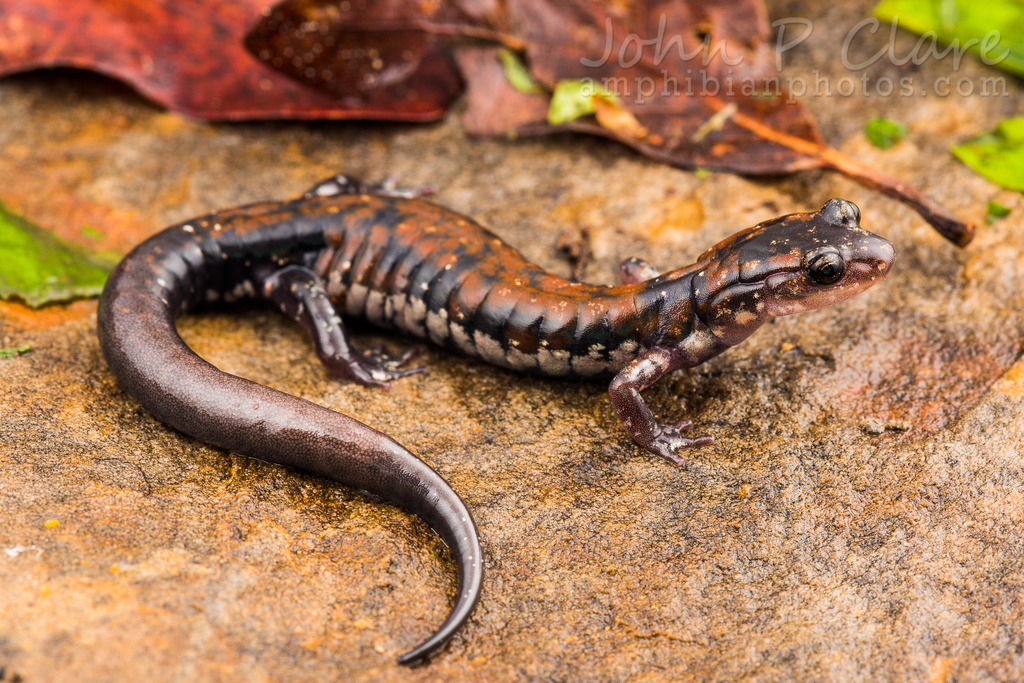
Rich Mountain Salamander
Plethodon ouachitae
The Rich Mountain salamander (Plethodon ouachitae) is a species of salamander in the family Plethodontidae. It is endemic to the Ouachita Mountains in western Arkansas and eastern Oklahoma. Its natural habitat is temperate forests. It is threatened by habitat loss.
From the article Rich Mountain salamander on Wikipedia (CC BY-SA), quoted section by section
Description
Rich Mountain salamanders grow to a length of about 5 centimetres (2.0 in), snout to vent. They are mottled and slatey-grey in colour which makes them inconspicuous. There are glands on their backs which secrete a noxious substance to deter predators. The distinct lineages present characteristic color variations, corresponding with the mountain range where found.
Range & habitat
The Rich Mountain salamander was first collected at Rich Mountain east of Page, Oklahoma in the Ouachita Mountains. They only occur on six distinct mountains; Buffalo, Winding Stair, Black Fork, Kiamichi, Round, and Rich Mountain. It has been described as a sky island species due to the strict high elevation of the range. Where their range overlaps that of the Fourche Mountain salamander (Plethodon fourchensis), some hybridization occurs. Their habitat is mixed deciduous woodland particularly on north facing slopes near wet seeps. They are also found in the characteristic talus rock glaciers of the Ouachitas, under logs, rocks and debris and in cave entrances.
Wikipedia: “Distribution and habitat”
Listen
Looking for field recordings…
Where it lives
Recorded sightings
—
geo-referenced records in GBIF, from museums, herbaria and field observers.
Drag the globe to turn it. Dots are where records exist, not a range map; darker means more records.
In the stacks
Searching the stacks…
Every page naming Plethodon ouachitae in the Biodiversity Heritage Library →
This page is assembled live from iNaturalist, GBIF, Wikipedia, the Source Library and the Internet Archive. It is not yet part of the hand-edited codex. iNaturalist taxon 27243.