- Animals
- ›Chordates
- ›Vertebrates
- ›Reptiles
- ›Snakes and Lizards
- ›Snakes
- ›Colubrid Snakes
- ›Colubrine Snakes
- ›Chironius
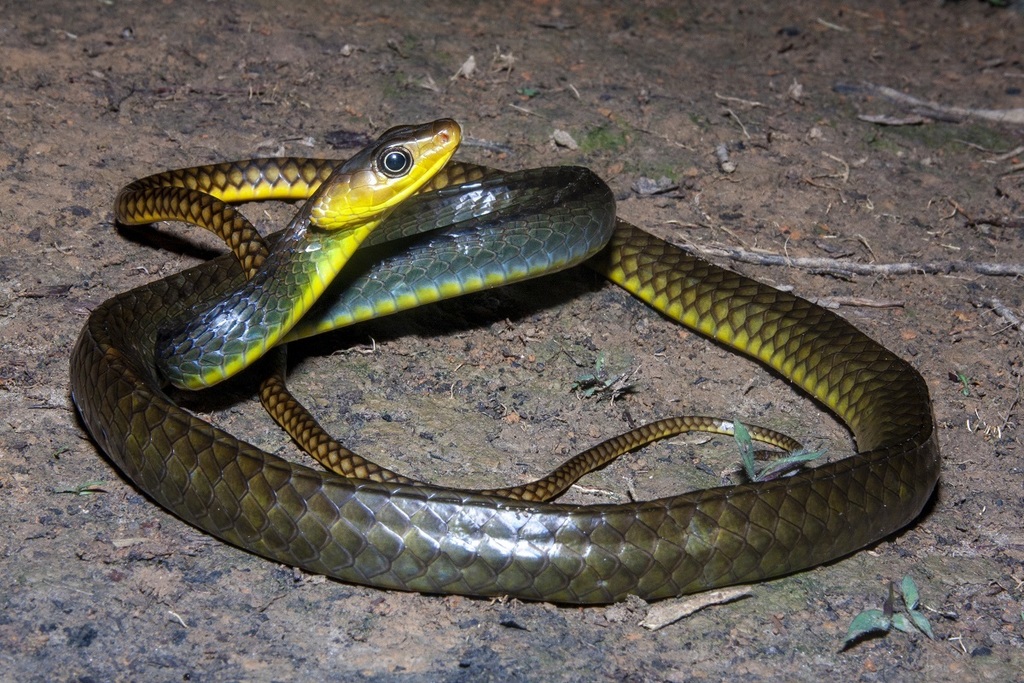
South American Sipo
Chironius multiventris
Chironius multiventris, commonly known as the long-tailed machete savane, is species of colubrid snake.
From the article Chironius multiventris on Wikipedia (CC BY-SA), quoted section by section
Description
The body is elongate, and strongly laterally compressed. The tail is long, as the common name implies. The dorsum is olive to light brown. There is a narrow whitish, black-edged, vertebral stripe. The upper labials and the ventrum are yellowish. The ventrals are 178–183, and the subcaudals are 172–202. (Both these counts are higher than in C. carinatus.) The dorsal scales are arranged in 12 rows anteriorly and at midbody, in 10 rows posteriorly. (C. carinatus has 8 rows posteriorly.) Adults may attain a total length of 136 cm (4 ft 6 in), with a tail 56 cm (22 in) long.
Range & habitat
It is found in Peru, northern Venezuela, Colombia in the Guainía and Trinidad and Tobago.
Wikipedia: “Geographic range”
Where it lives
Recorded sightings
—
geo-referenced records in GBIF, from museums, herbaria and field observers.
Drag the globe to turn it. Dots are where records exist, not a range map; darker means more records.
In the stacks
Searching the stacks…
Every page naming Chironius multiventris in the Biodiversity Heritage Library →
This page is assembled live from iNaturalist, GBIF, Wikipedia, the Source Library and the Internet Archive. It is not yet part of the hand-edited codex. iNaturalist taxon 27241.