- Animals
- ›Chordates
- ›Vertebrates
- ›Amphibians
- ›Salamanders
- ›Lungless Salamanders
- ›Plethodontine Salamanders
- ›Plethodon
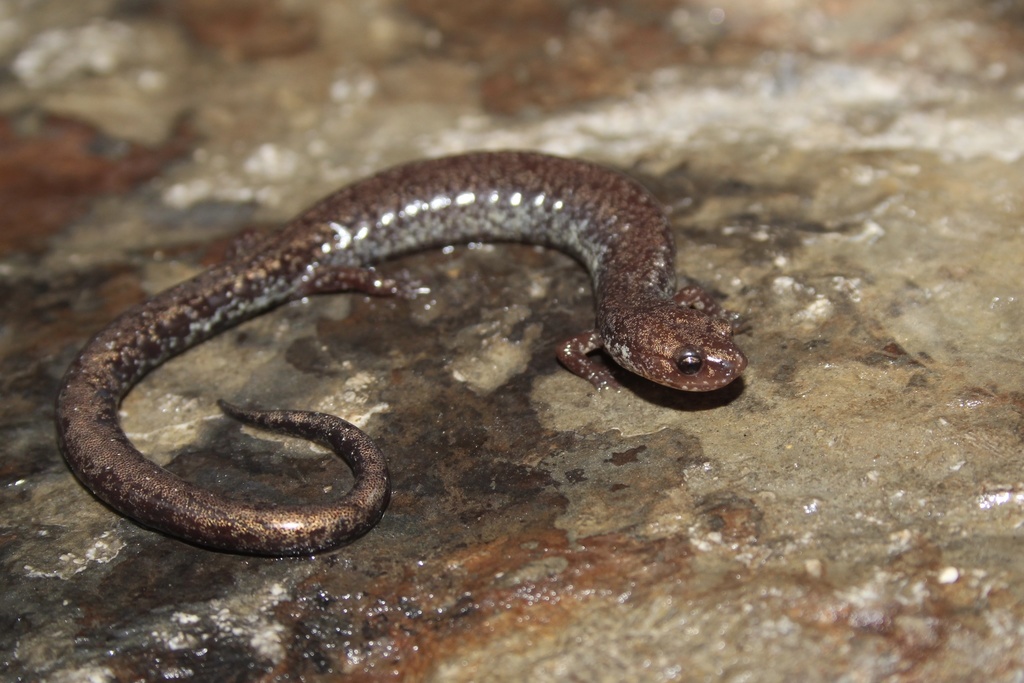
Ravine Salamander
Plethodon richmondi
The ravine salamander (Plethodon richmondi) is a species of salamander in the family Plethodontidae. The species is endemic to the United States, and it is threatened by habitat loss.
From the article Ravine salamander on Wikipedia (CC BY-SA), quoted section by section
Description
An adult ravine salamander is 7.5–11.5 cm (3–4½ inches) in total length (including tail). It has short limbs and is somewhat worm-like in appearance and movement. Dorsally and laterally, it is dark brown or black, with silvery or brassy flecks. Ventrally, unlike other small plethodontids, it is dark brown or black.
Range & habitat
The ravine salamander is found in eastern Kentucky, Ohio, southern West Virginia, western Virginia, and northwestern North Carolina, northeastern Tennessee.
Wikipedia: “Geographic range”
What it does
The natural habitat of P. richmondi is temperate forests, in which it prefers the slopes of valleys and ravines. It is a terrestrial species and is found among the leaf litter, hiding under logs, stones or stumps. It hibernates underground in winter and aestivates at the height of summer.
Reproduction. Eggs of P. richmondi are laid in cracks and crevices and develop directly into juvenile salamanders without an intervening larval stage.
Wikipedia: “Habitat and behavior”
In human culture
The epithet, richmondi, is in honor of its discoverer, Neil D. Richmond, who later succeeded M. Graham Netting as Curator of the Section of Amphibians and Reptiles at the Carnegie Museum of Natural History, Pittsburgh, Pennsylvania.
Wikipedia: “Etymology”
Listen
Looking for field recordings…
Where it lives
Recorded sightings
—
geo-referenced records in GBIF, from museums, herbaria and field observers.
Drag the globe to turn it. Dots are where records exist, not a range map; darker means more records.
In the stacks
Searching the stacks…
Every page naming Plethodon richmondi in the Biodiversity Heritage Library →
This page is assembled live from iNaturalist, GBIF, Wikipedia, the Source Library and the Internet Archive. It is not yet part of the hand-edited codex. iNaturalist taxon 27209.