- Animals
- ›Chordates
- ›Vertebrates
- ›Amphibians
- ›Salamanders
- ›Lungless Salamanders
- ›Plethodontine Salamanders
- ›Plethodon
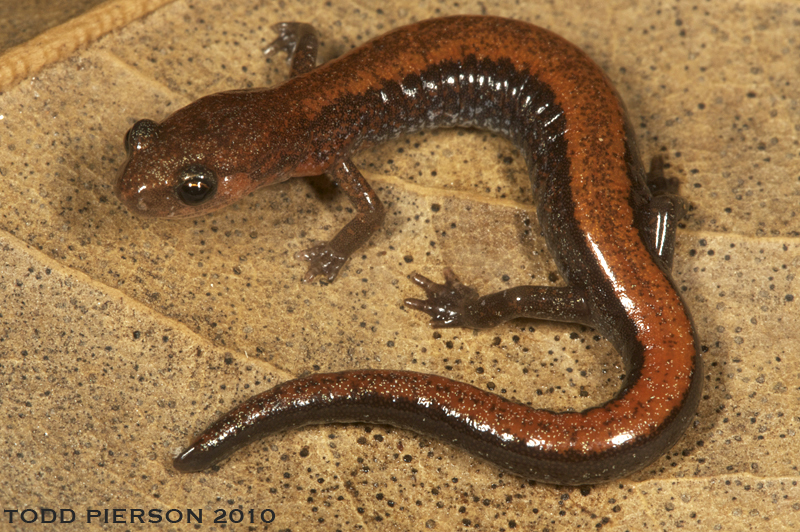
Southern Red-backed Salamander
Plethodon serratus
The southern red-backed salamander (Plethodon serratus) is a species of salamander endemic to the United States. It is found in four widely disjunct populations: one in central Louisiana; one in the Ouachita Mountains of Arkansas and Oklahoma; one in central Missouri; and one from southeastern Tennessee, to southwestern North Carolina, western Georgia, and eastern Alabama. It is sometimes referred to as the Georgia red-backed salamander or the Ouachita red-backed salamander. It was once considered a subspecies of the red-backed salamander, Plethodon cinereus.
From the article Southern red-backed salamander on Wikipedia (CC BY-SA), quoted section by section
Description
The southern red-backed salamander is typically gray or black in color, with a red-brown, fading stripe across the width of its back. It grows from 8 to 11 cm (3 to 4 in) in length. Similar to Plethodon cinereus, Plethodon serratus comes in several atypical color variations. The typical red backed phase with a red dorsal stripe consists of most individuals. The atypical variations include a lead backed phase with a dark grey stripe, a silver back phase with a light grey dorsal stripe, hypomelanistic (leucistic) variations of the red backed form, and the rare white backed, or ghost phase. Unlike P. cinereus, P. serratus has not yet been found to have an erythristic variation.
What it does
Mostly nocturnal, it is often found under ground debris in moist, forested areas. In dry seasons, it moves closer to permanent water sources. Its primary diet is small arthropods and mollusks.
Wikipedia: “Behavior”
Listen
Looking for field recordings…
Where it lives
Recorded sightings
—
geo-referenced records in GBIF, from museums, herbaria and field observers.
Drag the globe to turn it. Dots are where records exist, not a range map; darker means more records.
In the stacks
Searching the stacks…
Every page naming Plethodon serratus in the Biodiversity Heritage Library →
This page is assembled live from iNaturalist, GBIF, Wikipedia, the Source Library and the Internet Archive. It is not yet part of the hand-edited codex. iNaturalist taxon 27166.