- Animals
- ›Chordates
- ›Vertebrates
- ›Reptiles
- ›Snakes and Lizards
- ›Snakes
- ›Colubrid Snakes
- ›Colubrine Snakes
- ›Coluber
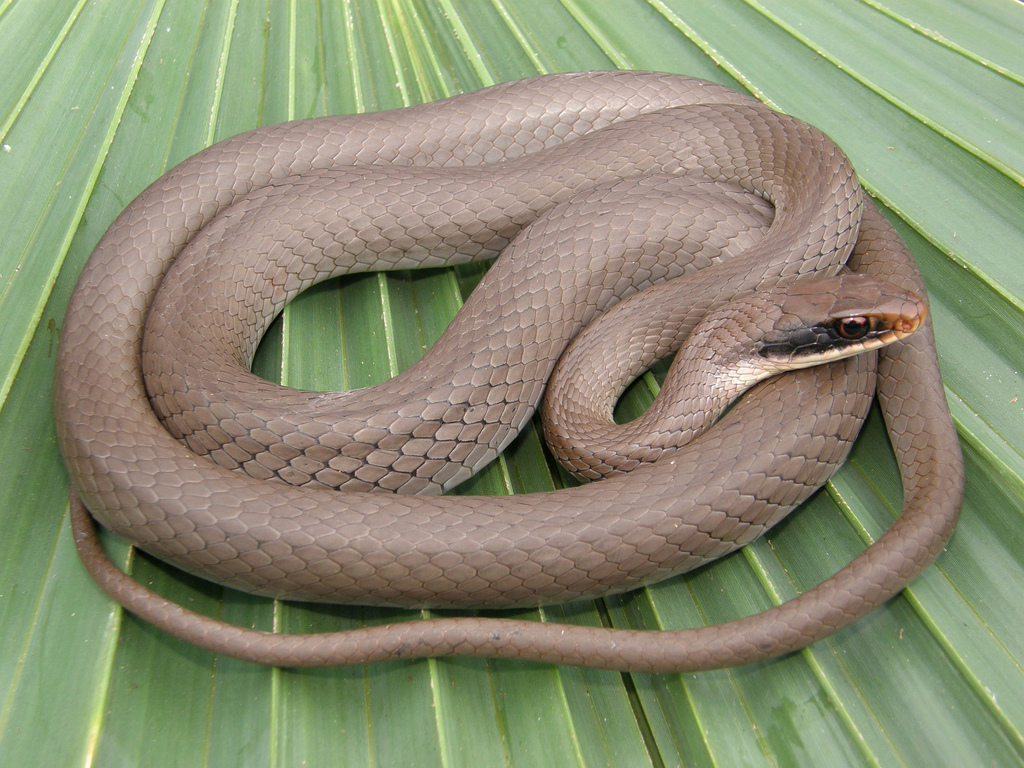
North American Racer
Coluber constrictor
The eastern racer, or North American racer (Coluber constrictor), is a species of nonvenomous snake in the subfamily Colubrinae of the family Colubridae. The species is native to North America and Central America. Eleven subspecies, including the nominotypical subspecies, are recognized, which as a group are commonly referred to as the eastern racers. The species is monotypic in the genus Coluber.
From the article Eastern racer on Wikipedia (CC BY-SA), quoted section by section
Description
Adult eastern racers can typically vary from 50 to 152 cm (20 to 60 in) in total length (tail included) depending on the subspecies, but a record-sized specimen measured 185.4 cm (73.0 in) in total length. A typical adult specimen will weigh around 556 g (1.226 lb), with little size difference between the sexes. The patterns vary widely among subspecies. Most are solid-colored as their common names imply: black racers, brown racers, tan racers, blue racers, or green racers. "Runner" is sometimes used instead of "racer" in their common names. All subspecies have a lighter-colored underbelly: white, light tan, or yellow in color. Juveniles are more strikingly patterned, with a middorsal row of dark blotches on a light ground color. The tail is unpatterned. As they grow older, the dorsum darkens and the juvenile pattern gradually disappears.
Range & habitat
Coluber constrictor is found throughout much of the United States, on both sides of the Rocky Mountains, but it also ranges north into Canada and south into Mexico, Guatemala, and Belize.
Wikipedia: “Geographic range”
What it does
The eastern racers are fast-moving, highly active, diurnal snakes. Their diet consists primarily of small rodents, other mammals (as large as small cottontail rabbits), frogs, toads, small turtles, lizards, and other snakes. Some subspecies are known to climb trees to eat eggs and young birds. Juveniles often consume soft-bodied insects and other small invertebrates, as well as small frogs, small reptiles (including lizards and snakes and their eggs), young rodents, and shrews. Despite their specific name, constrictor, they do not really employ constriction, instead simply subduing struggling prey by pinning it bodily, pressing one or two coils against it to hold it in place instead of actually suffocating it. Most smaller prey items are simply swallowed alive. They are curious snakes with excellent vision. They are visual hunters and hunt exclusively in the daytime and are often seen raising their heads above the ground to get a better view of their surroundings, a behavior dubbed "periscoping" by snake enthusiasts. Aptly named, racers are very fast and typically flee from a potential predator. However, once cornered, they put up a vigorous fight, biting hard and often. They are difficult to handle and will writhe, defecate, and release a foul-smelling musk from their cloacae. Vibrating their tails among dry leaves, racers can sound convincingly like rattlesnakes.
Wikipedia: “Behavior”
Where it lives
Recorded sightings
—
geo-referenced records in GBIF, from museums, herbaria and field observers.
Drag the globe to turn it. Dots are where records exist, not a range map; darker means more records.
In the stacks
Searching the stacks…
Every page naming Coluber constrictor in the Biodiversity Heritage Library →
This page is assembled live from iNaturalist, GBIF, Wikipedia, the Source Library and the Internet Archive. It is not yet part of the hand-edited codex. iNaturalist taxon 27137.