- Animals
- ›Chordates
- ›Vertebrates
- ›Amphibians
- ›Salamanders
- ›Lungless Salamanders
- ›Hemidactyliine Salamanders
- ›Eurycea
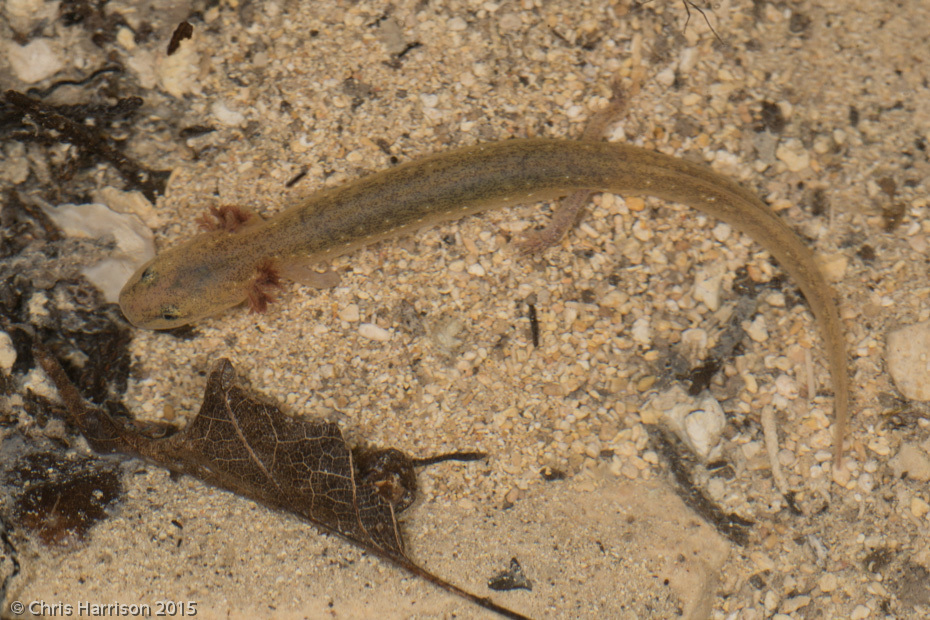
Texas Salamander
Eurycea neotenes
Eurycea neotenes, also known as the Texas salamander, Bexar County salamander, Edwards Plateau salamander, or Texas neotenic salamander, is a species of entirely aquatic, lungless salamander native to the United States. It is endemic to central Texas, near Helotes, in Bexar County.
From the article Eurycea neotenes on Wikipedia (CC BY-SA), quoted section by section
Description
The Texas salamander grows from 2 to 4 in (5.1 to 10.2 cm) in length. It is brown in color, often with yellow or brown mottling, with light-yellow spotting down its back. It is neotenic, with a slender body, short limbs, and bright-red external gills. The Texas salamander lives in caves, which resulted in reduced vision in its eyes, due to the long period of time in darkness. It is akin to the Texas blind salamander Eurycea rathbuni.
What it does
The Texas salamander has reduced vision or can be completely blind, which makes it difficult to hunt for food. It hunts by swishing its head side to side to create water pressure waves and sensing their prey break the still water. The Texas salamander typically preys on amphipods, blind shrimp (Palaemonetes antrorum), daphnia, small snails and other invertebrates.
Wikipedia: “Diet”
Listen
Looking for field recordings…
Where it lives
Recorded sightings
—
geo-referenced records in GBIF, from museums, herbaria and field observers.
Drag the globe to turn it. Dots are where records exist, not a range map; darker means more records.
In the stacks
Searching the stacks…
Every page naming Eurycea neotenes in the Biodiversity Heritage Library →
This page is assembled live from iNaturalist, GBIF, Wikipedia, the Source Library and the Internet Archive. It is not yet part of the hand-edited codex. iNaturalist taxon 27117.