
Giant Salamanders
Cryptobranchidae
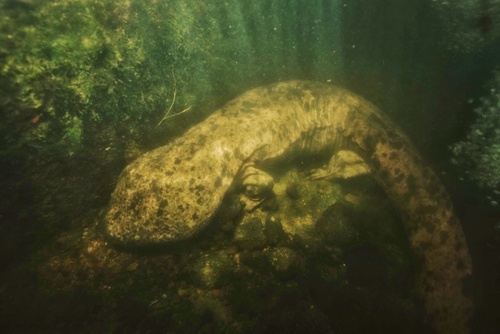
The Cryptobranchidae (commonly known as giant salamanders) are a family of large salamanders that are fully aquatic. The family includes some of the largest living amphibians. They are native to China, Japan, and the eastern United States. Giant salamanders constitute one of two living families—the other being the Asiatic salamanders belonging to the family Hynobiidae—within the Cryptobranchoidea, one of two main divisions of living salamanders.
The largest species are in the genus Andrias, native to east Asia. The South China giant salamander (Andrias sligoi) can reach a length of 1.8 m (5.9 ft). The Japanese giant salamander (Andrias japonicus) reaches up to 1.44 m (4.7 ft) in length, feeds at night on fish and crustaceans, and has been known to live for more than 50 years in captivity.
2 branches of this family, most-observed first · about 7 known species
See this branch on the Wheel of Life →
Where it lives
Recorded sightings
—
geo-referenced records in GBIF, from museums, herbaria and field observers.
Drag the globe to turn it. Dots are where records exist, not a range map; darker means more records.
In the stacks
Searching the stacks…
Every page naming Cryptobranchidae in the Biodiversity Heritage Library →
This page is assembled live from iNaturalist, GBIF, Wikipedia, the Source Library and the Internet Archive. It is not yet part of the hand-edited codex. iNaturalist taxon 26802.