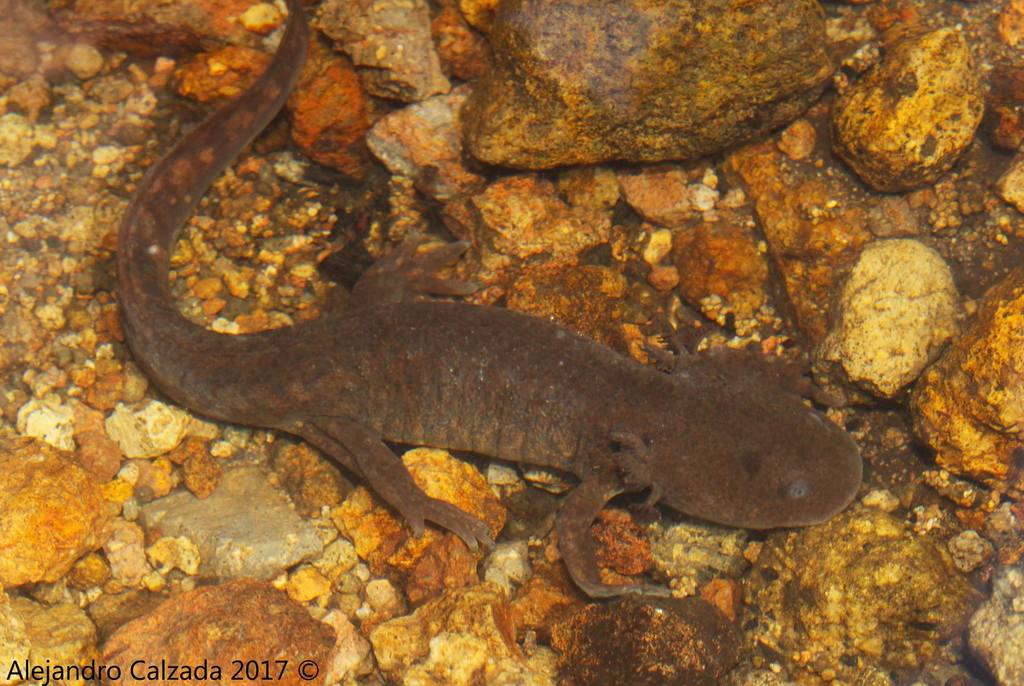
Leora's Stream Salamander
Ambystoma leorae
The Leora's stream salamander or ajolote (Ambystoma leorae) is a rare species of mole salamander in the family Ambystomatidae. It is endemic to a very small area of land in the Iztaccihuatl-Popocatepetl National Park on the border of the State of Mexico with Puebla, with a single known population on Mount Tlaloc. Its very specific requirements as regards water quality militates against its survival in a habitat where water is being extracted, cattle graze and the salamander has traditionally been eaten as food. It has been listed as a threatened species by the Mexican Government and as "critically endangered" by the International Union for Conservation of Nature.
From the article Leora's stream salamander on Wikipedia (CC BY-SA), quoted section by section
Range & habitat
This species is endemic to the Sierra Nevada in central Mexico. It was historically restricted to six locations in the Iztaccihuatl-Popocatepetl National Park (IPNP) located on the border of the State of Mexico with Puebla. Long ago it disappeared from the heavily polluted Rio Frio where it was first found. A recent research rediscovered a new and relict locality of A. leorae, possibly the last one. The new study reports that the critically endangered species persists in a single population on Mount Tlaloc, located adjacent to Mexico City, one of the largest and most densely urbanized area on earth.
Wikipedia: “Distribution”
Listen
Looking for field recordings…
Where it lives
Recorded sightings
—
geo-referenced records in GBIF, from museums, herbaria and field observers.
Drag the globe to turn it. Dots are where records exist, not a range map; darker means more records.
In the stacks
Searching the stacks…
Every page naming Ambystoma leorae in the Biodiversity Heritage Library →
This page is assembled live from iNaturalist, GBIF, Wikipedia, the Source Library and the Internet Archive. It is not yet part of the hand-edited codex. iNaturalist taxon 26788.