- Animals
- ›Chordates
- ›Vertebrates
- ›Reptiles
- ›Snakes and Lizards
- ›Snakes
- ›Colubrid Snakes
- ›Colubrine Snakes
- ›Dasypeltis
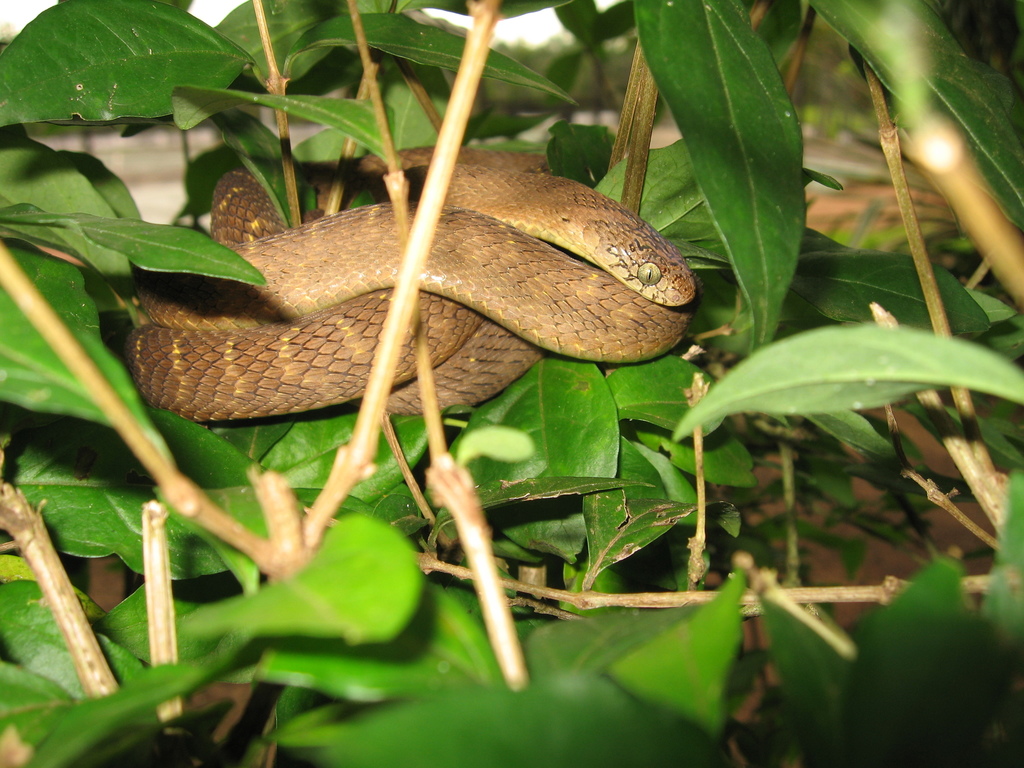
Central African Egg-eating Snake
Dasypeltis fasciata
Dasypeltis fasciata, commonly known as the Central African egg-eating snake or the western forest eggeater, is a species of snake in the family Colubridae. The species is endemic to Africa. It is one of 18 species in the genus Dasypeltis, and is occasionally kept in captivity as an exotic pet along with other members of its genus, particularly D. scabra and D. medici.
From the article Central African egg-eating snake on Wikipedia (CC BY-SA), quoted section by section
Description
Owing to their nature as obligate ovivores, all members of the genus Dasypeltis are arboreal, preferring to remain in the trees where they can locate bird-nests, and tend to be nocturnal as this is when the diurnal bird species they prey upon are asleep and most likely to leave their eggs unguarded. Their diet also affects their biology, and has resulted in an evolutionary adaptation that has removed their teeth and substantially increased the capacity of their necks. This facilitates the consumption of whole eggs. Once inside the neck, three bony projections from the cervical vertebrae are extended and the egg is crushed against them, puncturing and cracking it. The eggs are then squeezed to extract the liquids inside, and the shell is regurgitated. This adaptation allows them to exploit a food source that is almost completely uncontested in their natural habitat. During feeding, they have an extensible, highly flattened trachea that can push around the egg and allow them to continue breathing whilst swallowing an egg several times wider than their own body.
Wikipedia: “Anatomy and behaviour”
Range & habitat
D. fasciata is found in western and central Africa including the Central African Republic, Gambia, Nigeria, and Uganda.
Wikipedia: “Geographic range”
Where it lives
Recorded sightings
—
geo-referenced records in GBIF, from museums, herbaria and field observers.
Drag the globe to turn it. Dots are where records exist, not a range map; darker means more records.
In the stacks
Searching the stacks…
Every page naming Dasypeltis fasciata in the Biodiversity Heritage Library →
This page is assembled live from iNaturalist, GBIF, Wikipedia, the Source Library and the Internet Archive. It is not yet part of the hand-edited codex. iNaturalist taxon 26734.