
Ring-necked Snakes
Diadophis
Diadophis punctatus, commonly known as the ring-necked snake or ringneck snake, is a small, harmless species of colubrid snake found throughout much of the United States, as well as south in Central Mexico and as far north as Nova Scotia, Canada. Ring-necked snakes are generally fossorial and somewhat secretive, by nature, and, as a nocturnal species, are rarely seen during the daytime. These snakes are believed to be fairly abundant throughout most of their range, though no scientific evaluation supports this hypothesis. Scientific research is lacking for the species, despite their apparently common status, and more in-depth investigations are greatly needed. It is the only species within the genus Diadophis and, currently, 14 subspecies are identified, though many herpetologists question the morphologically based classifications.
The ring-necked snake is perhaps best known for its unique defensive posture: when threatened, it curls its tail into a tight coil, partially rolls onto its back, and shows its bright red-orange underside and ventral surface. In nature, vivid coloration on an animal generally serves as a warning to others that it is not afraid of delivering a dose of venom, or that it is poisonous if eaten; this "false warning" coloration is a form of mimicry, a survival adaptation in which a non-venomous species (i.e., the ring-necked snake) has evolved brighter coloration, similar to truly venomous species, and used it to their advantage.
1 branches of this genus, most-observed first · about 1 known species
See this branch on the Wheel of Life →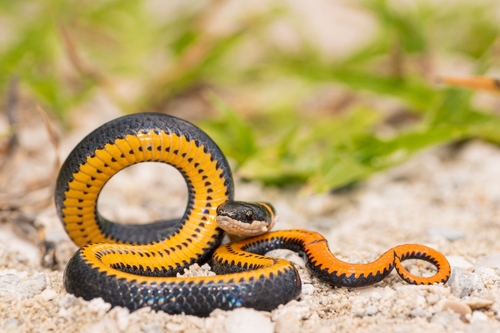
Where it lives
Recorded sightings
—
geo-referenced records in GBIF, from museums, herbaria and field observers.
Drag the globe to turn it. Dots are where records exist, not a range map; darker means more records.
In the stacks
Searching the stacks…
Every page naming Diadophis in the Biodiversity Heritage Library →
This page is assembled live from iNaturalist, GBIF, Wikipedia, the Source Library and the Internet Archive. It is not yet part of the hand-edited codex. iNaturalist taxon 26574.