- Animals
- ›Chordates
- ›Vertebrates
- ›Birds
- ›Rollers, Kingfishers, and Allies
- ›Kingfishers
- ›River, Dwarf, and Pygmy Kingfishers
- ›Ceyx
On eBird ↗
Philippine Dwarf-Kingfisher
Live sightings near you, the range map, bar charts of when it is seen, and Macaulay Library photos and recordings.
Philippine Dwarf Kingfisher
Ceyx melanurus
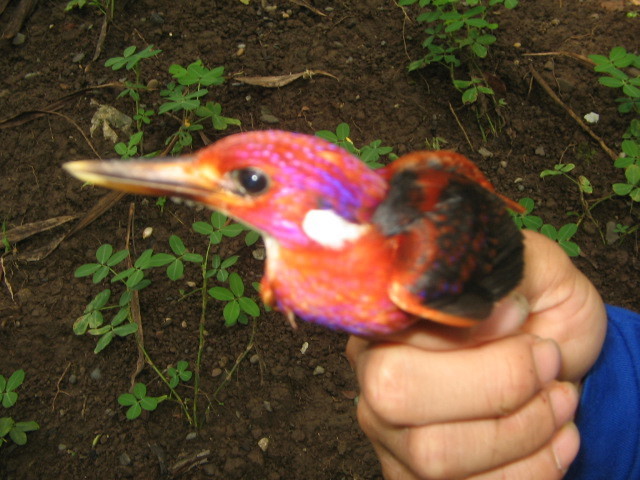
The Philippine dwarf kingfisher (Ceyx melanurus) is a species of bird in the family Alcedinidae that is endemic to the Philippines found in the islands of Luzon, Polillo Islands, Catanduanes, Basilan, Samar, Leyte and Mindanao. Its natural habitat is tropical moist lowland forests. Due to differences in plumage, It is recognized by the International Union for Conservation of Nature as two distinct species with the birds from Basilan and Mindanao classified as the South Philippine dwarf kingfisher and the North Philippine dwarf kingfisher for the rest of its range. It is threatened by habitat loss.
The North Philippine dwarf kingfisher (Ceyx melanurus) is a species of bird that is endemic to the Philippine islands. The Philippine dwarf kingfisher is in the Alcedindae family. Its bright red beak and mostly orange feathers make it stand out in the Philippine rainforest.The International Union for Conservation of Nature recognizes this bird as two distinct species. They are classified as regions where their habitat is located. These two species are called the North Philippine dwarf kingfisher and the South Philippine dwarf kingfisher.
From the article Philippine dwarf kingfisher on Wikipedia (CC BY-SA), quoted section by section
Range & habitat
The North Philippine Dwarf kingfisher species has a combined occurrence area of around 400,000 km. The areas where this species occurs are mainly the Philippine islands of Luzon, Polillo Islands, Catanduanes, Samar Leyte, and Mindanao. The North Philippine Dwarf kingfisher prefers areas of high rainfall for a habitat. They are seen near some waterways and low lying areas of water but are most seen in the dense rainforest.
Wikipedia: “Habitat”
What it does
The North Philippine Dwarf kingfisher have an elongated beak due to them living in the dense rainforest. Over Time, The North Philippine Dwarf kingfisher has evolved to have an elongated beak to make foraging for food in the dense rainforest easier. They hunt on the forest floor and have to pick through the dense rainforest to eat. This bird's main source of nutrition comes from leaf litter, small worms, insects, and spiders. As a predator to many small insects and to aquatic organisms it helps regulate population levels and prevent outbreaks from pests that could harm local vegetation. Another benefit the elongated beak proposes is the ability to strike at prey with speed and precision. The North Philippine Dwarf kingfisher is quick and agile, but it is not immune to predators like snakes, raptors, and lizards that also call the rainforest of the Philippines home. The thing that endangers this bird the most is the habitat loss due to deforestation, illegal logging, and agricultural expansion into the rainforest.
Wikipedia: “Ecology”
Listen
Looking for field recordings…
Where it lives
Recorded sightings
—
geo-referenced records in GBIF, from museums, herbaria and field observers.
Drag the globe to turn it. Dots are where records exist, not a range map; darker means more records.
In the stacks
Searching the stacks…
Every page naming Ceyx melanurus in the Biodiversity Heritage Library →
This page is assembled live from iNaturalist, GBIF, Wikipedia, the Source Library and the Internet Archive. It is not yet part of the hand-edited codex. iNaturalist taxon 2649.