- Animals
- ›Chordates
- ›Vertebrates
- ›Amphibians
- ›Frogs and Toads
- ›Old World Tree Frogs
- ›Rhacophorinae
- ›Raorchestes
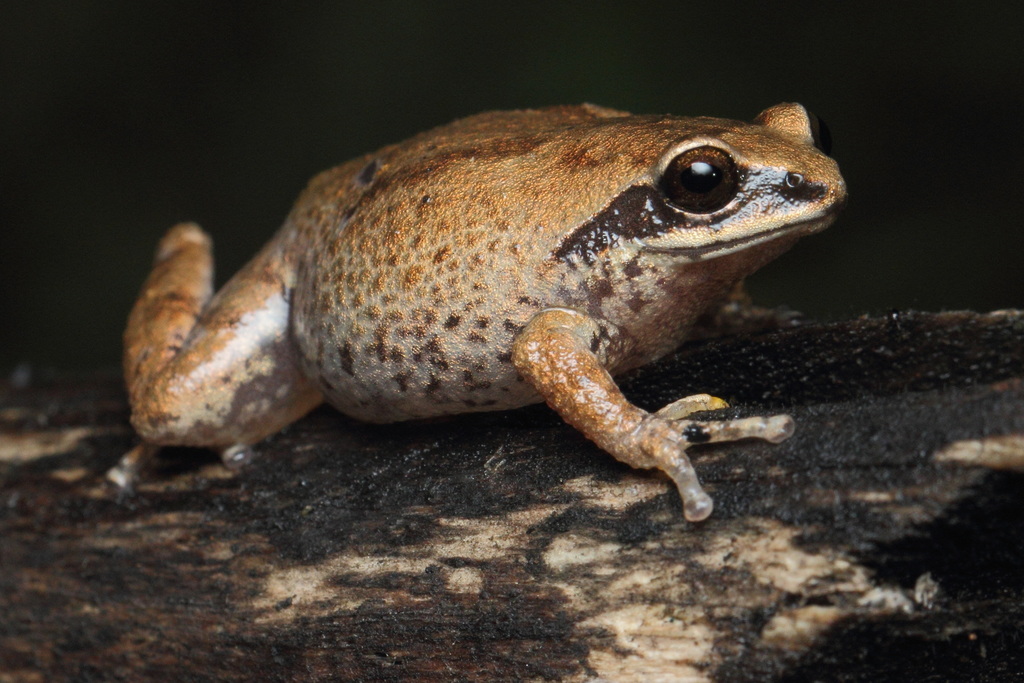
Spotted Bush Frog
Raorchestes tinniens
Raorchestes tinniens, also known as the spotted bush frog, black bush frog, tinkling Nilgiri bush frog, tinkling Nilgiri bush frog, and Rao's bubble-nest frog (the latter two referring to species now considered junior synonyms of R. tinniens), is a species of frog in the family Rhacophoridae. It is endemic to the Nilgiri Hills, a part of the Western Ghats, in Tamil Nadu and Kerala, southern India. It has a rather complicated taxonomic history, and there is still an open issue whether Ixalus montanus Günther, 1876 from Kudremukh (Karnataka), now in synonymy with Raorchestes tinniens, is indeed a valid species.
From the article Raorchestes tinniens on Wikipedia (CC BY-SA), quoted section by section
Description
Male Raorchestes tinniens measure about 18–22 mm (0.71–0.87 in) in snout-vent length of and females 25–28 mm (0.98–1.10 in). Dorsum is grey–brown and iris is dark-blackish brown. Flanks and groin are dark-brownish black, and belly is coarsely granular. "Ixalus montanus" from Kudremukh are larger, mean size for males and females being 29 mm (1.1 in) and 36 mm (1.4 in), respectively. They are also yellowish brown (instead dark brown) in their flanks and groin.
Range & habitat
Raorchestes tinniens is known from the Nilgiri Hills and surroundings. It is a terrestrial species found on the ground or low in the vegetation. It is associated with montane tropical moist evergreen forests, but can also be found in grasslands and modified areas close to forests. It is a common species within its distribution area, but it is threatened by habitat loss and believed to be declining. Scientists have seen it between 1700 and 2465 meters above sea level.
Wikipedia: “Distribution and habitat”
What it does
Males call even during the daytime. Raorchestes tinniens has direct development (i.e., there is no free-living larval stage). Eggs are laid in a hole in a ground. Froglets hatch after about 19 days.
Wikipedia: “Reproduction”
Listen
Looking for field recordings…
Where it lives
Recorded sightings
—
geo-referenced records in GBIF, from museums, herbaria and field observers.
Drag the globe to turn it. Dots are where records exist, not a range map; darker means more records.
In the stacks
Searching the stacks…
Every page naming Raorchestes tinniens in the Biodiversity Heritage Library →
This page is assembled live from iNaturalist, GBIF, Wikipedia, the Source Library and the Internet Archive. It is not yet part of the hand-edited codex. iNaturalist taxon 26431.