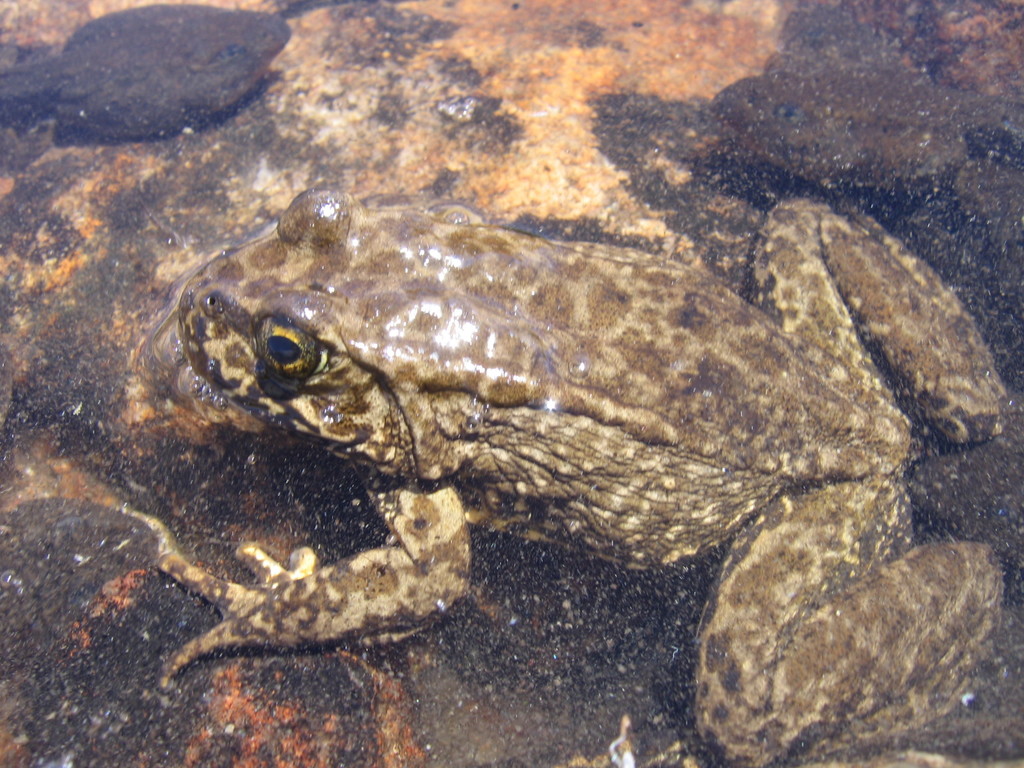
Southern Mountain Yellow-legged Frog
Rana muscosa
The southern mountain yellow-legged frog (Rana muscosa), formerly known as the mountain yellow-legged frog, is a species of true frog endemic to California in the United States. It occurs in the San Jacinto Mountains, San Bernardino Mountains, and San Gabriel Mountains in Southern California and the Southern Sierra Nevada. It is a federally listed endangered species, separated into two distinct population segments (DPS): a northern DPS, listed endangered in 2014, and a southern DPS that was listed endangered in 2002.
Populations formerly classified as Rana muscosa in the northern Sierra Nevada have since been redescribed as a new species: Rana sierrae, the Sierra Nevada yellow-legged frog. The Sierra Nevada yellow-legged frog has also been classified as a federally endangered species since 2014. The mountains separating the headwaters of the South Fork and Middle Fork of the Kings River mark the boundary between the ranges of the two species.
From the article Mountain yellow-legged frog on Wikipedia (CC BY-SA), quoted section by section
Description
Rana muscosa is 4 to 8.9 centimetres (1.6 to 3.5 in) long. Females tend to be larger than males. Its color and patterning are variable. It is yellowish, brownish, or olive with black and brown markings. The underside of its hind legs can be different hues of yellow, from a bold sun yellow to a lighter pale yellow; larger ones may have hints of orange on their hind legs. The throats of it range from white to yellow. Along with its variable coloration, the frog also has a dorsal pattern with dark spots in different shapes and sizes. Its species name muscosa is from the Latin meaning "mossy" or "full of moss", inspired by its coloration. It may have light orange or yellow thighs. When handled, the frog emits a defensive odor reminiscent of garlic.
Range & habitat
The frog occurs in mountain creeks, lakes and lakeshores, streams, and pools, preferring sunny areas. It rarely strays far from water, and can remain underwater for a very long time, likely through cutaneous gas exchange. As such, adults can be found on rocks around shorelines. Close proximity to water is important because eggs are either laid underwater attached to rocks or in shallow waters. The tadpoles require a permanent water habitat for at least two years while they develop. This is because tadpoles can die from a lack of moisture, especially dry summers. The frog has been noted at elevations of between about 1,214 and 7,546 feet (370 and 2,300 m) in Southern California. These habitats are primarily found in north of California in Sierra Nevada and south of California in the Transverse ranges.
Wikipedia: “Habitat”
What it does
The frog emerges from its wintering site soon after snowmelt. Its breeding season begins once the highest meltwater flow is over, around March through May in the southern part of its range, and up to July in higher mountains to the north. Fertilization is external, and the egg cluster is secured to vegetation in a current, or in still waters sometimes left floating free. How long it takes for breeding onset varies from 1–4 years depending on the levels of snow and temperature. Very cold temperatures may cause death of larvae. The juvenile may be a tadpole for 3 to 4 years before undergoing metamorphosis. However, this rate heavily varies depending on the temperature and elevation of the area. There are two classes of tadpoles: first year tadpoles and second year tadpoles. Metamorphosis tends to happen the second summer of tadpole life. They are called metamorphs when this transition from tadpole to young frog is occurring. They are then called a juvenile when it survives one winter. It becomes ready to reproduce after 2 years of the juvenile stage. It is found that the growth and development rate is slower at higher elevations.
Wikipedia: “Reproduction and early life”
Listen
Looking for field recordings…
Where it lives
Recorded sightings
—
geo-referenced records in GBIF, from museums, herbaria and field observers.
Drag the globe to turn it. Dots are where records exist, not a range map; darker means more records.
In the stacks
Searching the stacks…
Every page naming Rana muscosa in the Biodiversity Heritage Library →
This page is assembled live from iNaturalist, GBIF, Wikipedia, the Source Library and the Internet Archive. It is not yet part of the hand-edited codex. iNaturalist taxon 25637.