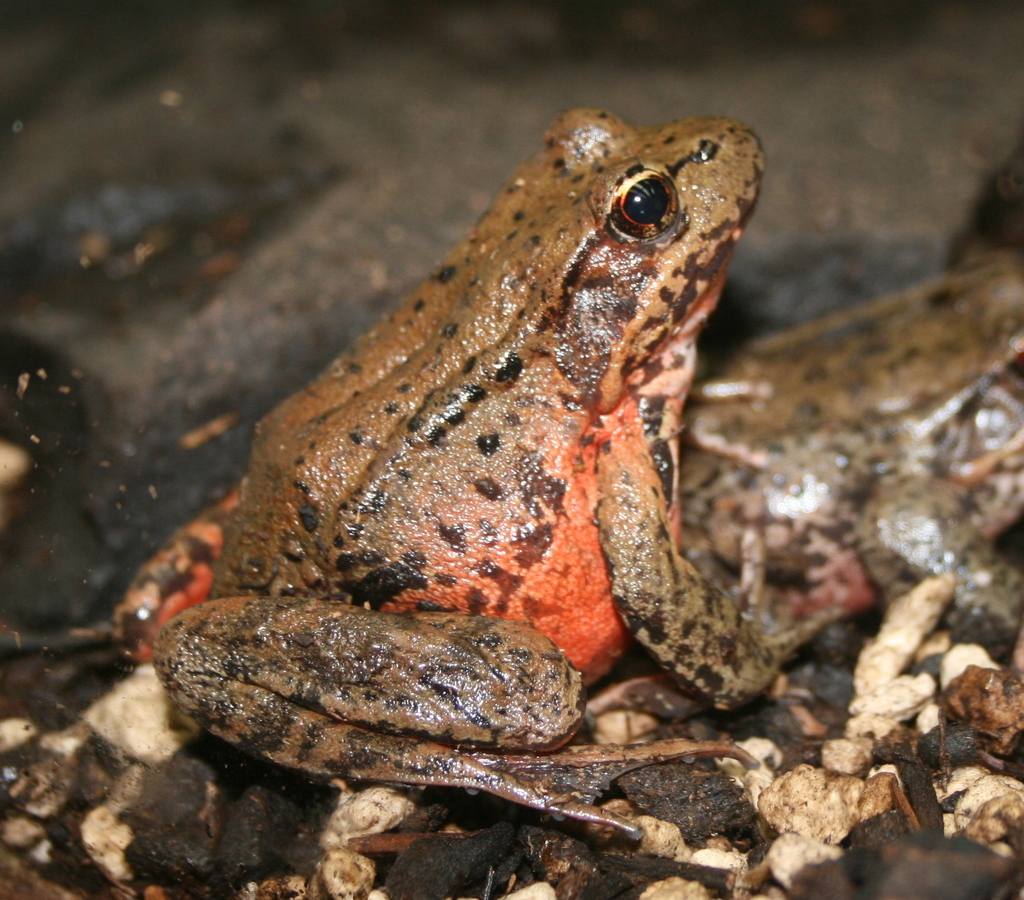
Northern Red-legged Frog
Rana aurora
Northern red-legged frogs (Rana aurora) are an amphibian species in the true frog family. They have greenish- to reddish-brown skin, red hind legs, dark spots across their backs, and dark facial masks. As a member of the genus Rana, this species is considered a true frog, with characteristic smooth skin and a narrow waist. These frogs are distributed along the Pacific coast of the United States and Canada, from Northern California to southwest British Columbia. There is some range overlap with the federally protected California red-legged frog. Northern red-legged frogs generally breed from January to March, laying eggs in water with submerged vegetation.
Northern red-legged frogs have decreasing population sizes and are listed as "Least Concern" by IUCN. They are a conservation strategy species in Oregon. These frogs are negatively affected by roads due to their characteristic breeding migration from upland-terrestrial to aquatic habitat. Excessive road fatalities have led to novel volunteer programs and wildlife undercrossing projects to protect urban frog populations in Portland, Oregon.
From the article Northern red-legged frog on Wikipedia (CC BY-SA), quoted section by section
Description
Northern red-legged frogs have smooth skin that ranges from greenish- to reddish-brown in color. Their name comes from the bright-red coloration found underneath their relatively long, webbed hind legs. There are variable densities and patterns of dark spots and flecks across the frog's body. Their eyes are golden-brown. A thin, horizontal dark marking extends from the front of their eye to their nostrils, and a light stripe follows their jawline. A reddish-brown mask covers their tympanum. Adults have characteristic Rana species features, including prominent dorsolateral folds (ridges along their backs) along the entire dorsal margin, non-warty skin, and a small waist. The northern red-legged frog has long, powerful legs well adapted to jumping. Northern red-legged frogs demonstrate sexual dimorphism in their size. Larger females can reach 10.7 cm (4.2 in), and males can reach 8.1 cm (3.2 in), but size varies by location. Both sexes are typically a few inches smaller than these maximums in Washington state. Noted lookalike species are the California red-legged frog, Oregon spotted frog, and the Cascades frog. Northern red-legged frogs are smaller than California red-legged frogs, and demonstrate differences in color pattern, limb length, and eye size. …
Range & habitat
The northern red-legged frog is found west of the Cascade mountain range in the Pacific Northwest. Their range includes Northern California, western Oregon, western Washington and southwestern British Columbia, including Vancouver Island. Database entry includes a range map and justification for why this species is considered least concern. Entry covers R. aurora.</ref> It also occurs somewhat less-commonly in the southern Cascade Range. Their California range spans every coastal county from southern Mendocino County northward. These frogs can live at elevations up to 1,426 m (4,680 ft), though is not found above an elevation of 1,200 m (3,937 ft) in Northern California coastal mountain ranges, or above 914 m (3,000) in Washington. It is considered introduced to Alaska. The southern limit of the northern red-legged frog ends in Northern California's Mendocino County, as is the case for some other Pacific Northwest amphibians. Most California and northern red-legged frog populations demonstrate genetically distinct mitochondrial DNA in their range overlap, indicating a narrow band of hybridization across the region. One study looking at both California and northern red-legged frog presence in southern Mendocino County did not find widespread distribution in forest streams after analyzing environmental DNA.
Wikipedia: “Distribution”
What it does
Mature R. aurora prey upon terrestrial insects, but will also take small snails and crustaceans. Adults also consume worms, tadpoles, small fish, and even small frogs of other species. Tadpole larvae are herbivorous, and eat algae.
Wikipedia: “Diet”
Listen
Looking for field recordings…
Where it lives
Recorded sightings
—
geo-referenced records in GBIF, from museums, herbaria and field observers.
Drag the globe to turn it. Dots are where records exist, not a range map; darker means more records.
In the stacks
Searching the stacks…
Every page naming Rana aurora in the Biodiversity Heritage Library →
This page is assembled live from iNaturalist, GBIF, Wikipedia, the Source Library and the Internet Archive. It is not yet part of the hand-edited codex. iNaturalist taxon 25545.