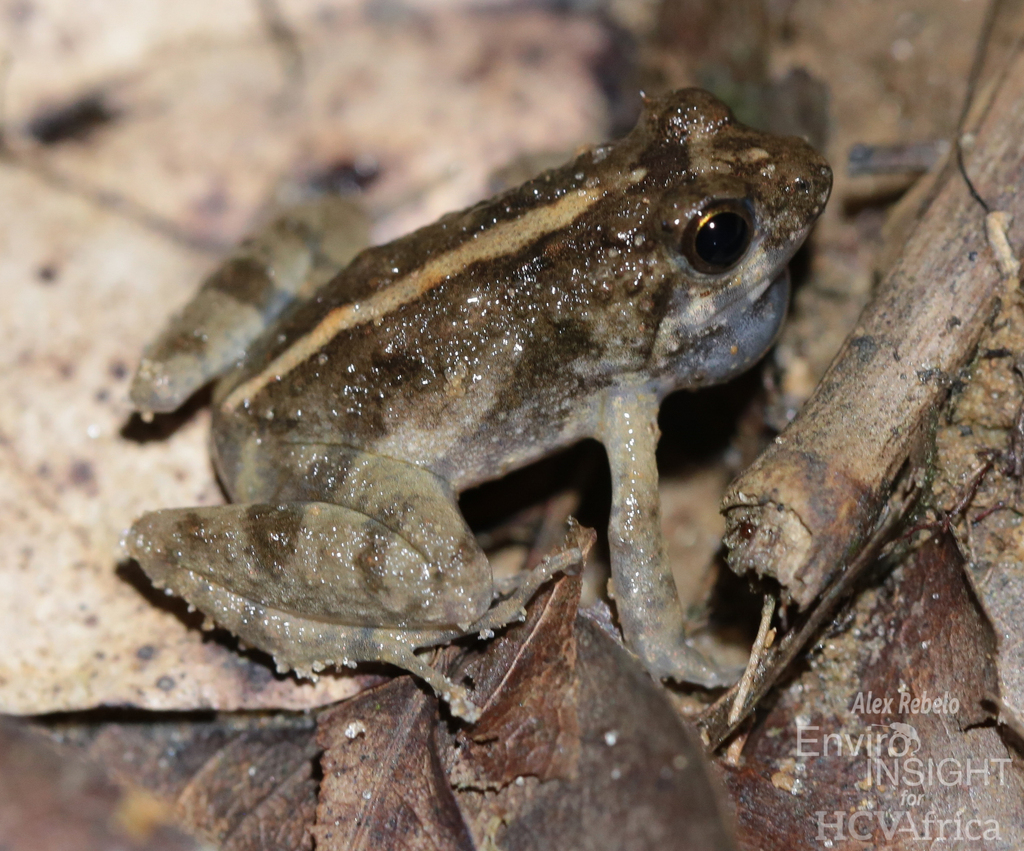
Boutry River Frog
Phrynobatrachus calcaratus
Phrynobatrachus calcaratus, the Boutry River frog, is a species of frog in the Phrynobatrachidae family. It is found in Cameroon, Central African Republic, Ivory Coast, Equatorial Guinea, Ghana, Guinea, Liberia, Nigeria, Senegal, possibly Benin, possibly Democratic Republic of the Congo, possibly Gambia, possibly Guinea-Bissau, possibly Mali, possibly Sierra Leone, and possibly Togo. Its natural habitats are subtropical or tropical moist lowland forests, subtropical or tropical moist montane forests, rivers, intermittent freshwater marshes, and heavily degraded former...
From the article Phrynobatrachus calcaratus on Wikipedia (CC BY-SA), quoted section by section
Description
Phrynobatrachus calcaratus is a small frog with a rounded snout and a moderately warty skin, growing to a snout-to-vent length of about 11 to 19 mm (0.4 to 0.7 in) for males and 16 to 23 mm (0.6 to 0.9 in) for females. The digits do not have enlarged tips and the fingers and toes are largely unwebbed. Most animals have a uniformly coloured greenish or brownish dorsal surface, slightly darker around the warts, and a whitish belly, but some have a spinal band of red with yellowish borders and a few have a red transverse band. The male has a prominent black vocal sac on the throat during the breeding season.
Range & habitat
This species is found in gallery forests in humid savannas, secondary forest along streams in the forest zone, and farm bush; it can also colonize savanna that has not burned. It is found mainly in lowland habitats, but elevations of 1,200 m (3,900 ft) in Cameroon.
Wikipedia: “Habitat”
What it does
The males call near suitable waterbodies and the females lay clutches of a few hundred eggs which hatch in three days. Tadpole growth is fast and the animals become mature at four to five months. They have a short lifespan and probably die within a few months of spawning.
Wikipedia: “Reproduction”
Listen
Looking for field recordings…
Where it lives
Recorded sightings
—
geo-referenced records in GBIF, from museums, herbaria and field observers.
Drag the globe to turn it. Dots are where records exist, not a range map; darker means more records.
In the stacks
Searching the stacks…
Every page naming Phrynobatrachus calcaratus in the Biodiversity Heritage Library →
This page is assembled live from iNaturalist, GBIF, Wikipedia, the Source Library and the Internet Archive. It is not yet part of the hand-edited codex. iNaturalist taxon 25403.