- Animals
- ›Chordates
- ›Vertebrates
- ›Amphibians
- ›Frogs and Toads
- ›Australian Ground Frogs
- ›Australian Ground Frogs
- ›Uperoleia
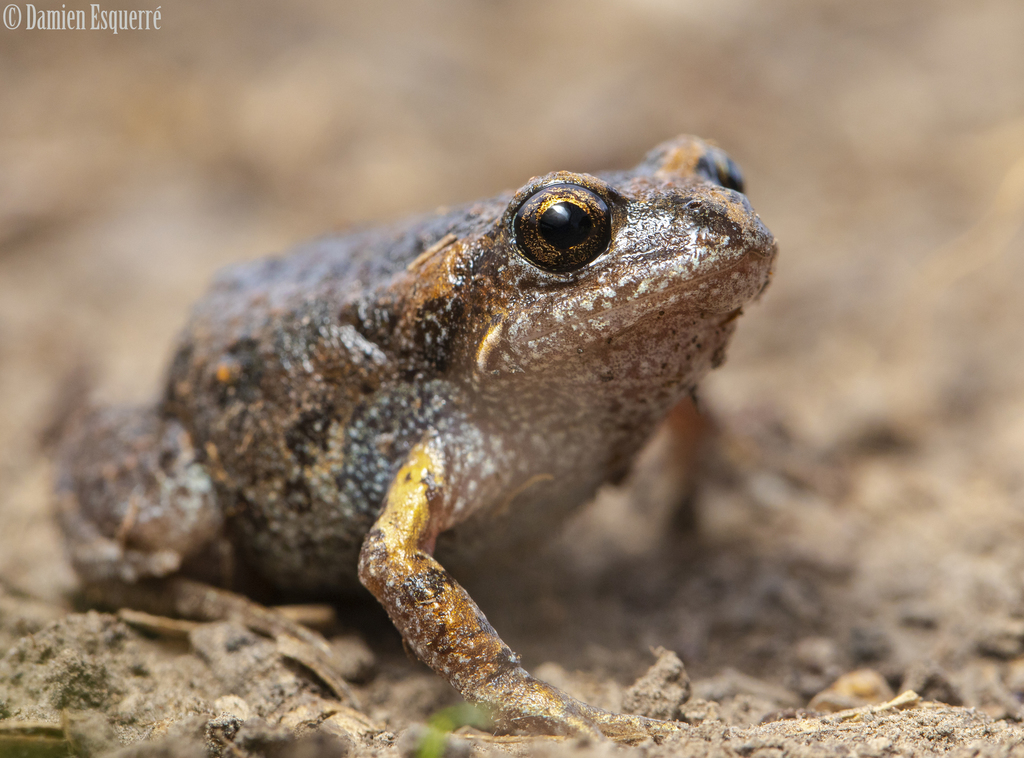
Smooth Toadlet
Uperoleia laevigata
The Smooth Toadlet (Uperoleia laevigata) is a species of Australian ground-dwelling frog native to the coast and west of the ranges of south-east Queensland, all of eastern New South Wales and north-eastern Victoria.
From the article Smooth toadlet on Wikipedia (CC BY-SA), quoted section by section
Description
The smooth toadlet reaches 35mm in length. It is grey-brown to olive-brown above often with darker spots and blotches. There is normally a pale triangular patch on the head in front of the eyes and a pale yellow patch in the armpit. It has prominent parotoid glands. Its belly is white and there is a red patch in the thighs.
What it does
This frog is associated with dry forest, sclerophyll forest and cleared grassland/farmland along the coast, slopes and ranges. Males make a drawn out "arrrrk" call from around the breeding site, this can be anything from a large permanent dam to a flooded ditch or grassland. Calling males can be right at the waters edge to up to 20 metres away. Calling occurs from spring to autumn. After heavy rain many of these frogs may breed in one or two weeks, when in drier times the breeding site may appear absent of this species.
Wikipedia: “Ecology and behaviour”
Listen
Looking for field recordings…
Where it lives
Recorded sightings
—
geo-referenced records in GBIF, from museums, herbaria and field observers.
Drag the globe to turn it. Dots are where records exist, not a range map; darker means more records.
In the stacks
Searching the stacks…
Every page naming Uperoleia laevigata in the Biodiversity Heritage Library →
This page is assembled live from iNaturalist, GBIF, Wikipedia, the Source Library and the Internet Archive. It is not yet part of the hand-edited codex. iNaturalist taxon 25281.