- Animals
- ›Chordates
- ›Vertebrates
- ›Amphibians
- ›Frogs and Toads
- ›Australian Ground Frogs
- ›Australian Ground Frogs
- ›Crinia
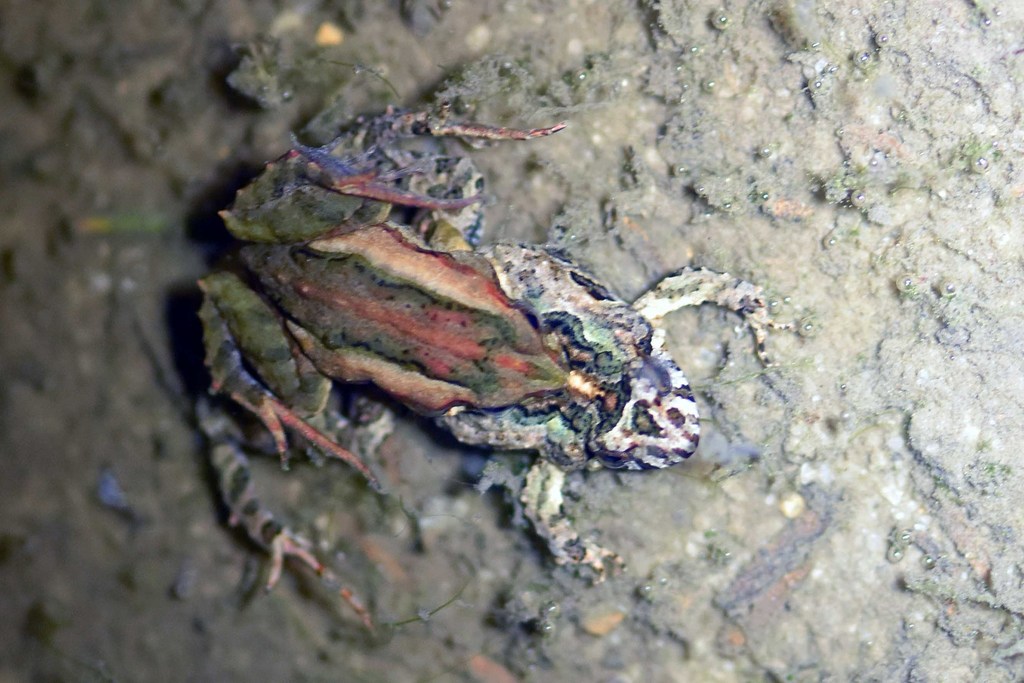
Rattling Froglet
Crinia glauerti
The Glauert's Froglet (Crinia glauerti) is a species of frog in the Myobatrachidae family. It is endemic to Australia. Its natural habitats are temperate forests, rivers, intermittent rivers, shrub-dominated wetlands, swamps, freshwater lakes, freshwater marshes, arable land, pastureland, plantations, rural gardens, water storage areas, ponds, open excavations, sewage treatment areas, and introduced vegetation. It is threatened by habitat loss.
From the article Rattling froglet on Wikipedia (CC BY-SA), quoted section by section
Description
As with many other small (< 3 cm) Crinia species across Australia, rattling froglets show considerable variation in dorsal and ventral colouration and patterns. Colouration on dorsal surfaces can be sandy gold, light grey to fawn, brown, bright russet, dark grey, dark brown, or almost black, with patterns that vary from uniform colouration to blotched, marbled and striped. Skin can vary from smooth to rough, with or without raised longitudinal folds. Ventral patterns are dimorphic between the sexes. Males typically have varying levels of black on the chin, throat, belly, and legs, although they can also be very plain or have white and black blotching on the belly. Females typically have a white chin, throat and belly, with varying degrees of black blotching. Both sexes can have a mid-ventral stripe or cross.
It is not always possible to separate rattling froglets, squelching froglets (C. insignifera), South Coast froglets (C. subinsignifera), and bleating froglets (C. pseudinsignifera) from one another, particularly if just a photo of the dorsal surface is available. The ventral surface patterns may help guide identification, however as these are also highly variable care must be taken. The geographic distribution of the species may also help to identify an individual, however there is overlap between various species in many locations, making mis-identification easy.
Range & habitat
Rattling froglets are found in southwestern Australia, along the coast and adjacent areas. The species is patchily distributed from the Moore River area, north of Perth, to the Albany region and Stirling Ranges in the south-east. Rattling froglets occupy coastal plains, inland ranges, and riverine areas, often occurring near natural swamps, creeks and pools in forests, but also pastureland, plantations, rural gardens, water storage areas, ponds, open excavations, and sewage treatment areas.
Wikipedia: “Distribution and habitat”
What it does
Like other Crinia species, rattling froglets probably feed on a variety of small insects and arachnids, including mosquitoes, caterpillars, flies, and small spiders. Rattling froglets typically breed in creeks, swamps or pools, including flooded or seasonally inundated grasslands or shrubby areas beside streams, gutters and seeps. They are usually present in areas that remain wet throughout most of the year. Frogs in amplexus are frequently observed on top of floating vegetation (e.g. duckweed) in shallow (< 50 cm) water. Eggs are laid singly, usually attached in small groups or rows along stems of submerged vegetation or leaves, or on the substrate in shallow water. Tadpoles take about four months to develop into frogs, and feed mostly on sediments and algae.
Wikipedia: “Behaviour and ecology”
Listen
Looking for field recordings…
Where it lives
Recorded sightings
—
geo-referenced records in GBIF, from museums, herbaria and field observers.
Drag the globe to turn it. Dots are where records exist, not a range map; darker means more records.
In the stacks
Searching the stacks…
Every page naming Crinia glauerti in the Biodiversity Heritage Library →
This page is assembled live from iNaturalist, GBIF, Wikipedia, the Source Library and the Internet Archive. It is not yet part of the hand-edited codex. iNaturalist taxon 25233.