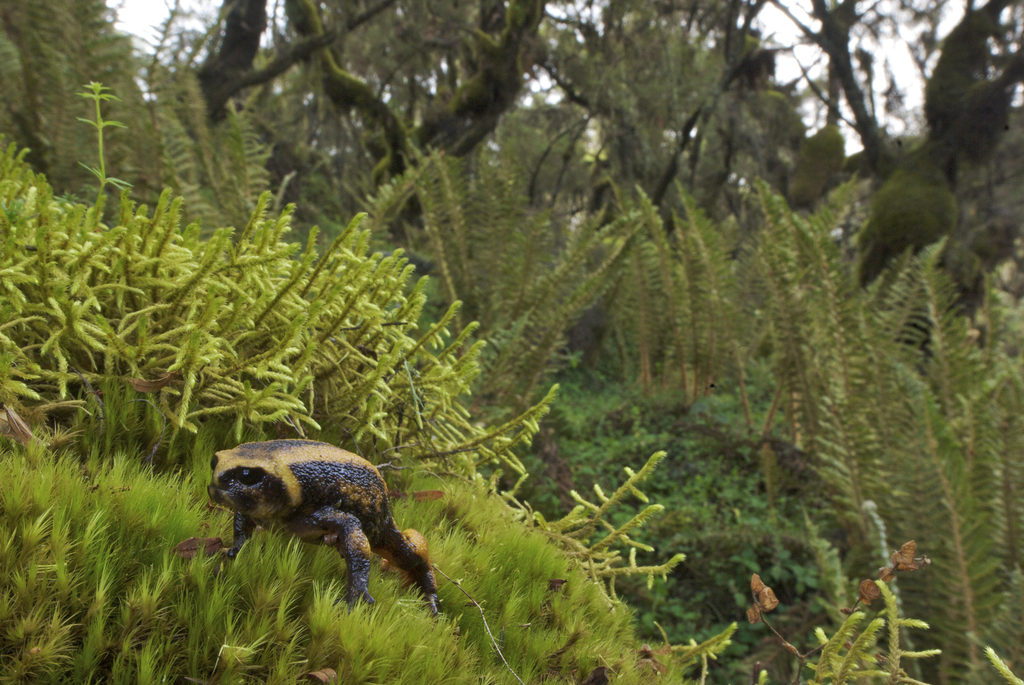
Bale Mountains Tree Frog
Balebreviceps hillmani
The Bale Mountains tree frog (Balebreviceps hillmani) is a species of frog in the family Brevicipitidae. It is the only species in the monotypic genus Balebreviceps and endemic to the Bale Mountains of Ethiopia.
Its natural habitats are tree heath (Erica arborea) woodland near the timberline as well as partly cleared mixed forest further down. Despite its entire range being within the Bale Mountains National Park, it is threatened by habitat loss and deterioration (deforestation) caused by cattle grazing, firewood collection, fencing, and settlement development.
From the article Bale Mountains tree frog on Wikipedia (CC BY-SA), quoted section by section
Description
Balebreviceps hillmani is a stout bodied frog. They are most commonly referred to as the Bale Mountains tree frog or the Ethiopian short-headed frog. They have a smooth ventral side, except their throat, while their dorsal side is thick and pitted. The throat of this species is wrinkly. They have short but muscular legs and their toes lack webbing and have a reduced fifth toe. The males lack vocal sacs and the females lack auditory apparatuses, causing them to be unaware of airborne vibrations. A unique feature of this tree frog is their structured palate. They are purple or brown in color with a pair of yellow/golden stripes.
Range & habitat
The Bale Mountains tree frog is native and endemic to Ethiopia, specifically to Harenna in the Bale Mountains. The current population is continuing to decline since the late 1980s. There is also a decline specifically in the number of mature individuals. The population size is very low and this species is critically endangered.
Wikipedia: “Geographic range and population”
Listen
Looking for field recordings…
Where it lives
Recorded sightings
—
geo-referenced records in GBIF, from museums, herbaria and field observers.
Drag the globe to turn it. Dots are where records exist, not a range map; darker means more records.
In the stacks
Searching the stacks…
Every page naming Balebreviceps hillmani in the Biodiversity Heritage Library →
This page is assembled live from iNaturalist, GBIF, Wikipedia, the Source Library and the Internet Archive. It is not yet part of the hand-edited codex. iNaturalist taxon 25012.