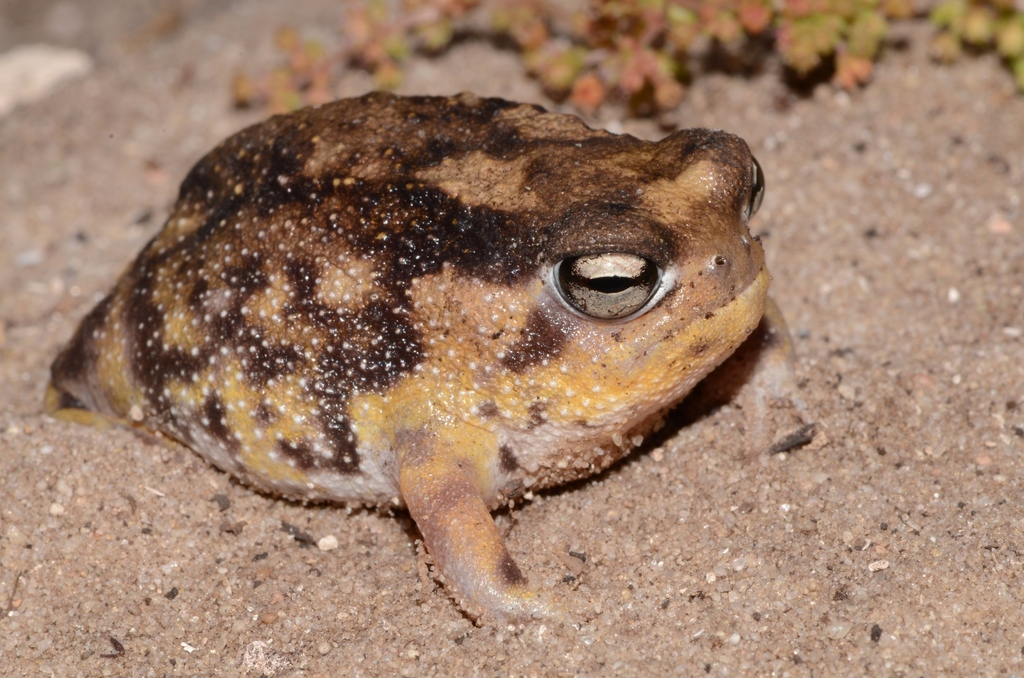
Namaqua Rain Frog
Breviceps namaquensis
The Namaqua rain frog (Breviceps namaquensis) is a species of frog in the family Brevicipitidae, found in South Africa, Zimbabwe, and possibly Namibia. Its natural habitats are subtropical or tropical dry shrubland and sandy shores. It is threatened by habitat loss.
From the article Namaqua rain frog on Wikipedia (CC BY-SA), quoted section by section
Range & habitat
It is a fossorial frog that inhabits scrub-covered sandy areas in the succulent karoo biome. Development is direct (i.e., there is no free-living larval stage) and does require an aquatic habitat. It is a locally abundant frog, but it can experience some habitat loss because of agricultural expansion in the south of its range. It is present in several protected areas.
== References ==
Wikipedia: “Habitat and conservation”
What it does
When disturbed, these frogs have the ability to inflate their bodies dramatically and squeak as a defence mechanism to deter predators. Breeding activity has been recorded in winter, spring and summer. They spend most of their time underground, surfacing after the rains to feed on insects. Its eggs are laid in underground chambers and are covered in a thick, viscous, jelly-like substance. Once the eggs hit tadpole stage, the jelly softens into a fluid in which they live until they fully metamorphose into frogs (absorbing nutrients from the egg yolk as they grow).
Wikipedia: “Behaviour”
Listen
Looking for field recordings…
Where it lives
Recorded sightings
—
geo-referenced records in GBIF, from museums, herbaria and field observers.
Drag the globe to turn it. Dots are where records exist, not a range map; darker means more records.
In the stacks
Searching the stacks…
Every page naming Breviceps namaquensis in the Biodiversity Heritage Library →
This page is assembled live from iNaturalist, GBIF, Wikipedia, the Source Library and the Internet Archive. It is not yet part of the hand-edited codex. iNaturalist taxon 24991.