- Animals
- ›Arthropods
- ›Chelicerates
- ›Arachnids
- ›Spiders
- ›Typical Spiders
- ›Entelegyne Spiders
- ›Thomisoidea Spiders
- ›Crab Spiders
- ›Thomisinae
- ›Diaeini
- ›Synema
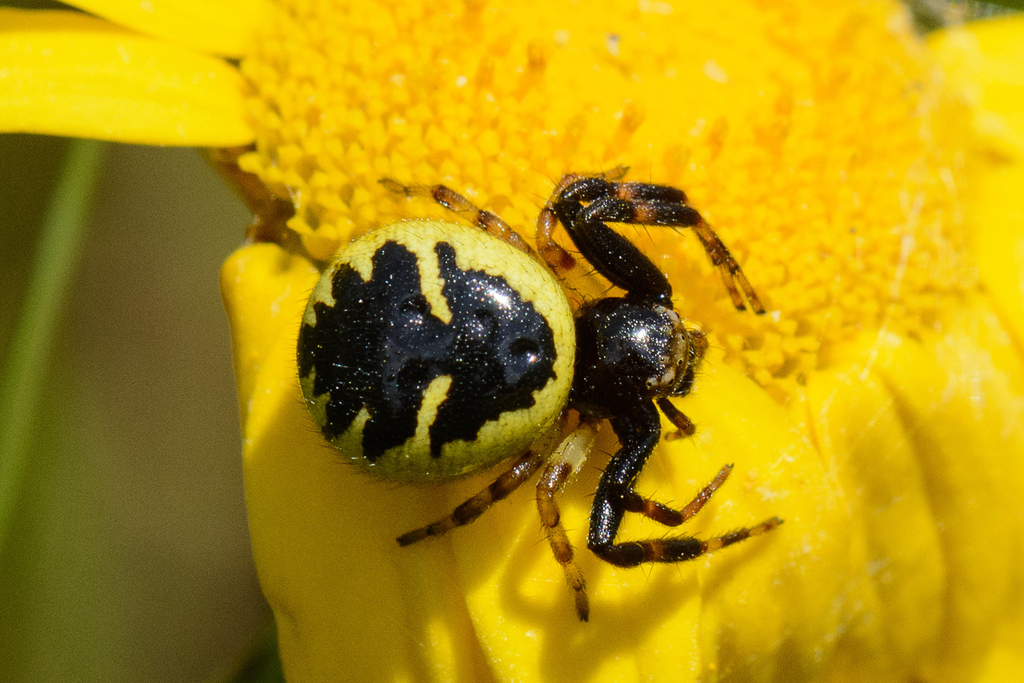
Napoleon Spider
Synema globosum
Synema globosum is a species of spider belonging to the family Thomisidae (crab spiders). It is sometimes called the Napoleon spider, because of a supposed resemblance of the markings on the abdomen to a silhouette of Napoleon wearing his iconic hat.
From the article Synema globosum on Wikipedia (CC BY-SA), quoted section by section
Description
The adult males reach 2–4 mm (0.08–0.16 in) in length, while females are 7–8 millimetres (0.28–0.31 in) long. They can mostly be encountered from May through August on flowering plants (especially yellow or red Apiaceae species), waiting for their prey. The two pairs of the front legs, used for hunting the flower-feeding insects, are more developed than the rear ones, which have a predominant motor function. A striking feature of this species is the variation in colour among females. Mature males have a black abdomen with two white marks. In mature females, the background colour of the abdomen can be red, yellow or white, with a black pattern which has been noted for a certain resemblance to the silhouette of Napoleon. Prosoma and legs are black or dark brown. Like other species of the family Thomisidae, these spiders do not make a web, but actively hunt their prey.
Range & habitat
This species is present in most countries of Europe and in the eastern Palearctic realm, although absent from Scandinavia and the British Isles. It is especially common throughout the Mediterranean region.
Wikipedia: “Distribution”
Where it lives
Recorded sightings
—
geo-referenced records in GBIF, from museums, herbaria and field observers.
Drag the globe to turn it. Dots are where records exist, not a range map; darker means more records.
In the stacks
Searching the stacks…
Every page naming Synema globosum in the Biodiversity Heritage Library →
This page is assembled live from iNaturalist, GBIF, Wikipedia, the Source Library and the Internet Archive. It is not yet part of the hand-edited codex. iNaturalist taxon 245656.