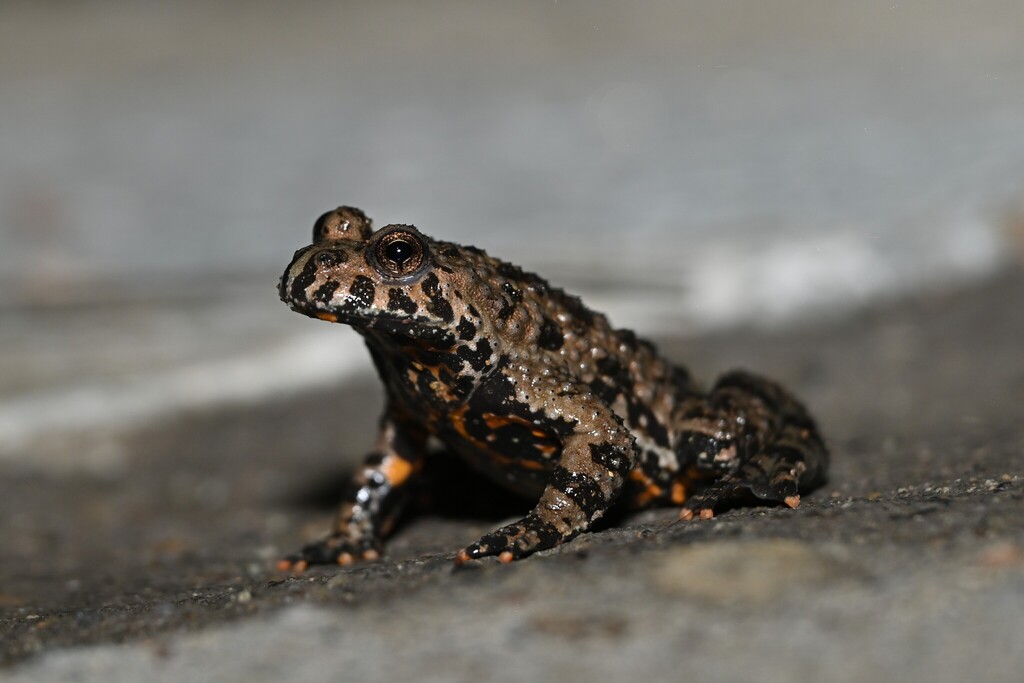
Oriental Fire-bellied Toad
Bombina orientalis
The Oriental fire-bellied toad (Bombina orientalis) is a small semiaquatic frog species found in northeastern Asia, where they primarily dwell in slow-moving bodies of water and temperate forests. Quite common throughout much of their range, these frogs have mild toxins that can be excreted through their skin, with their vibrant underbellies serving as a warning of this. While not a true toad, their green and black skin is covered in small tubercles, giving them a toadlike appearance. Their sounds, mainly produced by males during the mating season, are very unlike those of other frogs. While their population is in decline, their numbers are still high overall, with the International Union for Conservation of Nature (IUCN) rating them as a least-concern species. They are commonly kept as pets in land and water vivaria, as a relatively easy-to-care for species. They are also frequently used in scientific research, with their behavior, vocalizations, and learning skills all moderately studied.
From the article Oriental fire-bellied toad on Wikipedia (CC BY-SA), quoted section by section
Description
Oriental fire-bellied toads can be bright, grayish, or brownish green, with black mottling on their dorsal regions. Like other Bombina species, B. orientalis has a brightly colored ventral region, which can be yellow, red, or orange-red, mottled with dark spots. The finger and toe tips are usually red. The skin on its upper side is covered in small tubercles, the most pronounced of the genus Bombina. Although it is typically referred to as a toad, the fire-bellied toad is not a true toad. They can reach a length of about 3.8–5.1 centimetres (1.5–2.0 in), weighing about 28–57 grams (0.99–2.01 oz). Males and females can be told apart by the males' nuptial pads on their first and second fingers. Besides having more noticeable tubercles on their skin, B. orientalis can also be distinguished from other members of Bombina by their lack of gular sacs (like B. pachypus and unlike B. bombina) and nuptial pads (like B. bombina and unlike B. pachypus, although later research has shown that males do in fact have a few, as previously mentioned). Subtler differences include their belly coloration, which is typically more red than yellow (unlike B. pachypus) and bright finger tips (unlike B. bombina).
Range & habitat
The toad can be found in Korea, northeastern Russia, (where they have become rather rare) and northeastern China, and possibly southern Japan, specifically Tsushima Strait, although the latter is very likely erroneous, as a team of Japanese researchers in the later half of the 20th century was unable to locate any. There is also a somewhat genetically distinct population in Beijing that was introduced from Yantai in Shandong in 1927 by Mr. Liu Cheng-chao. About 200 were released into wetland habitats, where they later bred. There have been multiple reports of escaped specimens in Broward County, Florida, US, mostly in the immediate vicinity of an animal importer's facility. There have been no other reports of such occurrences in the United States, and there are no well-established escaped populations. They are semiaquatic, generally dwelling in slow-moving streams or ponds. When out of the water, they can often be found in coniferous and broadleaved forests. They can be found at elevations of up to 1,100 metres (3,600 ft). They are very resilient to environmental disturbance, especially compared to other amphibians, and as such can be found living and even breeding in heavily polluted water.
Wikipedia: “Distribution and habitat”
What it does
Bombina orientalis are one of the most plentiful amphibians in their native lands, particularly the central part of their range. The toads are diurnal (active during the day), and studies have found that while they can acquire some from their diet, Oriental fire-bellied toads rely partly on sunlight to obtain adequate levels of vitamin D3.
Diet. As larvae, Oriental fire-bellied toads consume algae, fungi, detritus, plants and protozoans. As adults, their diet consists of terrestrial invertebrates, including worms, molluscs and insects. Their diet in the wild contributes to their toxicity, and for that reason, wild specimens have more potent toxins. Oriental fire-bellied toads are incapable of extending their tongues to catch prey, but must instead leap at their target.
Breeding. Breeding takes place around mid-May, when temperatures become warmer. It is at this time that the toads emerge from hibernation. Males call to the females with a light sound that is comparable to a musical triangle. They will jump onto the backs of any other fire-bellied toad that happens to pass by, which in some cases will cause them to accidentally attempt to mate with other species of amphibians, fish, plants, or even human fingers. Females lay 40 to 110 eggs in a large cluster near the surface of the water. …
Wikipedia: “Behavior and ecology”
In human culture
According to the American Museum of Natural History, the red-bellied toad, Chinese bell toad, Oriental bell toad, eastern fire-bellied toad, and Korean fire-bellied toad are all common names that have been used to describe the species at one point or another.
Wikipedia: “Etymology”
Listen
Looking for field recordings…
Where it lives
Recorded sightings
—
geo-referenced records in GBIF, from museums, herbaria and field observers.
Drag the globe to turn it. Dots are where records exist, not a range map; darker means more records.
In the stacks
Searching the stacks…
Every page naming Bombina orientalis in the Biodiversity Heritage Library →
This page is assembled live from iNaturalist, GBIF, Wikipedia, the Source Library and the Internet Archive. It is not yet part of the hand-edited codex. iNaturalist taxon 24501.