 NL·0351
Herbarium of the Nature Library
- Name
- Pterophyllum scalare
- Family
- Cichlidae
- Native to
- Amazon basin in Brazil, Colombia, Peru, French Guiana and Guyana (Amapá, Oyapock and Essequibo rivers)
- Habitat
- Flooded forest, Swamps, Slow, vegetated rivers
Freshwater angelfish
Pterophyllum scalare
Also calledAcará-bandeira (Portuguese, 'flag cichlid') · Escalar (Spanish) · Skalar (German)
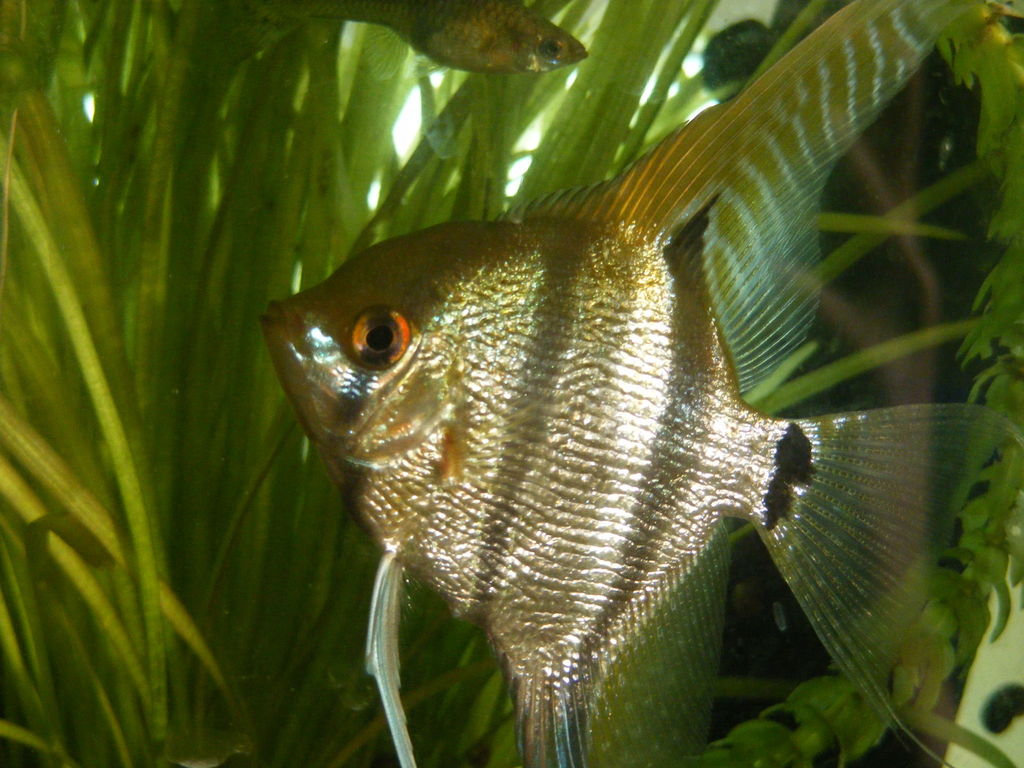
A tall, silver Amazonian cichlid with sweeping fins and black bars, built to hide among reeds and sunken branches. It is one of the best-known aquarium fish, and pairs bond and raise their young together.
Pterophyllum scalare, most commonly referred to as angelfish or freshwater angelfish, is the most common species of Pterophyllum kept in captivity. It is native to the Amazon Basin in Peru, Colombia, and Brazil. Particularly to the Ucayali river in Peru, the Oyapock River in French Guiana, the Essequibo River in Guyana, the Solimões, the Amapá, and the Amazon rivers in Brazil. It is found in swamps or flooded grounds where vegetation is dense and the water is either clear or silty. Its native waters range from a neutral pH of 7.0 down to near 6.0, with a general water hardness (gH) range of 3 to 10 °dH, and water temperature ranging from 26 to 30 °C. This is the species of angelfish most frequently found in the aquarium trade. A similar P. scalare exists in the Rio Orinoco. They are of the same size and shape, the only difference being the stripes; the Orinoco P. scalare has thinner, but dual, stripes. Wikipedia
What it can do
- iIts very compressed body and vertical bars help it blend in among vertical reeds and roots
- iiPairs clean a leaf or branch, lay rows of eggs on it, and both parents fan and guard them
- iiiParents move wrigglers to fresh pits or leaves in their mouths
In the field
Field marks
- aDisc-shaped, extremely compressed body, taller than long with fins
- bVery long, triangular dorsal and anal fins and threadlike pelvic fins
- cSilver with three to four bold black vertical bars, one through the eye
- Not to be confused with
- Altum angelfish (P. altum) of the Orinoco and Rio Negro is taller, with a notch above the snout. Leopold's angelfish (P. leopoldi) has a dark spot at the dorsal-fin base and a less prominent tail bar. Discus is round, not tall.
- Where to see it
- Amazonian floodplains near Santarém and Manaus; public aquaria and home aquaria worldwide
- When
- Resident; breeds through the rainy season
Life & habits
- Diet
- Carnivore and omnivore: small fish, insect larvae, crustaceans and worms
- Habitat
- Quiet, vegetated, often tannin-stained water among roots, plants and sunken wood
- Size
- About 15 cm long and up to 25 cm tall including fins
- Lifespan
- About 10 years in captivity
Hovers among stems in small groups, then pairs off to breed and become strongly territorial.
Where it lives
Recorded sightings
—
geo-referenced records in GBIF, from museums, herbaria and field observers.
Native range
Amazon basin in Brazil, Colombia, Peru, French Guiana and Guyana (Amapá, Oyapock and Essequibo rivers)
Drag the globe to turn it. Dots are where records exist, not a range map; darker means more records.
In the old herbals & bestiaries
No plate in the Source Library names this exact species, so these show its closest relatives as the old naturalists drew them: same genus, or the same kind of animal. Click a plate to read the page it came from, with translation.


In the stacks
Searching the stacks…
Every page naming Pterophyllum scalare in the Biodiversity Heritage Library →
Marginalia
Imported to Europe in the early 20th century, angelfish were bred in American aquaria by the 1920s and were among the first tropical fish kept as household pets.
Curiosity
The name Pterophyllum means 'winged leaf' in Greek, after its leaf-like body and wing-like fins.
Kinship



Photographs: iNaturalist contributors under the licences shown. Records: GBIF.org. Historical plates: Source Library (CC BY-SA 4.0; originals public domain). Summary text: Nature Library editors and Wikipedia (CC BY-SA). Medicinal and edibility notes are historical and educational, not advice. iNaturalist taxon 244861.