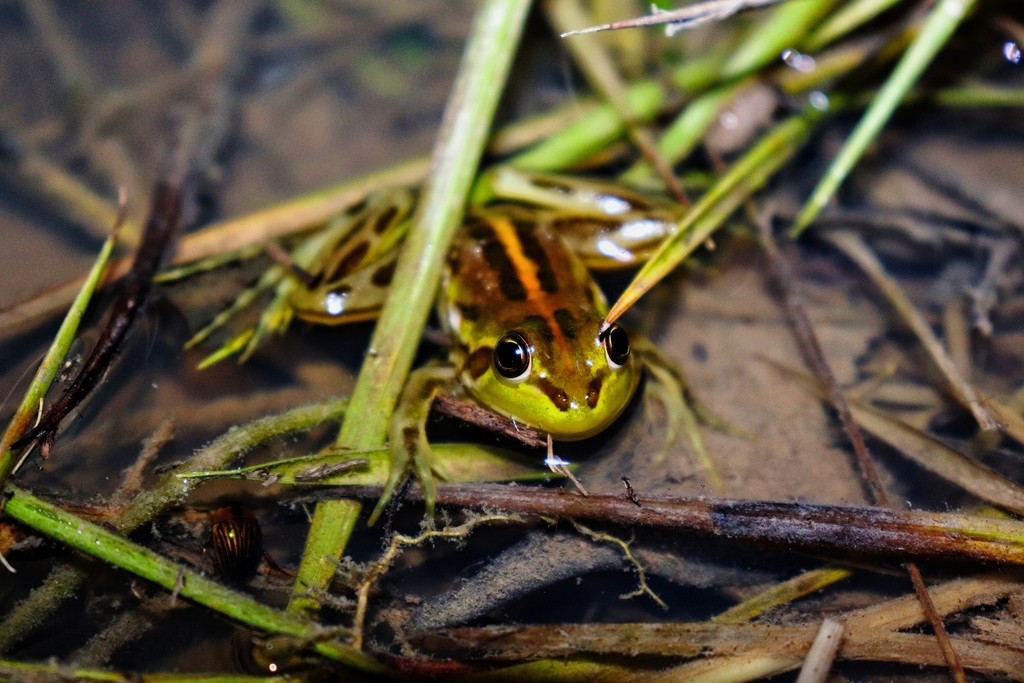
Tocantins Swimming Frog
Pseudis tocantins
Pseudis tocantins is a species of frog in the Hylidae family. It is endemic to Brazil. Its natural habitats are moist savanna, subtropical or tropical moist shrubland, swamps, freshwater lakes, freshwater marshes, and ponds. It is threatened by habitat loss.
From the article Pseudis tocantins on Wikipedia (CC BY-SA), quoted section by section
Description
Adult females measure 36–38 mm (1.4–1.5 in) in snout–vent length. The overall appearance is robust. The head is longer than it is wide and the snout is rounded. The tympanum is distinct, elliptical in shape. The eyes are big. The toes are fully webbed. Skin is mostly smooth. Preserved specimens are dorsally brown with darker markings.
Range & habitat
Pseudis tocantins is an aquatic frog found in permanent ponds, lakes and swamps. Breeding takes place in these same habitats. It is a common species, but it can be threatened by expanding agriculture, overgrazing, infrastructure development (both expanding human settlements and dams), and water pollution. Indeed, the type locality has probably already been decimated by dam construction. Nevertheless, this species is present in several protected areas.
== References ==
Wikipedia: “Habitat and conservation”
Listen
Looking for field recordings…
Where it lives
Recorded sightings
—
geo-referenced records in GBIF, from museums, herbaria and field observers.
Drag the globe to turn it. Dots are where records exist, not a range map; darker means more records.
In the stacks
Searching the stacks…
Every page naming Pseudis tocantins in the Biodiversity Heritage Library →
This page is assembled live from iNaturalist, GBIF, Wikipedia, the Source Library and the Internet Archive. It is not yet part of the hand-edited codex. iNaturalist taxon 24408.