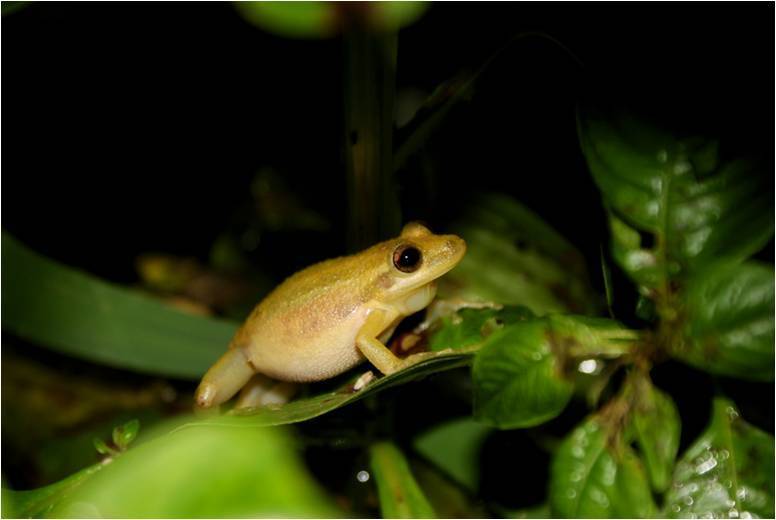
Crubixa Snouted Tree Frog
Scinax alter
Scinax alter, the Crubixa snouted treefrog, is a species of frog in the family Hylidae endemic to Brazil. Its natural habitats are subtropical or tropical moist shrubland, subtropical or tropical seasonally wet or flooded lowland grassland, swamps, intermittent freshwater lakes, freshwater marshes, intermittent freshwater marshes, pastureland, and ponds.
From the article Scinax alter on Wikipedia (CC BY-SA), quoted section by section
Description
The adult male frog measures 22.5 to 31.1 mm long in snout-vent length and the adult female frog 23.9–31.0 mm. Scientists distinguish this frog from related species by the bright white stripes, lined with dark brown, down the sides of its body. It also has a dark brown intraorbital blotch in the shape of an inverted triangle. It has small dark brown rostral stripes in front of its eyes. The insides of its back legs are lighter brown. The belly is yellow-brown. It has a slender body and protuberant eyes. It has vomerine teeth in its jaw. The tadpole is 22.9 to 32.0 mm long, with the tail.
Wikipedia: “Appearance”
Range & habitat
Its natural habitats are subtropical or tropical moist shrubland, subtropical or tropical seasonally wet or flooded lowland grassland, swamps, intermittent freshwater lakes, freshwater marshes, intermittent freshwater marshes, pastureland, and ponds. Most of these frogs live along the Atlantic Ocean in the east. Some of them live further away from the ocean in the Rio Doce valley in Minas Gerais. Others live higher up in the hills in Espírito Santo. They have been seen on arbustive plants near ponds in the edges of forests or open areas. They can live in habitats with sand dunes if there are tall enough plants growing in them. Scientists have noticed them both on the ground and in trees.
== References ==
Wikipedia: “Habitat”
Listen
Looking for field recordings…
Where it lives
Recorded sightings
—
geo-referenced records in GBIF, from museums, herbaria and field observers.
Drag the globe to turn it. Dots are where records exist, not a range map; darker means more records.
In the stacks
Searching the stacks…
Every page naming Scinax alter in the Biodiversity Heritage Library →
This page is assembled live from iNaturalist, GBIF, Wikipedia, the Source Library and the Internet Archive. It is not yet part of the hand-edited codex. iNaturalist taxon 24293.