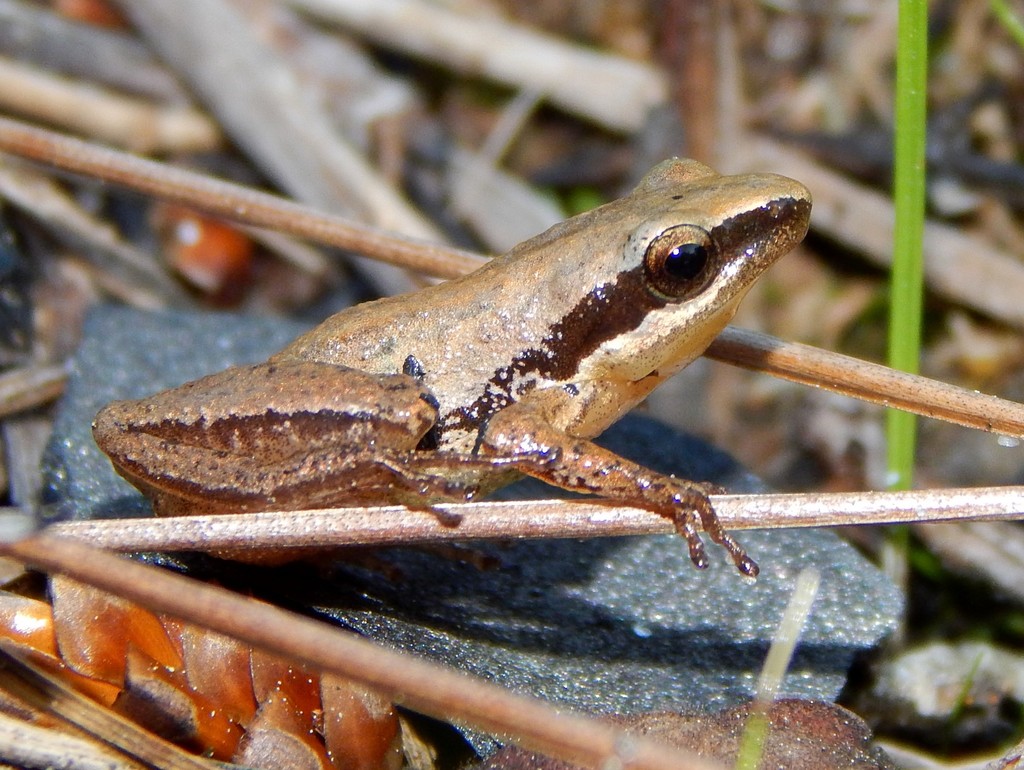
Little Grass Frog
Pseudacris ocularis
The little grass frog (Pseudacris ocularis) is a species of chorus frog endemic to the Southeastern United States. It is currently the smallest North American anuran and occurs in a wide variety of ephemeral and semi-permanent wetlands.
From the article Little grass frog on Wikipedia (CC BY-SA), quoted section by section
Description
P. ocularis is the smallest frog in North America, only reaching a maximum snout-vent-length of 18mm. It is normally pale brown, but can have a green or pink tinge. This species is further characterized by a variable dark stripe which runs through each of the frog's eyes and down the sides of its body. The Latin term ocularis translates to "of the eye" in reference to this bold ocular stripe.
Range & habitat
This species occurs in a wide variety of ephemeral and semi-permanent wetlands in the southeastern Coastal Plain and favors grassy areas in and around cypress ponds and similar sites. It seldom inhabits permanent ponds, but it still can. Its range spreads from the southernmost parts of Florida and Alabama to Virginia. This species can be used as an indicator of healthy wetlands. In urbanized wetlands P. ocularis is noticeably absent. It is commonly found on lower tree trunks and foliage up to a height of 1 metre (3 ft) or more; males prefer these sites as calling perches. However, they spend a considerable amount of their foraging time on the ground. This species possesses the ability to rotate its head and neck more than other frog species due to unusual flexibility in its vertebral column. This is thought to aid in searching for prey or looking for a more suitable perch before leaping. The majority of food items consist of arthropods that are associated with leaf litter and/or soil—springtails, ants, thrips, palpigrades, etc. There has been some recorded research showing that adults have fed on large cockroaches, walking sticks, and mites.
Wikipedia: “Habitat and feeding”
What it does
To gain a female's attention, males will remain perched on top of grass stems or tree trunks and call. This calling is most often compared to high insect-like chirps. P. ocularis The little Grass Frog breeds in shallow, fish free wetlands, including cypress domes, marshes, bogs, wet prairies, wet flatwoods, and floodplain forests. Generally breeding peaks in March and April, but can begin breeding in January in Florida. Females can generally reproduce more than once per annual cycle. The eggs will usually be laid on a pond bottom or vegetation in shallow water. Females lay an avergae of 100 eggs, but can lay up to 200 eggs with 1-5 eggs per cluster. Eggs take 1–2 days to hatch and larvae take 7–70 days to metamorphose. The average time to reach maturity is 7.31 days.
Wikipedia: “Reproduction”
Listen
Looking for field recordings…
Where it lives
Recorded sightings
—
geo-referenced records in GBIF, from museums, herbaria and field observers.
Drag the globe to turn it. Dots are where records exist, not a range map; darker means more records.
In the stacks
Searching the stacks…
Every page naming Pseudacris ocularis in the Biodiversity Heritage Library →
This page is assembled live from iNaturalist, GBIF, Wikipedia, the Source Library and the Internet Archive. It is not yet part of the hand-edited codex. iNaturalist taxon 24262.