- Animals
- ›Chordates
- ›Vertebrates
- ›Birds
- ›Rollers, Kingfishers, and Allies
- ›Kingfishers
- ›Tree Kingfishers
- ›Dacelo
On eBird ↗
Blue-winged Kookaburra
Live sightings near you, the range map, bar charts of when it is seen, and Macaulay Library photos and recordings.
Blue-winged Kookaburra
Dacelo leachii
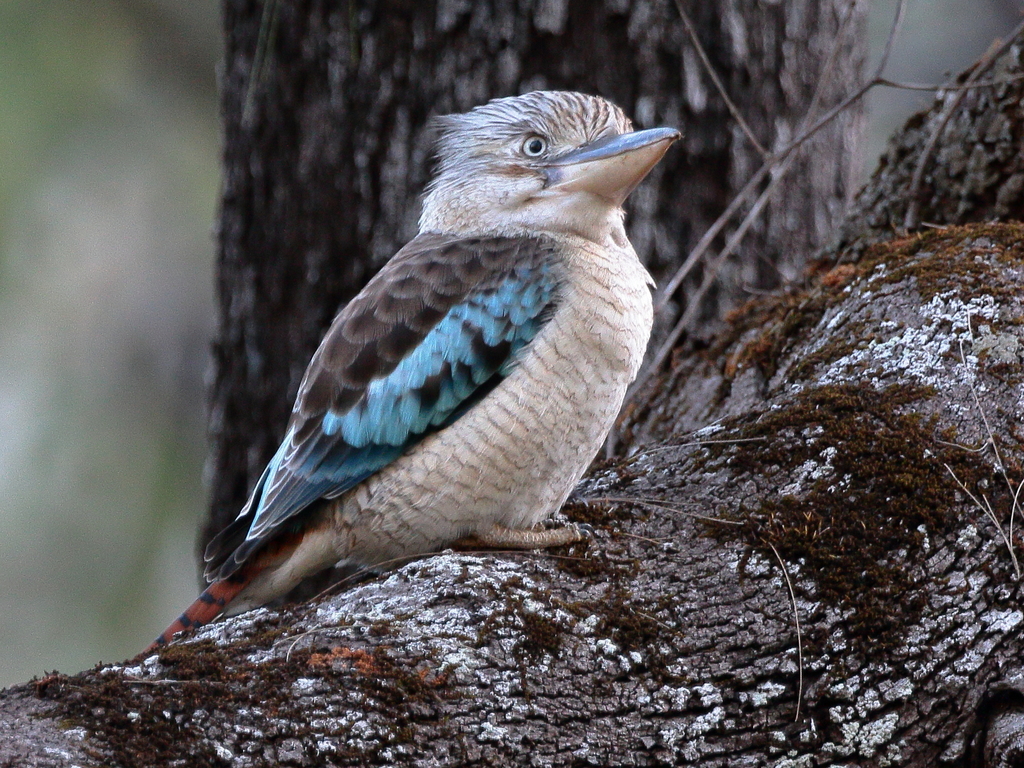
The blue-winged kookaburra (Dacelo leachii) is a large species of kingfisher native to northern Australia and southern New Guinea.
Measuring around 40 cm (16 in), it is slightly smaller than the more familiar laughing kookaburra. It has cream-coloured upper- and underparts barred with brownish markings. It has blue wings and brown shoulders and blue rump. It is sexually dimorphic, with a blue tail in the male, and a rufous tail with blackish bars in the female.
From the article Blue-winged kookaburra on Wikipedia (CC BY-SA), quoted section by section
Description
The adult blue-winged kookaburra measures around 38 to 42 cm (15 to 17 in) in length and weighs 260 to 330 g (9.2 to 11.6 oz). Compared to the related laughing kookaburra, it is smaller, lacks a dark mask, has more blue in the wing, and has striking white eyes. It has a heavier bill than its larger relative. The head and underparts are cream-coloured with brownish streaks. It is sexually dimorphic, with a blue tail in the male, and a rufous tail with blackish bars in the female. Immature birds have more prominent brown bars and marks in their plumage, giving a "dirty" appearance, and their eyes are predominantly brown for the first two years of life. Their call has been described as a maniacal cackling or barking.
Range & habitat
The blue-winged kookaburra has a distribution from southern New Guinea and the moister parts of northern Australia, to the vicinity of Brisbane in southern Queensland across the Top End, and as far down the Western Australian coast as the Shark Bay area. It does not occur between Broome and Port Hedland in northwestern Australia. Widespread and common throughout its large range, the blue-winged kookaburra is evaluated as of least concern on the IUCN Red List of Threatened Species. Found in family groups of up to 12 individuals, it lives in open savannah woodland and Melaleuca swamps, as well as farmlands such as sugarcane plantations.
Wikipedia: “Distribution and habitat”
What it does
The blue-winged kookaburra hunts and eats a great variety of animals that live on or close to the ground. In the summer wet season, insects, lizards and frogs make up a higher proportion of their diet, while they eat arthropods such as crayfish, scorpions, and spiders, as well as fish, earthworms, small birds and rodents at other times. They have even been recorded waiting for and snatching insects flushed out by bushfires.
Wikipedia: “Feeding”
Listen
Looking for field recordings…
Where it lives
Recorded sightings
—
geo-referenced records in GBIF, from museums, herbaria and field observers.
Drag the globe to turn it. Dots are where records exist, not a range map; darker means more records.
In the stacks
Searching the stacks…
Every page naming Dacelo leachii in the Biodiversity Heritage Library →
This page is assembled live from iNaturalist, GBIF, Wikipedia, the Source Library and the Internet Archive. It is not yet part of the hand-edited codex. iNaturalist taxon 2417.