- Animals
- ›Chordates
- ›Vertebrates
- ›Birds
- ›Rollers, Kingfishers, and Allies
- ›Kingfishers
- ›Tree Kingfishers
- ›Halcyon
On eBird ↗
Black-capped Kingfisher
Live sightings near you, the range map, bar charts of when it is seen, and Macaulay Library photos and recordings.
Black-capped Kingfisher
Halcyon pileata
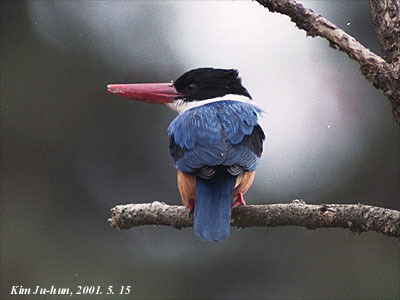
The black-capped kingfisher (Halcyon pileata) is a tree kingfisher which is widely distributed in tropical Asia from India east to China, Korea and Southeast Asia. This most northerly of the tree kingfishers is resident over much of its range, but northern populations are migratory, wintering south of their range in Sri Lanka, Thailand, Borneo and Java. It is distinctive in having a black cap that contrasts with the whitish throat, purple-blue wings and the coral red bill. The species is mainly found in coastal and mangrove habitats but can sometimes be found far inland.
From the article Black-capped kingfisher on Wikipedia (CC BY-SA), quoted section by section
Description
This kingfisher is about 28 centimetres (11 in) long. The adult has purple-blue wings and back, black head and shoulders, white neck collar and throat, and rufous underparts. The large bill and legs are bright red. In flight, large white patches or "mirrors" at the base of the primaries are visible on the blue and black wings. Sexes are similar, but juveniles are a duller version of the adult and show streaks on the throat. The call of this kingfisher is a cackling ki-ki-ki-ki-ki. Usually seen on coastal waters and especially in mangroves, it is easily disturbed. It perches conspicuously and dives to catch fish, and also feeds on large insects. The flight of the black-capped kingfisher is rapid and direct, the short rounded wings whirring. The breeding season is in summer. The nest is a tunnel in an earth bank. A single clutch of 4-5 round, white eggs is typical. A subspecies palawanensis has been described, but the species is considered to be monotypic with no clear plumage differences across its range.
Range & habitat
The species is found mainly near the coast in mangrove forests and along estuaries and rivers. The distribution ranges from India (including the Andaman and Nicobar Islands where they occur even on remote islands like Narcondam), Sri Lanka, Kansu, Shansi, Korea, Malay Peninsula, Thailand, Burma, Ryukyu Islands, Bangladesh, Hainan, Philippines (Palawan, Balabac, Basilan, Tawi Tawi), Borneo, Sumatra east to Sulawesi where it occurs only in winter. Vagrants in winter have been recorded in Pakistan, while movements related to rainfall may lead to their being found far inland and away from their usual distribution.
Wikipedia: “Distribution and habitat”
In human culture
Like many other kingfishers, this species was much sought for the blue feathers for use in the millinery trade. Feathers were used in making fans in China. In Hong Kong, their feathers were cut and glued over ornaments used by women.
== References ==
Wikipedia: “In culture”
Listen
Looking for field recordings…
Where it lives
Recorded sightings
—
geo-referenced records in GBIF, from museums, herbaria and field observers.
Drag the globe to turn it. Dots are where records exist, not a range map; darker means more records.
In the stacks
Searching the stacks…
Every page naming Halcyon pileata in the Biodiversity Heritage Library →
This page is assembled live from iNaturalist, GBIF, Wikipedia, the Source Library and the Internet Archive. It is not yet part of the hand-edited codex. iNaturalist taxon 2353.