- Fungi Including Lichens
- ›Ascomycete Fungi
- ›Sac Fungi and Lichens
- ›Common Lichens
- ›Shield Lichens, Sunburst Lichens, Rosette Lichens, and Allies
- ›Sunburst Lichens and Allies
- ›sunburst lichens, firedots, and allies
- ›Xanthorioideae
- ›Xanthomendoza
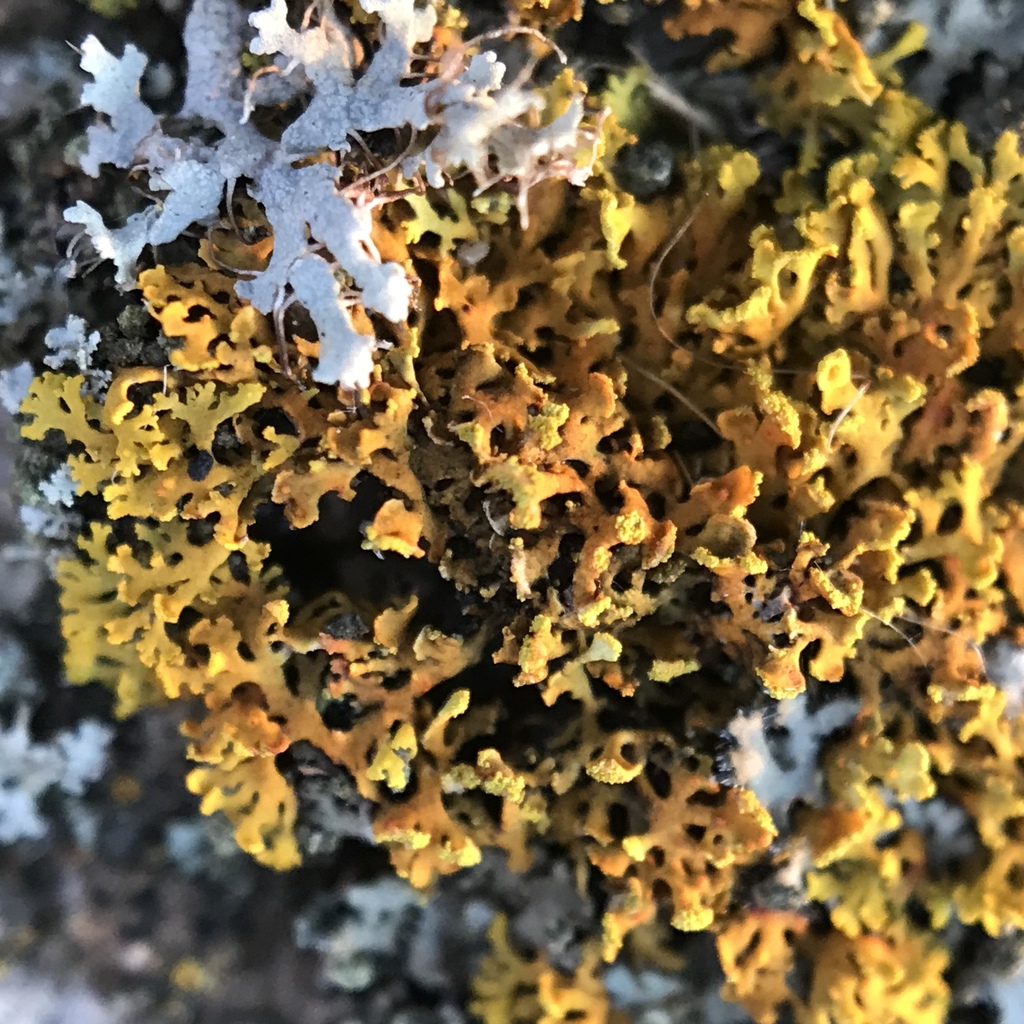
Bare-bottom Sunburst Lichen
Xanthomendoza weberi
Gallowayella weberi is a species of corticolous and saxicolous (bark- and rock-dwelling), foliose lichen in the family Teloschistaceae. Recorded from the eastern and central United States, it is a small lichen with a smooth yellow to orange upper surface and a contrasting white lower surface. It was previously placed in the genus Xanthomendoza and appears in older literature as Xanthomendoza weberi. Herbarium records indicate that it is widespread across the eastern and central United States, with its centre of distribution in the coastal plain of the Southeast, where it grows on bark, rock, and even concrete and other man-made surfaces.
From the article Gallowayella weberi on Wikipedia (CC BY-SA), quoted section by section
Description
Gallowayella weberi is a foliose lichen that forms small thalli up to 4 mm wide, which adhere to surfaces ranging from closely to somewhat loosely attached. The lobes of the thallus are flat, ranging from horizontal to slightly ascending, and measure between 0.3 and 0.5 mm in width. The tips of these lobes often curve inward, and the outermost parts of mature lobes are truncated or cut off squarely. The upper surface of Gallowayella weberi has a yellow to orange color and is smooth to the touch. Its lower surface contrasts with a white color. The cortex, or the outer layer of the lichen, is made of tightly packed cells and is colorless, except for the presence of external anthraquinone crystals, which are chemical compounds often found in lichens. The photobiont (photosynthetic partner) is a unicellular green alga from the genus Trebouxia. The medulla, which is the inner tissue beneath the cortex, has a net-like structure made of short cells. Rhizines, which are root-like structures helping the lichen to anchor to its substrate, are mostly present and are white in color, turning yellow when exposed. They can be either attached to the substrate or free. …
Range & habitat
Gallowayella weberi can grow on diverse substrates including bark and rock, as well as on artificial ones such as concrete and tombstones. It is native to North America, and herbarium-based mapping indicates that it is widespread across the eastern and central United States, with its centre of distribution in the coastal plain of the southeastern United States. At the Delaware locality originally used to describe Xanthomendoza rosmarieae, the lichen was abundant on roadside plantings of Norway maple (Acer platanoides).
Wikipedia: “Habitat and distribution”
What it does
Tremella xanthomendozae is a lichenicolous fungus that infects Gallowayella weberi (it was named when its host was classified in genus Xanthomendoza).
== References ==
Wikipedia: “Species interactions”
Where it lives
Recorded sightings
—
geo-referenced records in GBIF, from museums, herbaria and field observers.
Drag the globe to turn it. Dots are where records exist, not a range map; darker means more records.
In the stacks
Searching the stacks…
Every page naming Xanthomendoza weberi in the Biodiversity Heritage Library →
This page is assembled live from iNaturalist, GBIF, Wikipedia, the Source Library and the Internet Archive. It is not yet part of the hand-edited codex. iNaturalist taxon 233685.