- Fungi Including Lichens
- ›Ascomycete Fungi
- ›Sac Fungi and Lichens
- ›Common Lichens
- ›rocktripes, bloodspot lichens, and allies
- ›rocktripes, bloodspot lichens, and allies
- ›Rocktripes, Toadskin Lichens, and allies
- ›Umbilicaria
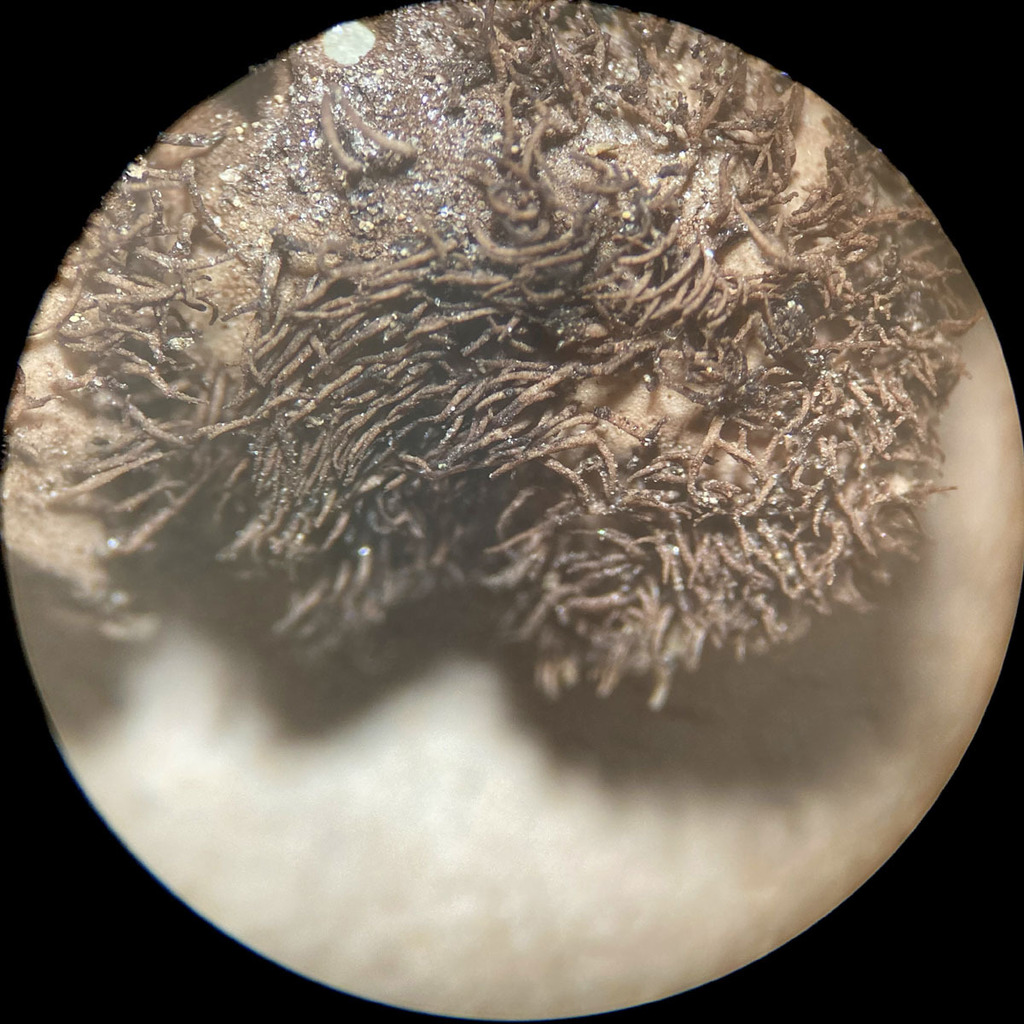
Granulating Rocktripe Lichen
Umbilicaria hirsuta
Umbilicaria hirsuta is a species of rock-dwelling, foliose (leafy) lichen in the family Umbilicariaceae, known in North America as the granular rock tripe. The species was first published in 1793 by Johan Peter Westring, who credited Olof Swartz for the name and noted that the lichen could be used as a dye source. The species was later transferred to the genus Umbilicaria by Erik Acharius. In Europe it has been treated as part of a complex of closely similar taxa, including U. grisea and U. freyi, which differ in thallus anatomy and the type of vegetative propagules they produce.
The thallus is typically 2 to 5 cm (0.8 to 2.0 in) across, grey to brownish grey, and attached to the rock at a single central point; its underside bears dark, root-like rhizinomorphs, and the margins often produce powdery vegetative propagules. The main secondary metabolite is gyrophoric acid, detected by a red reaction with the C spot test. Umbilicaria hirsuta grows on siliceous rock across much of Europe and North America, from the Arctic to Mexico and from the Iberian highlands to the Scottish Highlands, and has also been recorded from Mongolia, but records are scattered and it is seldom common. It tolerates drying and cold; experiments suggest that ribitol helps sustain photosynthesis at sub-zero temperatures, and that the species is sensitive to some pollutants, including fluoranthene.
From the article Umbilicaria hirsuta on Wikipedia (CC BY-SA), quoted section by section
Description
The thallus of Umbilicaria hirsuta typically spans 2 to 5 cm (0.8 to 2.0 in) across. Thalli may occur singly or in small clusters. The lobe edges often curve downward and may be smooth and rounded or jagged and torn. The upper surface is grey to brownish grey, finely cracked, and often becomes areolate as it breaks down into diffuse powdery propagules near and on the margins. The sparse, powdery to granular vegetative propagules are usually not grouped into discrete soralia and can therefore be easy to overlook. In the European U. hirsuta group these propagules have been interpreted as "parasoredia" because they arise from fragmentation of the algal-bearing upper thallus layer rather than from undifferentiated medulla. The underside of Umbilicaria hirsuta ranges from pale brown to black, generally becoming darker towards the centre. The underside may be smooth or have small wart-like protrusions, and it typically bears numerous dark brown to black, root-like rhizinomorphs. Fruiting bodies (apothecia) are uncommon. When present, they are small (0.5–2 mm in diameter) and may be slightly depressed or raised on the thallus surface. They are flat but may appear wrinkled or convoluted, and are sometimes encircled by soralia (clusters of soredia). …
Range & habitat
In North America, Umbilicaria hirsuta is sporadic from the Arctic to Mexico and appears to be rare throughout its range. It grows on non-calcareous rock, especially on sheltered rock faces in forested or semi-open areas, and is rare in the Pacific Northwest. Kofranek and McCune reported the species from Oregon for the first time in 2008, finding it on a non-calcareous igneous rock outcrop in the Siskiyou Mountains, where it grew on vertical rock faces in filtered light under partial forest canopy cover. Later fieldwork in southwestern Oregon found additional populations on very large boulders and rock outcrops at open, high-elevation sites in the Cascade–Siskiyou region, typically on underhangs or along trickle lines; the same study reported collections from northern and central California and summarized several older records from southern California. In Montana, it has been recorded several times beginning with an initial report from Glacier National Park, and more recently from an old fibreglass travel trailer in western Montana, where it colonized the sheltered side alongside other lichen species. In the Iberian Peninsula, Umbilicaria hirsuta is chiefly a lichen of higher elevations, occurring mainly from the upper supramediterranean belt (the cooler upland zone above the lowland Mediterranean belt) upward, or from the montane belt in the Pyrenees and Cantabrian Mountains. …
Wikipedia: “Habitat and distribution”
What it does
Umbilicaria hirsuta can survive periods of desiccation (drying out). As the thallus loses water, its spectral reflectance — the way it reflects light — increases across wavelengths, with the largest changes in the visible spectrum. Water-related reflectance indices, including the water index and the normalized difference vegetation index, track changes in thallus water status such as water potential and water saturation deficit. This relationship suggests that remote sensing techniques could be used to monitor how hydrated thalli are in the field without direct sampling. The species can also maintain photosynthesis in cold environments. At low temperatures, photosynthetic electron transport is supported in part by ribitol, a sugar alcohol that acts as a cryoprotective compound — it helps stabilize cellular structures when the thallus dehydrates or freezes. In experiments at −5 °C (23 °F), adding ribitol improved the potential quantum yield of photosystem II (Fv/Fm) and reduced non-photochemical quenching, both signs that the photosynthetic machinery was functioning more efficiently under stress. Together, these traits allow U. hirsuta to remain metabolically active in cold climates, including high mountain and polar regions. Laboratory exposure experiments suggest sensitivity to some pollutants. …
Wikipedia: “Ecology”
Where it lives
Recorded sightings
—
geo-referenced records in GBIF, from museums, herbaria and field observers.
Drag the globe to turn it. Dots are where records exist, not a range map; darker means more records.
In the stacks
Searching the stacks…
Every page naming Umbilicaria hirsuta in the Biodiversity Heritage Library →
This page is assembled live from iNaturalist, GBIF, Wikipedia, the Source Library and the Internet Archive. It is not yet part of the hand-edited codex. iNaturalist taxon 233245.