- Fungi Including Lichens
- ›Ascomycete Fungi
- ›Sac Fungi and Lichens
- ›Common Lichens
- ›rocktripes, bloodspot lichens, and allies
- ›rocktripes, bloodspot lichens, and allies
- ›Rocktripes, Toadskin Lichens, and allies
- ›Umbilicaria
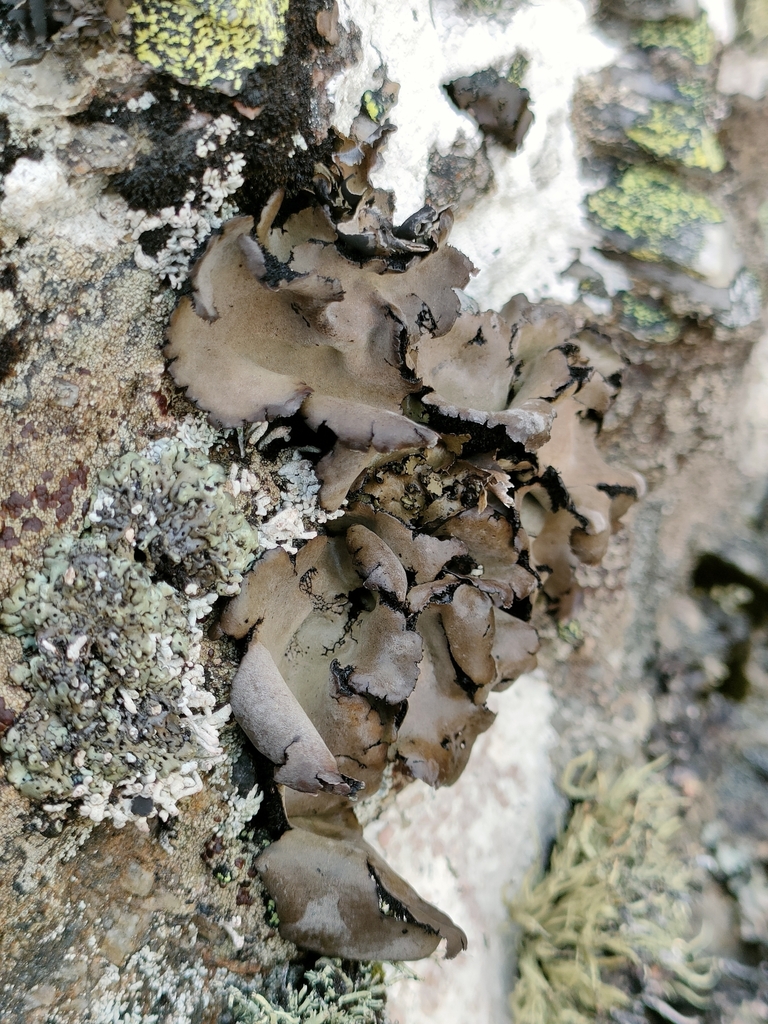
Tentacled Rocktripe Lichen
Umbilicaria aprina
Umbilicaria aprina is a species of foliose lichen in the family Umbilicariaceae. It is primarily found on exposed boulders in high alpine and polar regions worldwide.
From the article Umbilicaria aprina on Wikipedia (CC BY-SA), quoted section by section
Description
The thallus of Umbilicaria aprina is single-leaved (monophyllous), shield-shaped (peltate), and rigid, measuring up to 6 cm (2.4 in) in diameter. The upper surface is light grey, typically featuring radiating ridges from the central, elevated point known as the umbo. The lower surface is predominantly sooty black with a light grey rim about 2–3 mm wide along the margins. This lower surface is covered with single-celled reproductive propagules known as thalloconidia and adorned with white rhizinomorphs—root-like extensions that are unbranched or sparsely branched and densely populate the rim. Reproductive structures (apothecia) are rare, black, and may be up to 2.5 mm in diameter.
Range & habitat
Umbilicaria aprina is commonly found in the high alpine regions near glaciers and is present worldwide, including extreme arctic and Antarctic areas. Although it is not commonly found in the Andes, it exists throughout the mountain range. The species grows on boulders in these cold, exposed environments, which helps it avoid competition and survive in harsh conditions.
== References ==
Wikipedia: “Habitat and distribution”
Where it lives
Recorded sightings
—
geo-referenced records in GBIF, from museums, herbaria and field observers.
Drag the globe to turn it. Dots are where records exist, not a range map; darker means more records.
In the stacks
Searching the stacks…
Every page naming Umbilicaria aprina in the Biodiversity Heritage Library →
This page is assembled live from iNaturalist, GBIF, Wikipedia, the Source Library and the Internet Archive. It is not yet part of the hand-edited codex. iNaturalist taxon 233237.