- Fungi Including Lichens
- ›Ascomycete Fungi
- ›Sac Fungi and Lichens
- ›Common Lichens
- ›Shield Lichens, Sunburst Lichens, Rosette Lichens, and Allies
- ›Peltigerales
- ›Peltigeraceae
- ›Solorina
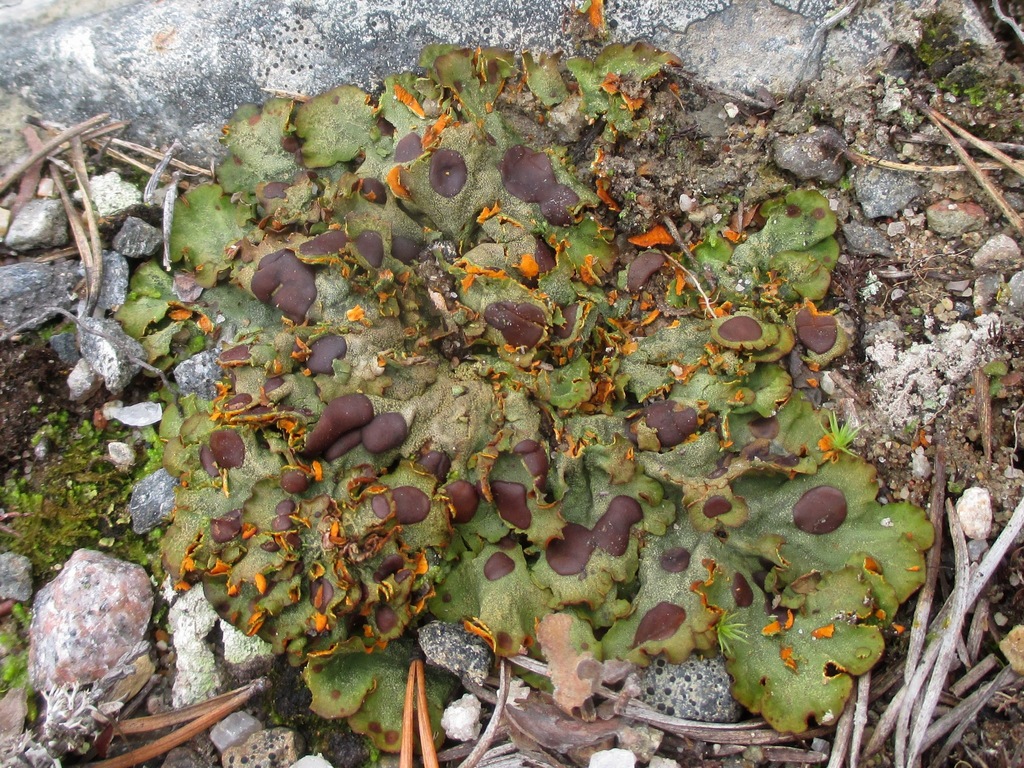
Chocolate Chip Lichen
Solorina crocea
Solorina crocea, commonly known as the orange chocolate chip lichen, is a species of terricolous (ground-dwelling) and foliose (leafy) lichen in the family Peltigeraceae. The lichen, which was first formally described by Carl Linnaeus in 1753, has an arctic–alpine and circumpolar distribution and occurs in Asia, Europe, North America, and New Zealand. It generally grows on the bare ground in sandy soils, often in moist soil near snow patches or seepage areas. Although several forms and varieties of the lichen have been proposed in its history, these are not considered to have any independent taxonomic significance.
The colouration of Solorina crocea is quite distinct, making it readily identifiable: its upper thallus surface is green, while both the undersurface and its internal medulla are bright orange. The orange colour results from a pigment called solorinic acid, one of several secondary compounds that occur in the lichen. The thallus features dark brown discs, usually sunken into the surface, which are apothecia–where spores are produced. The lichen has both blue-green algae and green algae as symbiotic partners (photobionts); they are organized into separate layers in the lichen thallus.
From the article Solorina crocea on Wikipedia (CC BY-SA), quoted section by section
Description
The foliose thallus of Solorina crocea forms large rosettes comprising thick, rounded lobes; it typically measures up to 6 cm (2+3⁄8 in) broad, although measurements up to 10 cm (4 in) have been recorded. It is usually tightly pressed to its growing surface. The lobes comprising the thallus are 5–15 mm (3⁄16–9⁄16 in) wide with slightly upturned edges; their outline varies from irregular to rounded. The upper thallus surface, when moist, is olive green; in less hydrated conditions it becomes reddish brown. The lower thallus surface is bright orange with a tomentose texture and a somewhat reticulate pattern of brownish veins. Lacking a cortex (an outer layer of compacted hyphae), it resembles a mat of orange-coloured, entangled threads. The medulla is orange. Isidia and soredia are absent. The distinctive colouration of the upper and lower surface make this lichen readily identifiable, although in the field the colour difference may not be easy to discern if the lichen is tightly attached to its substrate. The brown to reddish-brown apothecia measure 2–10 mm (1⁄16–3⁄8 in) in diameter. They are either more or less level with the cortex or somewhat convex, rather than in concave depressions, as is the case with some other Solorina species. The photobiont partners of Solorina crocea are arranged in two distinct layers in the thallus. …
Range & habitat
In North America its range extends from polar regions in alpine to subalpine habitats south to California and New Mexico. European countries in which the lichen has been recorded include Andorra, Austria, Bulgaria, Spain, Iceland, and Finland. In the UK, it occurs in the Scottish Highlands, and it is represented by a single record from Ireland. Its distribution in Italy is limited to the high-altitude Alps and the northern Apennines. In India, it is known from the Himalayas regions (Himachal Pradesh and Sikkim). Its range extends to the Eastern Himalayas, as it has been recorded from Xizang in Tibet at an altitude of 4,820 m (15,810 ft). In New Zealand, it has been collected from Mount Peel at an altitude of 1,350 m (4,430 ft). Recorded habitats for the lichen include boulder fields, leached windswept ridges, and areas of solifluction. In Iceland, Solorina crocea occurs in Salix herbacea snowbeds and north-facing slopes with abundant grasses and sedges. Generally, the lichen occurs on the bare ground in sandy soil. It grows in soils that are both acid-rich and base-rich as a result of seepage from late-lying snow patches.
Wikipedia: “Habitat and distribution”
What it does
Solorina crocea is often infected by Rhagadostoma lichenicola, a lichenicolous (lichen-dwelling) fungus. Infection results in the appearance of crowded blackish ascomata on the upper surface of the host thallus and a highly branched, dark mycelium below the fruitbodies. Its presence does not seem to affect the fertility of the lichen, suggesting that the fungus requires the function and integrity of the host to remain intact. The abundance of certain strains in the associated bacterial community of the lichen has been shown to be altered by the fungal infection. Bacteria normally associated with the lichen include members of the phyla Acidobacteriota, Planctomycetota, and Proteobacteria. Another lichenicolous fungus, Talpapellis solorinae, was described as a new species in 2015 from collections made in North Caucasus; it does not cause distinct damage to the infected host thallus. Other fungi that have been recorded infecting Solorina crocea include Arthonia peltigerina, Cercidospora punctillata, Corticifraga peltigerae, Cercidospora lichenicola, Pyrenidium actinellum, Stigmidium croceae, Protothelenella croceae, Thelocarpon epibolum, and Pronectria robergei. Infection by Stigmidium solorinarium results in the appearance of minute perithecia, while infection by Scutula tuberculosa will result in greyish to black lecideine apothecia.
Wikipedia: “Species interactions”
Where it lives
Recorded sightings
—
geo-referenced records in GBIF, from museums, herbaria and field observers.
Drag the globe to turn it. Dots are where records exist, not a range map; darker means more records.
In the stacks
Searching the stacks…
Every page naming Solorina crocea in the Biodiversity Heritage Library →
This page is assembled live from iNaturalist, GBIF, Wikipedia, the Source Library and the Internet Archive. It is not yet part of the hand-edited codex. iNaturalist taxon 231135.