- Animals
- ›Chordates
- ›Vertebrates
- ›Ray-finned Fishes
- ›Spiny-rayed fishes
- ›Perches, Scorpionfishes, Sticklebacks, and Allies
- ›Scorpionfishes and Allies
- ›Scorpionfishes
- ›Rockfishes
- ›Sebastes
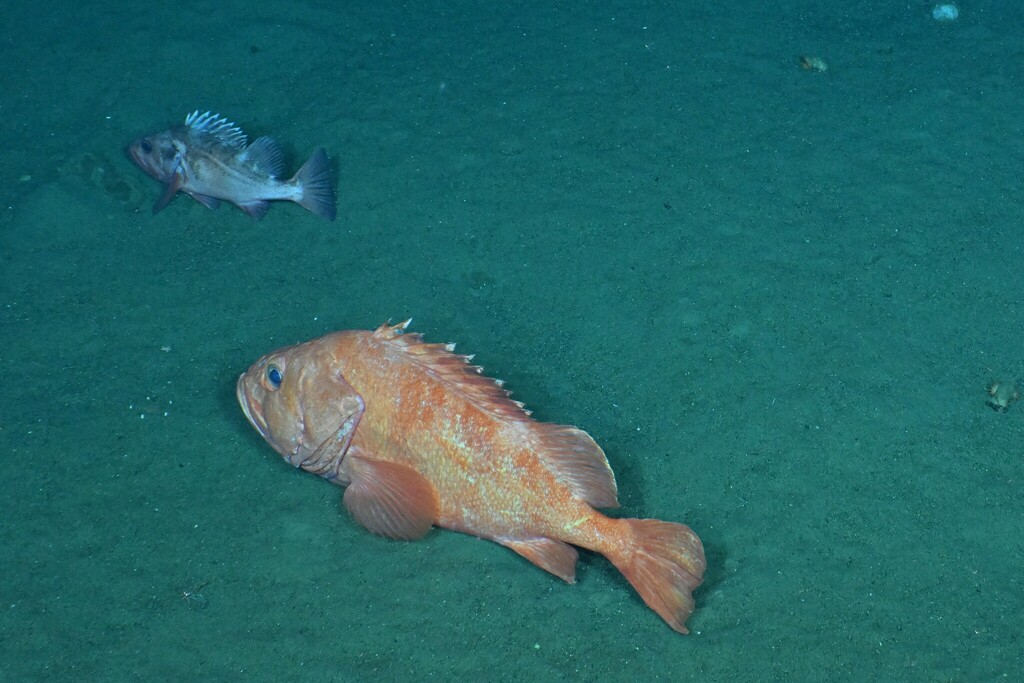
Shortraker Rockfish
Sebastes borealis
Shortraker rockfish (Sebastes borealis) is an offshore, demersal species distributed from the southeastern Kamchatka Peninsula, Russia, to Fort Bragg, California. It attains lengths greater than one metre (>39 inches) and weighs up to 20 kg (44 pounds). In the Gulf of Alaska, shortraker rockfish are sampled annually during longline surveys and are most abundant between depths of 300–400 metres (980–1,310 ft).
From the article Shortraker rockfish on Wikipedia (CC BY-SA), quoted section by section
Description
The shortraker rockfish is pale pink, pinkish-orange or red marked with blotches and saddles. Each of the fins have some black coloration and the dorsal fin may have white tips to the spines. They have a red mouth, which may have black blotches. When captured, their color darkens. They get their name from their stubby gill rakers, which are tipped with little nobs. They have large pores on their lower jaw. The dorsal fin has 13 spines and 13 soft rays while the anal fin has 3 spines and 7 soft rays, The spines on the head may be moderately sized or large and the spines present are the nasal, preocular, supraocular, postocular, tympanic, parietal and nuchal spines although they may or may not be coronal spines. They have no more than 2 spines below the eye. The caudal fin is slightly concave. The shortraker rockfish is the largest species in the genus Sebastes and the maximum reported total length is 120 cm (47 in)>
Range & habitat
The shortraker rockfish is distributed from the southeastern Kamchatka Peninsula, Russia, to Fort Bragg, California. It attains lengths greater than one metre (>39 inches) and weighs up to 20 kg (44 pounds). In the Gulf of Alaska, shortraker rockfish are sampled annually during longline surveys and are most abundant between depths of 300–400 metres (980–1,310 ft). It is a bathydemersal species found over soft substrates.
Wikipedia: “Distribution and habitat”
Where it lives
Recorded sightings
—
geo-referenced records in GBIF, from museums, herbaria and field observers.
Drag the globe to turn it. Dots are where records exist, not a range map; darker means more records.
In the stacks
Searching the stacks…
Every page naming Sebastes borealis in the Biodiversity Heritage Library →
This page is assembled live from iNaturalist, GBIF, Wikipedia, the Source Library and the Internet Archive. It is not yet part of the hand-edited codex. iNaturalist taxon 230754.