- Animals
- ›Chordates
- ›Vertebrates
- ›Amphibians
- ›Frogs and Toads
- ›Southern Frogs
- ›Leptodactylinae
- ›Leptodactylus
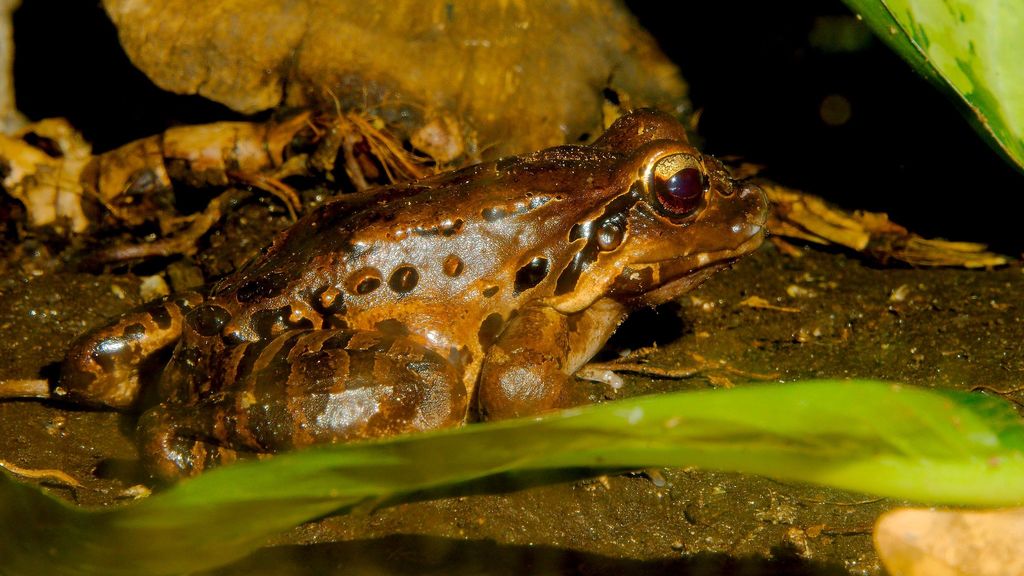
Mountain Chicken
Leptodactylus fallax
Leptodactylus fallax, commonly known as the mountain chicken or giant ditch frog, is a critically endangered species of frog that is native to the Caribbean islands of Dominica and Montserrat. The population declined by at least 80% from 1995 to 2004, with further significant declines later. A tiny wild population remains on Dominica where there are efforts to preserve it, but few or none survive in the wild on Montserrat and its survival now relies on a captive breeding project involving several zoos. The initial decline was linked to hunting for human consumption, along with habitat loss and natural disasters, but the most serious threat now appears to be the fungal disease chytridiomycosis, which was the primary cause of the most recent rapid decline. On Montserrat it is known as the mountain chicken, while on Dominica it is known as the crapaud, which simply means "toad" in French.
From the article Leptodactylus fallax on Wikipedia (CC BY-SA), quoted section by section
Description
The mountain chicken is one of the largest frogs in the world, the largest in its family Leptodactylidae, and the largest frog native to the Caribbean. It can reach 1 kg (2.2 lb) in weight and up to 22 cm (8.7 in) in snout–to–vent length, although a more typical adult size is 17–18 cm (6.7–7.1 in). Females tend to be larger than males. It is highly variable in color, with the upperparts varying from a uniform chestnut-brown to being barred or spotted. The color becomes more orange-yellow on the sides of the body, and pale yellow on the underparts. A black line runs from the snout to the angle of the mouth, and the upper-legs often have broad banding. The mountain chicken also has a distinctive, dark-outlined fold from the back of the head to the groin, and large, conspicuous eyes with dark pupils and a golden iris. The body is robust, with a large head and well-muscled legs. The male mountain chicken may be distinguished from the female by its smaller size, and by the black spur on each of its thumbs, which are used to clasp the female during amplexus (the mating embrace).
Range & habitat
The mountain chicken was once found on many of the Lesser Antillean islands in the eastern Caribbean, but is now restricted to just Dominica and Montserrat. It once occurred in certain places, including Guadeloupe, Martinique, Saint Kitts, and Nevis, but is now extirpated there and may also have inhabited Saint Lucia and Antigua. There was an unsuccessful attempt to introduce it to Jamaica and Puerto Rico (where it is not native). In the early 2000s, the mountain chicken was largely restricted to the Centre Hill of northern Montserrat, having been lost from much of the rest of the island by recent volcanic eruptions, and on the western side of Dominica. It is also found on the eastern side of Dominica, but the species origin there is unclear and it may have been introduced to the area. The mountain chicken is found in a variety of moist habitats, including dense secondary forest and scrub, hillside plantations, palm groves in river valleys, ravines, and flooded forest. It is most commonly found near streams and springs, and is rarely found in grasslands. On Dominica, it was most abundant at lower altitudes, although it occurs up to 400 m (1,300 ft), and was found up to 430 m (1,410 ft) on Montserrat.
Wikipedia: “Distribution and habitat”
What it does
The mountain chicken is terrestrial and nocturnal. A sit-and-wait predator with a voracious appetite, this frog consumes almost anything that can be swallowed whole. It is well camouflaged in its habitat and remains still for long periods before ambushing its prey, usually at night. Its diet is varied, but it is strictly carnivorous, largely consuming crickets and other insects, although millipedes, crustaceans, spiders (including tarantulas) and even small vertebrates, such as other frogs, snakes and small mammals such as bats, are all eaten. Despite its willingness to eat other frogs, except for consuming unfertilized eggs, cannibalism is not known from the mountain chicken. During the day, the mountain chicken frog resides in burrows, which it digs into moist soil.
Breeding. The mountain chicken has a highly unusual method of reproduction, as unlike most other amphibians which breed in water, this frog breeds in burrows around 50 cm (20 in) deep. The breeding season starts towards the end of the dry season, usually in April when there are heavy seasonal showers, and continues to August or September. At the start of this period, the male frogs compete to gain access to preferred nesting sites by wrestling and making loud 'whooping' calls from forest paths and undergrowth clearings. The winning male occupies a nesting burrow and emits 'trilling barks' to attract a female mate. …
Wikipedia: “Behavior and ecology”
In human culture
The mountain chicken is nicknamed thus because it is preyed upon and considered a local delicacy on the islands of Montserrat and Dominica, where it is found. It supposedly tastes like chicken.
Wikipedia: “Etymology”
Listen
Looking for field recordings…
Where it lives
Recorded sightings
—
geo-referenced records in GBIF, from museums, herbaria and field observers.
Drag the globe to turn it. Dots are where records exist, not a range map; darker means more records.
In the stacks
Searching the stacks…
Every page naming Leptodactylus fallax in the Biodiversity Heritage Library →
This page is assembled live from iNaturalist, GBIF, Wikipedia, the Source Library and the Internet Archive. It is not yet part of the hand-edited codex. iNaturalist taxon 22982.