- Fungi Including Lichens
- ›Ascomycete Fungi
- ›Sac Fungi and Lichens
- ›Common Lichens
- ›Shield Lichens, Sunburst Lichens, Rosette Lichens, and Allies
- ›shield lichens, rim lichens, and allies
- ›Ramboldiaceae
- ›Ramboldia
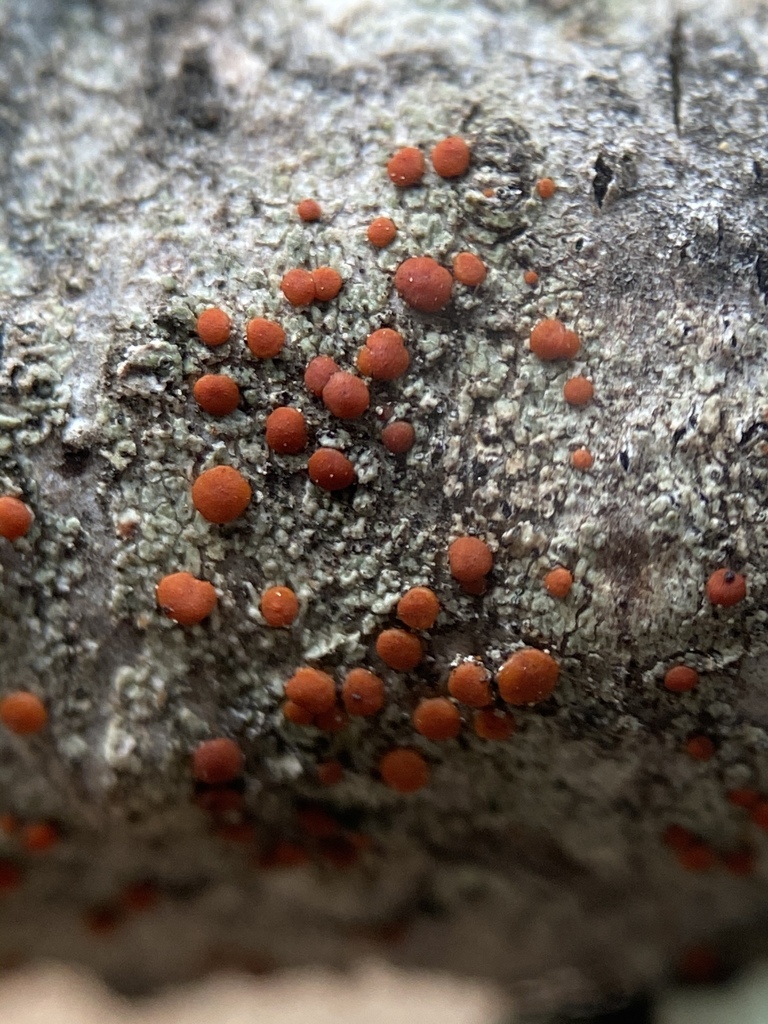
Ramboldia gowardiana
Ramboldia gowardiana is a species of corticolous (bark-dwelling), crustose lichen in the family Ramboldiaceae. First discovered in 2003 in Montana, United States, it typically appears as a grayish or greenish crust on tree bark, particularly on conifers like pines and firs. The lichen is characterised by its small, bright red to orange-red reproductive structures (apothecia) visible on its surface. R. gowardiana is found in dry, temperate forests from Alaska to California, often at elevations between 300 and 1,400 meters (about 980 to 4,600 feet). Initially classified in a different genus, it was reclassified as Ramboldia in 2008 based on genetic studies. This lichen is part of the biodiversity of the Pacific Northwest region of North America.
From the article Ramboldia gowardiana on Wikipedia (CC BY-SA), quoted section by section
Description
Ramboldia gowardiana has a crust-like thallus, which can range in color from grey and greyish olive to greenish-grey and whitish, particularly near the edges. The thallus is typically cracked and divided into small, irregular sections (rimose-areolate) and can be somewhat warty (verruculose or verrucose), though it is rarely smooth. The thallus lacks reproductive structures like soredia and isidia, which are common in many other lichens. Sometimes, a hypothallus—a layer beneath the main body—can be seen, with a dark reddish-brown to blackish colour. The thickness of the thallus varies widely, ranging from 100 to 1,000 μm. The lichen contains a green algal partner (photobiont) of the trebouxioid type, with cells that are typically spherical or slightly oval, measuring between 6 and 26 μm in diameter. Ramboldia gowardiana produces numerous apothecia, the fruiting bodies that produce spores. These apothecia are small, ranging from 0.2 to 2.5 mm in diameter, and can be found either individually or in clusters that merge to form small mounds. The apothecia are red to deep orange-red, with a matt surface that can be flat to strongly convex. …
Range & habitat
Ramboldia gowardiana is found in dry, temperate forests, predominantly growing on the bark of twigs and branches of conifers at elevations ranging from 300 to 1,400 meters. This lichen species is commonly associated with trees like Pseudotsuga menziesii (Douglas-fir), Larix occidentalis (western larch), Pinus contorta (lodgepole pine), Pinus ponderosa (ponderosa pine), and Picea engelmannii (Engelmann spruce) in inland areas. In Oregon and California, it also occurs on Abies procera (noble fir) and Pinus attenuata (knobcone pine). In northwestern Montana, R. gowardiana can be particularly abundant on the bark of Larix occidentalis branches and fine twigs, though it also grows on other conifers such as Abies grandis (grand fir), Abies lasiocarpa (subalpine fir), and Pinus monticola (western white pine), and rarely on Acer glabrum (Rocky Mountain maple). The lichen typically thrives in dry woodlands with low snow cover, short snow seasons, and warm, low-precipitation summers. …
Wikipedia: “Habitat and distribution”
Where it lives
Recorded sightings
—
geo-referenced records in GBIF, from museums, herbaria and field observers.
Drag the globe to turn it. Dots are where records exist, not a range map; darker means more records.
In the stacks
Searching the stacks…
Every page naming Ramboldia gowardiana in the Biodiversity Heritage Library →
This page is assembled live from iNaturalist, GBIF, Wikipedia, the Source Library and the Internet Archive. It is not yet part of the hand-edited codex. iNaturalist taxon 229804.