- Fungi Including Lichens
- ›Ascomycete Fungi
- ›Sac Fungi and Lichens
- ›Common Lichens
- ›Shield Lichens, Sunburst Lichens, Rosette Lichens, and Allies
- ›shield lichens, rim lichens, and allies
- ›bushy lichens, sea-fog lichens, and allies
- ›Ramalina
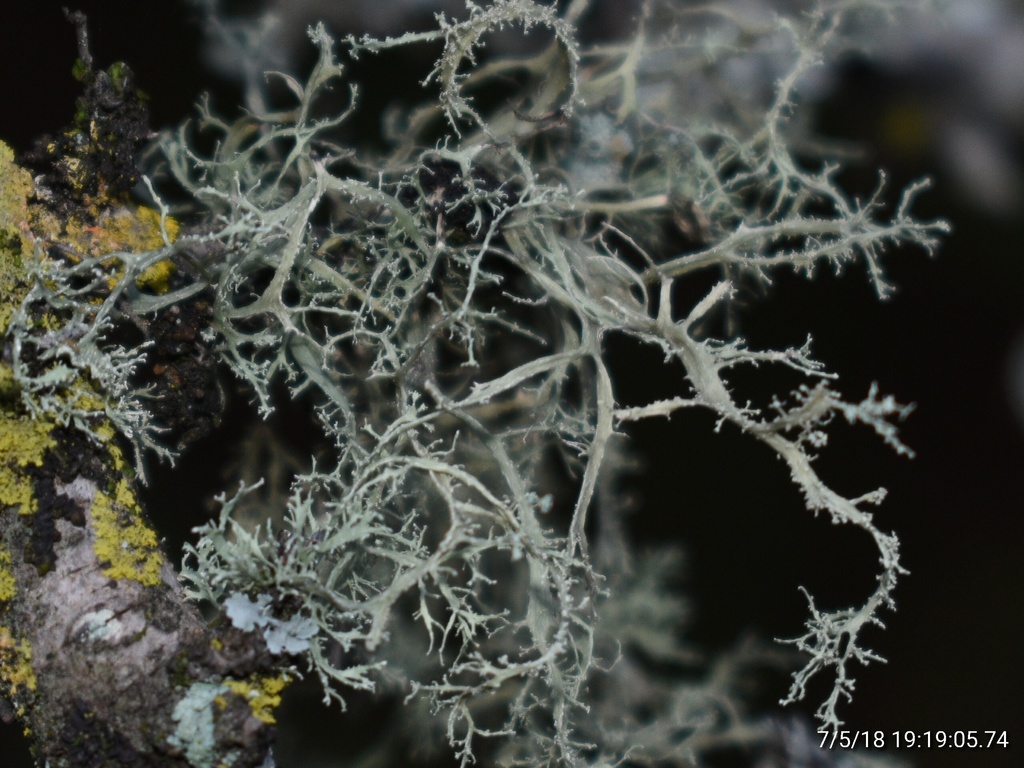
Quipu Lichen
Ramalina peruviana
Ramalina peruviana is a species of fruticose lichen in the family Ramalinaceae with a pantropical distribution. The lichen was first formally described by Erik Acharius in 1810, who wrote of its flat, compressed, branching thallus with narrow, undulating branches. It typically occurs on the bark of trees (corticolous) although occasionally it grows on rocks (saxicolous). Ramalina peruviana is widely distributed, found in subtropical and warm temperate regions across several continents. It has been recorded in diverse locations such as Pacific Islands, the southern United States, East Africa, Asia, Australasia, and South America. Its presence has been documented in specific habitats like mangroves in Australia and on certain tree species in Taiwan and China, where it thrives at higher elevations.
The lichen has an intricately branched and tufted thallus, greyish-green to yellowish-green in colour. The branches are rounded or irregularly thickened, and dotted with soralia (granular reproductive particles). Occasionally, the thallus surface has tiny pores for air exchange, known as pseudocyphellae. Apothecia (fruiting bodies) are rarely made by this species. Ramalina peruviana contains several secondary metabolites (lichen products), and a few novel chemicals have been isolated and identified from this lichen.
From the article Ramalina peruviana on Wikipedia (CC BY-SA), quoted section by section
Description
Ramalina peruviana has a thallus whose colour ranges from a grey-green to yellow-green hue, forming tufted, erect to slightly hanging clusters that can extend from 2 to 6 cm (13⁄16 to 2+3⁄8 in) in length, and up to about 3 cm (1+3⁄16 in) high. The branching of this lichen is intricate, varying from nearly symmetrical divisions (subdichotomous) to more irregular formations, with branches measuring between 0.15 and 1.3 mm in width. These branches may present as flat, nearly round (subterete), or round (terete) in cross-section, and can sometimes twist slightly, ending in sharp tips. The chondroid tissue (i.e., in cartilage-like central core of the branches) of Ramalina peruviana is not cracked. The cortex measures 15–20 μm thick. The surface texture of Ramalina peruviana can be either matt or shiny and varies from smooth to wrinkled (rugose), with pseudocyphellae—small, porous areas that allow gas exchange—occasionally present. The base of the lichen, or holdfast, may be clearly defined or spread out, especially in denser colonies. One of the distinguishing features of this species is the presence of soralia, which are small structures that produce powdery reproductive particles. These soralia are dot-like (punctiform) and can be found along the edges or at the tips of the branches, often giving rise to tiny fibrils. …
Range & habitat
The distribution of Ramalina peruviana extends into subtropical and warm temperate locations. Although typically corticolous (bark-dwelling), it is also known to occasionally grow on rocks (saxicolous), and was once recorded on a wooden fence post. In addition to its country of origin in Peru, the lichen has also been recorded from Africa, Australia, several Pacific Islands, Tristan da Cunha, and Saint Helena. Other South American countries that have recorded the presence of Ramalina peruviana are Brazil, Chile, Ecuador, and Uruguay. It occurs in several of the Cape Verde islands. Its distribution in North America extends north to the southern United States, including central Texas, Georgia, and Florida. Its East African range includes Kenya, Tanzania, and Uganda. It is also known from Morocco, where it was documented under the name Ramalina crispans. Although present in New Zealand, it is relatively uncommon. Nearby Pacific locations such as Chatham, Manawatāwhi / Three Kings, Kermadec Islands, and Cook Islands also host this species. In Australia, its grows exclusively corticously, and is most commonly found on the mangrove species Ceriops tagal and Rhizophora stylosa. The environmental conditions in these mangrove communities – including high temperatures, high light intensity, and low humidity – are thought to be ideal for the growth of the lichen. …
Wikipedia: “Habitat and distribution”
What it does
Several lichen-associated fungi have isolated from Ramalina peruviana and identified as belonging to the genera Colletotrichum, Daldinia, Hypoxylon, Nemania, Nigrospora, and Xylaria. The resident fungi have a collectively higher antioxidant activity than that of the host lichen, suggesting that the fungi, through the production of antioxidant compounds, might play a protective role in the lichen symbiosis. Lichenostigma maureri is a lichenicolous fungus that infects Ramalina peruviana. Common in Ecuador and known throughout South America, both sexual and asexual forms of the fungus (the latter known as Phaeosporobolus usneae) have been found parasitising the lichen in Cajas National Park.
Wikipedia: “Species interactions”
Where it lives
Recorded sightings
—
geo-referenced records in GBIF, from museums, herbaria and field observers.
Drag the globe to turn it. Dots are where records exist, not a range map; darker means more records.
In the stacks
Searching the stacks…
Every page naming Ramalina peruviana in the Biodiversity Heritage Library →
This page is assembled live from iNaturalist, GBIF, Wikipedia, the Source Library and the Internet Archive. It is not yet part of the hand-edited codex. iNaturalist taxon 229772.