- Animals
- ›Chordates
- ›Vertebrates
- ›Ray-finned Fishes
- ›Spiny-rayed fishes
- ›Perches, Scorpionfishes, Sticklebacks, and Allies
- ›Perches, groupers and allies
- ›Perches, Darters, and allies
- ›Darters
- ›Percina
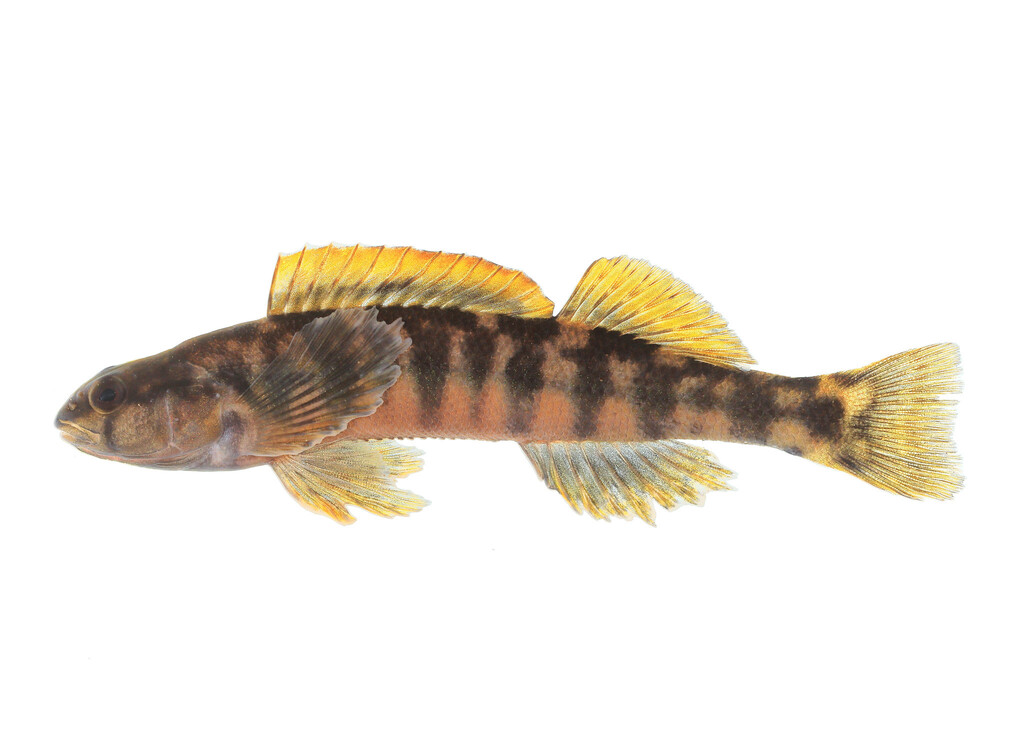
Halloween Darter
Percina crypta
The Halloween darter (Percina crypta) is a small freshwater fish native to North America. It is found in Georgia and Alabama in the drainage basin of the Apalachicola River, specifically in the Flint River system and the Chattahoochee River system. It prefers shallow, fast-flowing areas with gravel bottoms in small and medium-sized rivers. It was first described in 2008, having not previously been distinguished from the Blackbanded darter (P. nigrofasciata), formerly thought to occur in the same watershed. Blackbanded darter has since been split again with Westfall's darter now recognised from the Apalachicola drainage. The species is somewhat variable, being generally blackish dorsally, with some individuals having indistinct saddle-like barring. Males have orange and dark lateral striping while females have dark stripes and a yellowish-green belly. At a maximum standard length of 101 mm (4 in), males are slightly larger than females, and both sexes develop distinctive orange barring on the edge of the first dorsal fin during the breeding season.
The Halloween darter has a limited range and a fragmented distribution. The main threat faced by the species is a deterioration in the quality of its habitat. It has been classified as a "vulnerable species" by the International Union for Conservation of Nature. It has been listed as "threatened" in Georgia by the Georgia Department of Natural Resources, and is protected in Alabama under the Nongame Species Regulation of the Alabama Department of Conservation and Natural Resources.
From the article Halloween darter on Wikipedia (CC BY-SA), quoted section by section
Description
Halloween darters have terete (cylindrical or slightly tapering) bodies, with males longer than females. Males have a maximum standard length of 101 mm (4.0 in), while females have a maximum standard length of 85 mm (3.3 in). Males and females also vary in coloration. Males' heads range in color from a dark, bluish-gray to black, with specks of iridescent green or gold concentrated on their cheeks and opercles (protective coverings of the gills), though also present elsewhere on the head. Its eyes are darkly colored, and the preorbital bar (band of color on the preorbital, or in front of the eye sockets) is black. Both the chin and the lower jaw are bluish-black. Its sides are pale orange with blackish lateral stripes, which may be tinged with iridescent green. Its back is either black or, when possessing distinct saddles, amber or orange with black saddles. Females have dark olive-black tops of the head, with snouts that are a similar color but paler. Females have variable coloration of the cheek and opercle. They can be medium olive-black with yellow crescent-shaped markings or instead with pale yellow stippling (small dots) or mottling. Similar to males, they have iridescent green or gold speckling, though the speckles are concentrated on the opercles or cleithrum (bone that extends from pectoral fin up to the cranium above the gills). …
Range & habitat
The Halloween darter is endemic to the watershed of the Apalachicola River. This is formed from the confluence of two rivers, the Flint River and the Chattahoochee River. In the Flint River basin, the fish occurs both above and below the fall line, being present in several tributaries including Potato Creek, Lazer Creek, Muckalee Creek and Ichawaynochaway Creek. In the Chattahoochee River basin, it occurs above Lake Lanier in the Appalachian foothills of northeast Georgia, in the Chattahoochee itself, in the Chestatee River and the Sautee Creek. It is also present in the Uchee Creek, a tributary that joins the Chattahoochee River near the fall line in Alabama. This fish is typically found in fast-flowing sections of small and medium-sized rivers over bottoms composed of gravel, cobble or rock, often in areas where hornleaf riverweed (Podostemum ceratophyllum) grows.
Wikipedia: “Distribution and habitat”
What it does
It is insectivorous, consuming a variety of aquatic insects such as mayfly nymphs and larvae of midges, black flies, and caddisflies. Reproduction occurs in the spring, with spawning occurring in April and May, probably in fast-flowing riffle habitats. Females have a clutch size of 23–335 eggs; clutch size increases with female body size. Ripe egg cells are approximately 1.5 mm in diameter. Offspring hatch in June, with juveniles growing to more than half the maximum adult length by October. They reach sexual maturity at one year old. Lifespans likely do not exceed three years. The Halloween darter is a host species for US federally endangered species of freshwater mussel, the gulf moccasinshell. This mussel releases larvae called glochidia that lodge in the gills of suitable fish to develop into juveniles. Of twenty-four fish species in seven families tested as possible hosts for the gulf moccasinshell's larvae, successful metamorphosis of the larvae only occurred in the Halloween darter and three other darter species. The Halloween darter is also considered a moderately successful host for the larvae of the purple bankclimber mussel, with a metamorphosis success rate of approximately 34%.
Wikipedia: “Biology and ecology”
Where it lives
Recorded sightings
—
geo-referenced records in GBIF, from museums, herbaria and field observers.
Drag the globe to turn it. Dots are where records exist, not a range map; darker means more records.
In the stacks
Searching the stacks…
Every page naming Percina crypta in the Biodiversity Heritage Library →
This page is assembled live from iNaturalist, GBIF, Wikipedia, the Source Library and the Internet Archive. It is not yet part of the hand-edited codex. iNaturalist taxon 227439.