- Animals
- ›Chordates
- ›Vertebrates
- ›Mammals
- ›Therians
- ›Placental Mammals
- ›Primates, Rodents, and Allies
- ›Rodents
- ›Squirrels, Dormice, and Mountain Beavers
- ›Squirrels
- ›Ground and African Tree Squirrels
- ›Chipmunks
- ›Neotamias
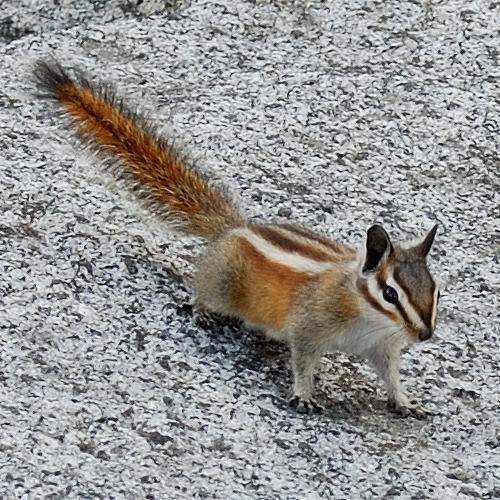
Lodgepole Chipmunk
Neotamias speciosus
The Lodgepole chipmunk (Neotamias speciosus) is a species of rodent in the family Sciuridae. It is found in the U.S. state of California at elevations from 1,500 to 3,000 metres (4,900 to 9,800 ft). The Lodgepole chipmunk has a variety of common names including: Tahoe chipmunk, Sequoia chipmunk, Mt. Pinos chipmunk, and San Bernardino chipmunk.
From the article Lodgepole chipmunk on Wikipedia (CC BY-SA), quoted section by section
Description
Females are larger than males. Female Lodgepole chipmunks have an average body weight of 55-69 grams whereas males on average are 50-60 grams. Along with weight, body length in females ranges 197–229 mm (7.8–9.0 in), while males are 200–222 mm (7.9–8.7 in). Body patterns remain consistent in both sexes as they exhibit characteristic white dorsal and facial stripes, where the central dorsal stripes are less prominent and closer to yellow-white than the lateral white stripes. In comparison to other close relatives, this species has darker and broader facial stripes. Other notable body patterns include dark black dorsal stripes, a lack of a black stripe underneath the prominent white lateral stripe, bright orange color on sides and orange-gray coloring on the shoulders, a gray under-belly, and a gray rump. The top of the head, the crown, is known to be brown with some gray interspersed. The tail, lengthier in females, ranges from 13–22 mm (0.51–0.87 in) and is characterized by its black tip and cinnamon body.
Range & habitat
The Lodgepole chipmunk spans from the high Sierra Nevada, San Jacinto, San Bernardino, and San Gabriel Mountain ranges of California into the Lake Tahoe region of the west central corner of Nevada. This species lives in subalpine coniferous forests made primarily of several species of pines (Lodgepole, Jeffrey, Ponderosa, and Sugar) and firs (Douglas, white and red). They can be observed foraging around and on top of rocks and fallen logs, which make up the forest floor. In 1978, a removal experiment based on observations was conducted by Mark A. Chappell which took four different species of chipmunk into account. This experiment was to detail the process of removal by the different species. In the experiment, it was noted that the four different species were allopatric, meaning they formed non-overlapping borders in their Sierra Nevada habitat. Each species (N. alpinus, N. speciosus, N. amoenus, and N. minimus) was noted to live at different zones in the Sierra Nevada. The Lodgepole chipmunk (N. speciosus) was observed living from 2400 to 3000 meters in the lodgepole pine zone, between the alpine zone (3000+ meters) and the Piñon pine/mountain mahogany zone (1900–2400 meters). …
Wikipedia: “Distribution and habitat”
What it does
Several different vocalizations are used by the Lodgepole chipmunk during both courtship and when frightened by a predator. During courtship, visual displays can be shown through the action of tail flipping and body postures of both sexes. Alongside visual displays, during courtship males and females utilize chips and whistles. When frightened or alerting others, the Lodgepole chipmunk produces a high pitched "whisk", a shrill "tsew", as well as the series "pst-pst-pst-a-ku" in a rapid and repeated manner. After caching food throughout the spring and summer months, hibernation begins at the end of October and lasts until early to mid April, a five-six month span.
Gestation. The period of gestation for a Lodgepole chipmunk lasts about one month. They often give birth to one litter each year, averaging 3-6 offspring, typically in July. During birth, the mother will usually go to an underground den near a large log or stone to give birth to its offspring. They may also use abandoned holes dug by Woodpeckers.
Wikipedia: “Behavior and communication”
Listen
Looking for field recordings…
Where it lives
Recorded sightings
—
geo-referenced records in GBIF, from museums, herbaria and field observers.
Drag the globe to turn it. Dots are where records exist, not a range map; darker means more records.
In the stacks
Searching the stacks…
Every page naming Neotamias speciosus in the Biodiversity Heritage Library →
This page is assembled live from iNaturalist, GBIF, Wikipedia, the Source Library and the Internet Archive. It is not yet part of the hand-edited codex. iNaturalist taxon 225755.