- Animals
- ›Arthropods
- ›Chelicerates
- ›Arachnids
- ›Spiders
- ›Typical Spiders
- ›Haplogyne Spiders
- ›Synspermiatid Spiders
- ›Spitting Spiders and Allies
- ›Sixeyed Sicariid Spiders
- ›Loxoscelinae
- ›Loxosceles
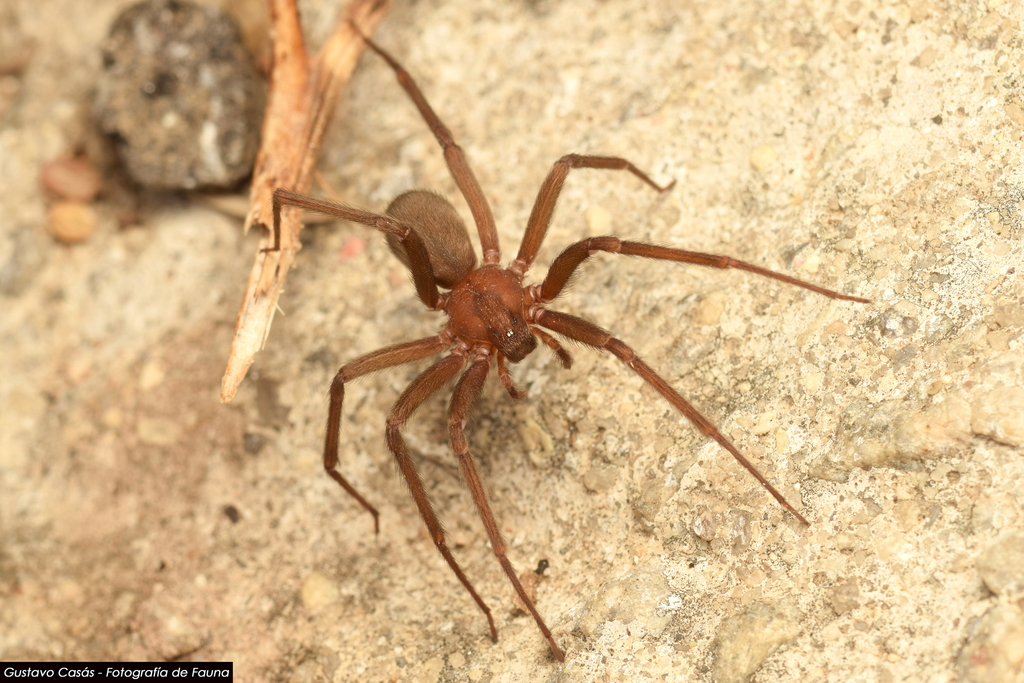
Chilean Recluse
Loxosceles laeta
The Chilean recluse spider is a venomous spider, Loxosceles laeta, of the family Sicariidae (formerly of the family Loxoscelidae). In Spanish, it (and other South American recluse spiders) is known as araña de rincón, or "corner spider"; in Portuguese, as aranha-marrom or "brown spider". This spider is considered by many to be the most dangerous of the recluse spiders, and its bite is known to frequently result in severe systemic reactions, including death.
From the article Chilean recluse spider on Wikipedia (CC BY-SA), quoted section by section
Description
The Chilean recluse is one of the larger species of recluse spiders, generally ranging from 8–40 mm in size (including legs). Like most recluses, it is brown and usually has markings on the dorsal side of its thorax, with a black line coming from it that looks like a violin with the neck of the violin pointing to the rear of the spider resulting in the nickname "fiddleback spider" or "violin spider" in English-speaking areas. Coloring varies from light tan to brown and the violin marking may not be visible. Since the "violin pattern" is not diagnostic, it is far more important, for purposes of identification, to examine the eyes. Most spiders have eight eyes, but recluse spiders have six eyes arranged in pairs (dyads) with one median pair and two lateral pairs. Like other recluse spiders, the Chilean recluse builds irregular webs that frequently include a shelter consisting of disorderly threads. Unlike most web weavers, they leave these webs at night to hunt. People get bitten when they unintentionally squeeze them in clothing and bedding. They frequently build their webs in woodpiles and sheds, closets, garages, and other places that are dry and generally undisturbed. The spider is frequently found in human dwellings. They can survive for a long time without food or water, a characteristic that encourages their worldwide spread.
Range & habitat
The Chilean recluse spider is native to South America. It is common in Chile, and can be found in Peru, Ecuador, Argentina, Uruguay, and south and eastern Brazil. It has been introduced into several areas outside its natural range but does not thrive in those locations. The spider is known to have established itself in the Los Angeles area. It has been reported in the United States, Canada, and Australia. One colony of the spider is living in the Natural History Museum of Helsinki, where it was probably introduced through fruit shipments in the 1960s and 1970s. Although the museum has often been visited regularly by local schools, preschools and daycares, only one bite has ever been recorded. In 2021, the spider was also found in three different school buildings in the town of Sandviken, Sweden. In 2025, a specimen was found on the campus of the University of Tübingen, in Germany.
Wikipedia: “Habitat”
In medicine
As indicated by its name (laeta meaning "happy"), this spider is not aggressive and usually bites only when pressed against human skin, such as when putting on an article of clothing. Like all sicariid spiders, the venom of the Chilean recluse contains the dermonecrotic agent sphingomyelinase D, which is otherwise found only in a few pathogenic bacteria. According to one study, the venom of the Chilean recluse along with the six-eyed sand spider Hexophthalma hahni, contains an order of magnitude more of this substance than that of other sicariid spiders such as the brown recluse. For a comparison of the toxicity of several kinds of spider bites, see the list of spiders having medically significant venom.
Effects of venom. The symptoms associated with Chilean recluse venom may range from a minor bite with mild skin irritation, to severe skin necrosis, called cutaneous loxoscelism, to a condition called viscerocutaneous loxoscelism, in 10-15% of cases, that causes necrosis of the victim's organs. Cutaneous loxoscelism results from serious bites causing a necrotising skin ulcer in about 50% of bites with destruction of soft tissue and may take months, and rarely years to heal, leaving deep scars. The damaged tissue will become gangrenous black and eventually slough away. …
Wikipedia: “Medical significance”
Where it lives
Recorded sightings
—
geo-referenced records in GBIF, from museums, herbaria and field observers.
Drag the globe to turn it. Dots are where records exist, not a range map; darker means more records.
In the stacks
Searching the stacks…
Every page naming Loxosceles laeta in the Biodiversity Heritage Library →
This page is assembled live from iNaturalist, GBIF, Wikipedia, the Source Library and the Internet Archive. It is not yet part of the hand-edited codex. iNaturalist taxon 224147.