On eBird ↗
Northern Carmine Bee-eater
Live sightings near you, the range map, bar charts of when it is seen, and Macaulay Library photos and recordings.
Northern Carmine Bee-eater
Merops nubicus
The northern carmine bee-eater (Merops nubicus) is a brightly-coloured bird in the bee-eater family, Meropidae. It is found across northern tropical Africa, from Senegal eastwards to Somalia, Ethiopia and Kenya. It was formerly considered to be conspecific with the southern carmine bee-eater which has a carmine coloured throat rather than the blue throat of the northern species.
From the article Northern carmine bee-eater on Wikipedia (CC BY-SA), quoted section by section
Description
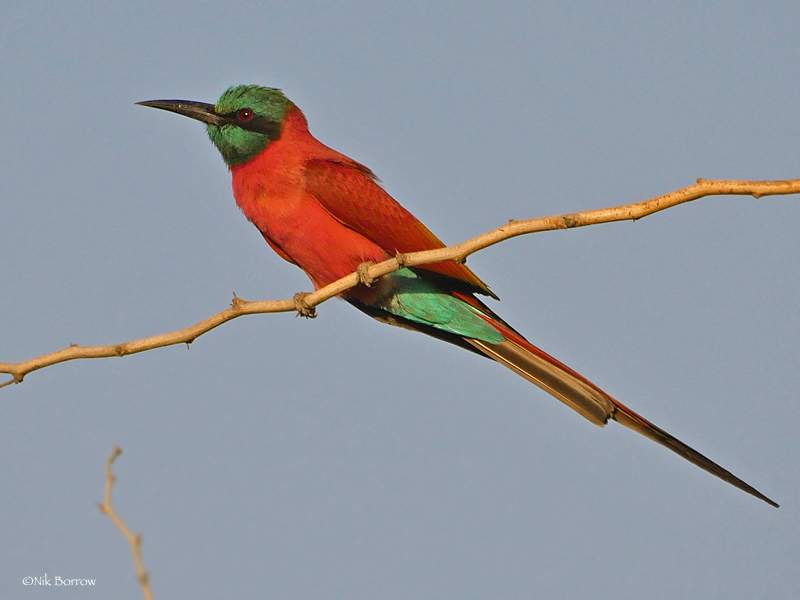
This species, like other bee-eaters, is a richly colored, slender bird, predominantly carmine in color, except for a greenish blue head and throat and distinctive black mask. This species has red eyes, a black, pointed, decurved beak, and elongated central tail feathers. The sexes are similar in appearance, and the juveniles can be distinguished from adults by their lack of elongated central tail feathers and the pinkish brown coloration of their mantle, chest to belly, and flanks. The call is a deep, throaty tunk in flight; a series of rik notes when perched.
Range & habitat
It is native to Benin, Burkina Faso, Cameroon, the Central African Republic, Chad, the Democratic Republic of the Congo, Côte d'Ivoire, Eritrea, Ethiopia, Gambia, Ghana, Guinea, Guinea-Bissau, Kenya, Liberia, Mali, Mauritania, Niger, Nigeria, Senegal, Sierra Leone, Somalia, Sudan, Tanzania, Togo and Uganda. It occurs as a vagrant in Burundi. Sue McLaren and colleagues have suggested that the distribution of the northern carmine bee-eater is tightly linked to the presence of secondary loess deposits throughout Africa.
Wikipedia: “Distribution”
What it does
Their diet is made up primarily of bees and other flying insects, such as flying ants, grasshoppers and locusts. The main hunting strategy of bee-eaters is to keep watch for flying insects from a perch, and then snatch them out of the air using their beaks, before returning to the perch.
Wikipedia: “Feeding”
Listen
Looking for field recordings…
Where it lives
Recorded sightings
—
geo-referenced records in GBIF, from museums, herbaria and field observers.
Drag the globe to turn it. Dots are where records exist, not a range map; darker means more records.
In the stacks
Searching the stacks…
Every page naming Merops nubicus in the Biodiversity Heritage Library →
This page is assembled live from iNaturalist, GBIF, Wikipedia, the Source Library and the Internet Archive. It is not yet part of the hand-edited codex. iNaturalist taxon 2220.