On eBird ↗
Chestnut-headed Bee-eater
Live sightings near you, the range map, bar charts of when it is seen, and Macaulay Library photos and recordings.
Chestnut-headed Bee-eater
Merops leschenaulti
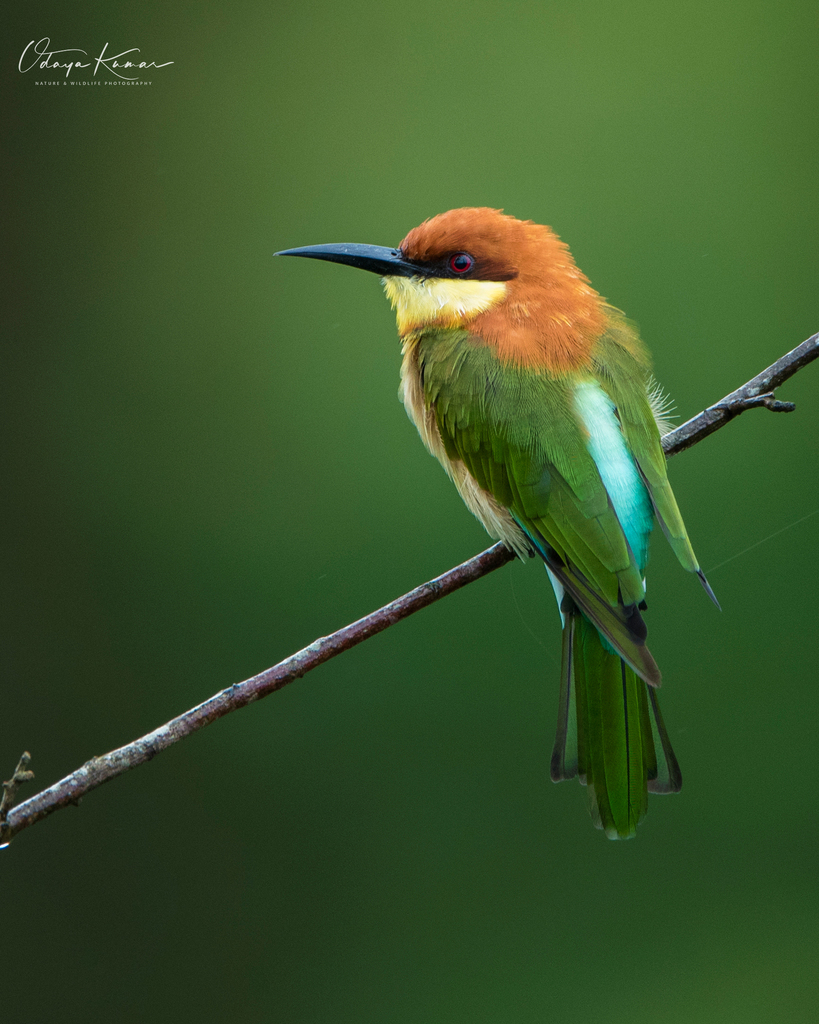
The chestnut-headed bee-eater (Merops leschenaulti), or bay-headed bee-eater, is a bird in the bee-eater family Meropidae. It breeds on the Indian subcontinent and adjoining regions, ranging from India, Bangladesh and Sri Lanka across Southeast Asia to Indonesia.
This species, like other bee-eaters, is a richly coloured, slender bird. It is predominantly green, with blue on the rump and lower belly. Its face and throat are yellow with a black eye stripe, and the crown and nape are rich chestnut. The thin curved bill is black. Sexes are alike, but young birds are duller. It is 18–20 cm long and lacks the two elongated central tail feathers possessed by most of its relatives.
From the article Chestnut-headed bee-eater on Wikipedia (CC BY-SA), quoted section by section
Description
The chestnut-headed bee-eater is 18–20 cm (7.1–7.9 in) in overall length and weighs 26–33 g (0.92–1.16 oz). The sexes are similar in appearance. The forehead, crown, nape, mantle and ear-coverts are bright chestnut. The lores are black, continued as a thin band under the eye and ear-coverts. The wing coverts, lower back and tertials are green, the latter are tipped with bluish. The rump and uppertail coverts are pale shining blue. The primaries and secondaries are green, rufous on the inner webs, and all tipped dusky. The central tail-feathers are bluish on the outer, and green on the inner webs; the others are green, margined on the inner web with brown and all tipped dusky. The sides of the face, chin and throat are yellow; below this a broad band of chestnut extending to the sides of the neck and meeting the chestnut of the upper plumage; below this again is a gorget formed by a short distinct band of black and then an ill-defined band of yellow. The remainder of lower plumage is green tipped with blue, especially on the vent and undertail coverts. The iris is red, the bill is black, the legs are dusky black and the claws dark horn-colour. The juveniles are like the adult but duller. They a green forehead, forecrown and mantle. The lower throat is yellow rather than chestnut and the gorget band is indistinct. …
Range & habitat
This is a bird which breeds in sub-tropical open woodland. It is most common in highland areas.
Wikipedia: “Distribution and habitat”
What it does
As the name suggests, bee-eaters predominantly eat insects, especially bees, wasps and hornets, which are caught in the air by sorties from an open perch. Instances of feeding on fish by flying over water are known.
Wikipedia: “Food and feeding”
Listen
Looking for field recordings…
Where it lives
Recorded sightings
—
geo-referenced records in GBIF, from museums, herbaria and field observers.
Drag the globe to turn it. Dots are where records exist, not a range map; darker means more records.
In the stacks
Searching the stacks…
Every page naming Merops leschenaulti in the Biodiversity Heritage Library →
This page is assembled live from iNaturalist, GBIF, Wikipedia, the Source Library and the Internet Archive. It is not yet part of the hand-edited codex. iNaturalist taxon 2208.