On eBird ↗
Swallow-tailed Bee-eater
Live sightings near you, the range map, bar charts of when it is seen, and Macaulay Library photos and recordings.
Swallow-tailed Bee-eater
Merops hirundineus
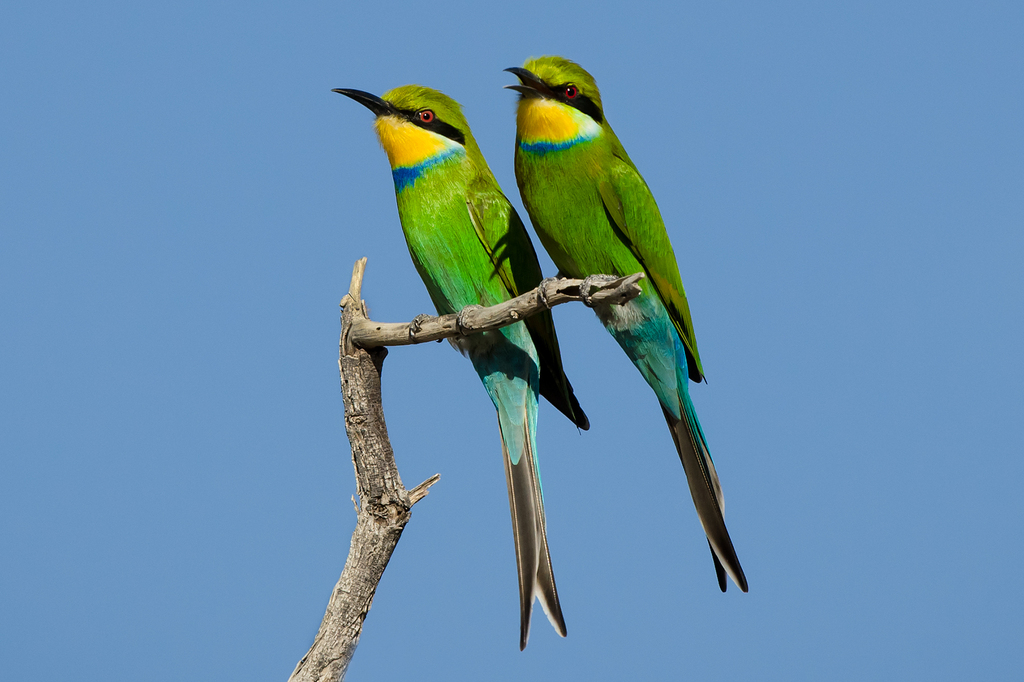
The swallow-tailed bee-eater (Merops hirundineus) is a species of bee-eater native to sub-Saharan Africa. It feeds predominantly on insects, especially bees and their relatives, which are caught in flight from an open perch. Its vivid colors and forked tail are distinctive.
From the article Swallow-tailed bee-eater on Wikipedia (CC BY-SA), quoted section by section
Description
Like other bee-eaters, this is a richly coloured, slender bird. Its colours and readily visible forked tail make it unmistakable. It is mainly green with a yellow throat, blue gorget and black eye stripe and beak. Swallow-tailed bee-eaters can reach a length of 20–22 cm, including the long forked green or blue feathers. Sexes are alike.
Range & habitat
It breeds in savannah woodlands of sub-Saharan Africa. It is partially migratory, moving in response to rainfall patterns. This is a species which prefers somewhat more wooded country than most bee-eaters.
Wikipedia: “Distribution and habitat”
What it does
This attractive bird is readily approached. Just as the name suggests, bee-eaters predominantly eat insects, especially bees, wasps and hornets, which are caught in the air by sorties from an open perch. The swallowtail has a preference for honeybees. These bee-eaters nest as pairs or in very small colonies in sandy banks, or similar flat ground. They make a relatively long tunnel in which the 2 to 4 spherical, white eggs are laid. They also feed and roost communally.
Wikipedia: “Behaviour”
Listen
Looking for field recordings…
Where it lives
Recorded sightings
—
geo-referenced records in GBIF, from museums, herbaria and field observers.
Drag the globe to turn it. Dots are where records exist, not a range map; darker means more records.
In the stacks
Searching the stacks…
Every page naming Merops hirundineus in the Biodiversity Heritage Library →
This page is assembled live from iNaturalist, GBIF, Wikipedia, the Source Library and the Internet Archive. It is not yet part of the hand-edited codex. iNaturalist taxon 2203.