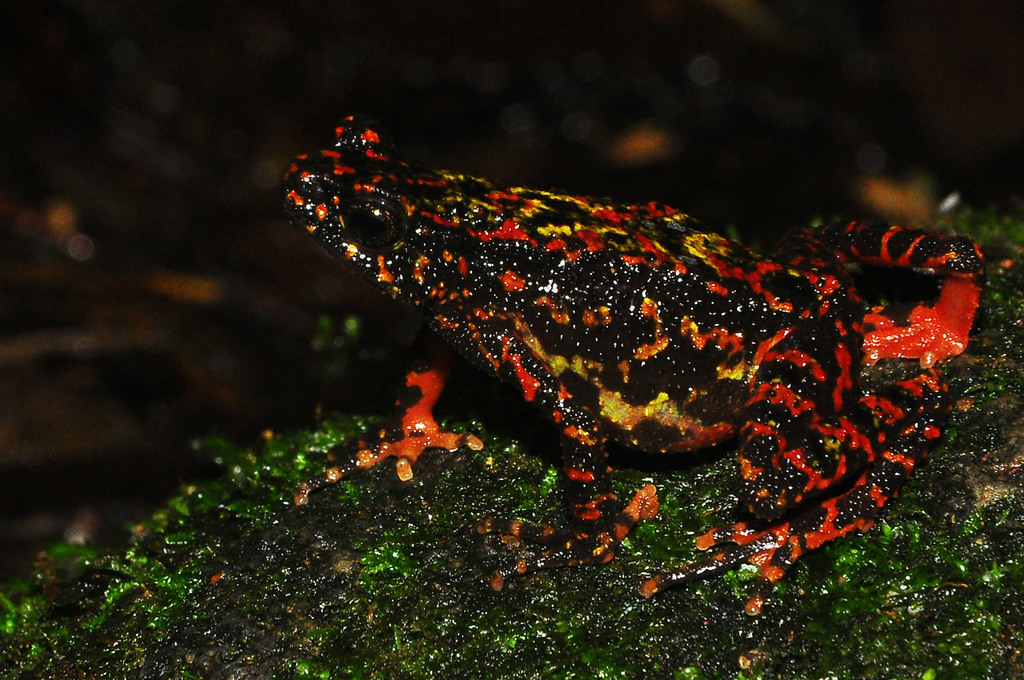
Bleeding Toad
Leptophryne cruentata
The bleeding toad, fire toad or Indonesian tree toad (Leptophryne cruentata) is a species of true toad in the amphibian family Bufonidae, endemic to Java, Indonesia. L. javanica was, formerly, synonymous with the bleeding toad prior to its description as a distinct species in 2018, although the degree of differentiation between these species is low. The bleeding toad is listed as a critically endangered species due to a drastic population decline. The factors behind this decline are unclear, but appear consistent (despite ambiguous observations) with the global spread of chytrid fungus, a particularly lethal fungal spore for frogs and toads; once infected, the animals develop a condition known as chytridiomycosis before ultimately dying.
From the article Bleeding toad on Wikipedia (CC BY-SA), quoted section by section
Description
Bleeding toads are medium-sized toads that have dark red/purple bodies with blood-red to yellow marbling present on the back and legs. Males measure 20–30 mm (0.79–1.18 in) and females 25–40 mm (0.98–1.57 in) in snout–vent length. They resemble other toads in the family Bufonidae with several distinctions. They have reduced Bidder's organs, and partially fused pectoral epicoracoid cartilage. In addition, they have a slender habitus and elongate limbs. They received the common name "bleeding toad" due to the red back markings and the skin secretions they produce when stressed.
Range & habitat
Bleeding toads are endemic to western Java and are known from a small number of sites in the Mount Gede Pangrango National Park and from around Mount Halimun Salak National Park. They prefer the boundary zones between the moist lowland areas and mountainous forests, and are at present typically found between altitudes of 1,200–2,000 m (3,900–6,600 ft) above sea level. They breed and lay their eggs in slow moving, vernal streams in which the larvae develop.
Wikipedia: “Distribution”
Listen
Looking for field recordings…
Where it lives
Recorded sightings
—
geo-referenced records in GBIF, from museums, herbaria and field observers.
Drag the globe to turn it. Dots are where records exist, not a range map; darker means more records.
In the stacks
Searching the stacks…
Every page naming Leptophryne cruentata in the Biodiversity Heritage Library →
This page is assembled live from iNaturalist, GBIF, Wikipedia, the Source Library and the Internet Archive. It is not yet part of the hand-edited codex. iNaturalist taxon 21837.