On eBird ↗
Puerto Rican Tody
Live sightings near you, the range map, bar charts of when it is seen, and Macaulay Library photos and recordings.
Puerto Rican Tody
Todus mexicanus
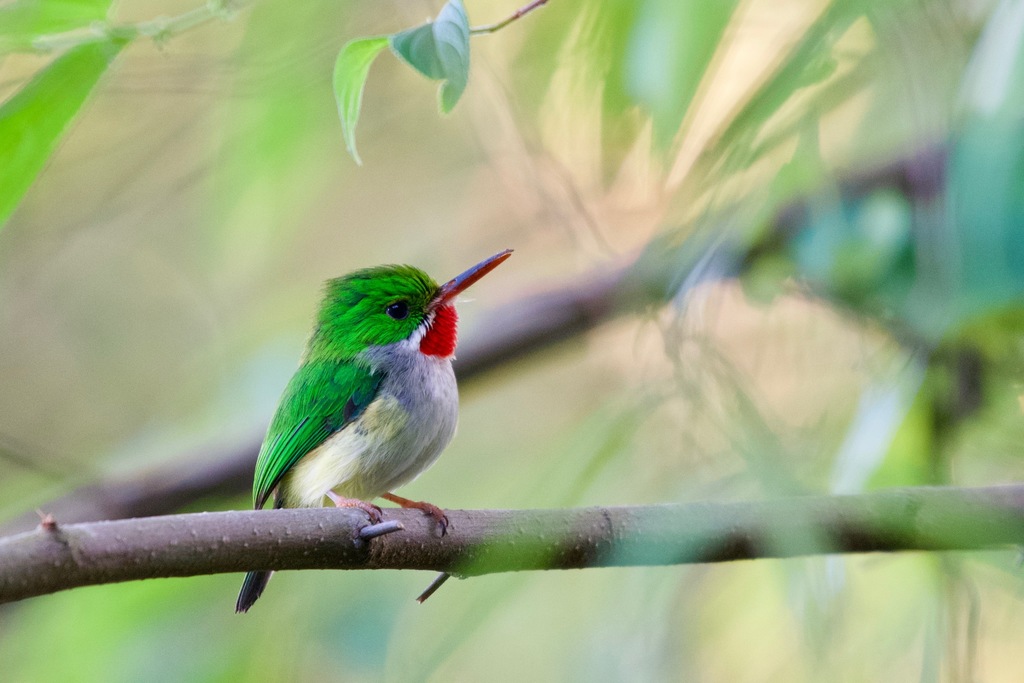
The Puerto Rican tody (Todus mexicanus), locally known in Spanish as San Pedrito ("little Saint Peter"), is a bird endemic to the main island of Puerto Rico. In 2022, the tody was approved as the official national bird of Puerto Rico by the legislative assembly. However, the proposal did not advance, largely due to the scientific name of the bird which erroneously identifies it as a native of Mexico. In 2023, the assembly approved a petition to the International Commission on Zoological Nomenclature (ICZN) seeking the renaming of the tody as Todus borinquensis.
From the article Puerto Rican tody on Wikipedia (CC BY-SA), quoted section by section
Description
The Puerto Rican tody is a small, brightly colored, non-passerine forest bird. It is one of the smallest representatives of the order Coraciiformes, with an average body length of 11 cm and weight of 5 to 6 g. The upperparts of the Puerto Rican tody are an emerald green color, and it has light-yellow flanks and underside tail coverts, and a white belly and chest. The "San Pedrito", also known as "Medio Peso" by the local people, has a red throat and lower bill, which in itself is long and broad. It can be as long or longer than the head, and as half as long as the wing. Their legs and feet are a brownish color and the tarsus is similar in length to the bill. Both males and females have a short tail, ranging from two-thirds to three-fourths as long as the wings. Males and females are not sexually dichromatic, and their only difference is their eye color; males have gray eyes whereas females' eyes are white. The young have similar colored feathers as the adults, but lack the red markings, have a grayish colored belly and have shorter bills. The Puerto Rican tody differs from the other todies in that it is the only species without pink or yellow-green colored feathers on its flanks.
Range & habitat
The Puerto Rican tody can be found throughout the main island of Puerto Rico. It is found predominantly in forested areas, especially in high-altitude damp forests where insect concentrations are higher, as well as in dense thickets, such as the Guánica Forest located in the southern region of the island.
Territory. Todies have small territories. In lowland forests a tody's territory size is approximately 0.7 hectares (1.8 acres), but in higher elevations, where insect prey is less abundant, the territory size can increase up to two hectares per pair. Breeding territories are centered around the nest burrow and are smaller than their home ranges which are defended by the pair year-round.
Agonistic displays. When the Puerto Rican tody encounters an intruder it fluffs up and raises its crest. If disturbed, a bobbing up and down motion accompanied by vocalizations is portrayed; though both males and females are capable of this display, males tend to bob more. This bobbing display has also been seen after feeding and during nest building. Chasing intruders, wing flicking and wing rattles are also some of the other exhibited displays. The majority of these territorial defense displays is reserved for other todies, as they tend to be very tolerant of other species.
Wikipedia: “Habitat”
What it does
The Puerto Rican tody is primarily insectivorous (85.9% of its diet). Todies eats katydids, grasshoppers, crickets, earwigs, dragonflies, flies, beetles, spiders (8.2%), and occasionally small lizards (3.5%) and frogs. Todies are considered voracious eaters. Todies forage and feed using different methods, including air-feeding and leaf feeding, the latter being the most common method of foraging. When they leaf feed they sit quietly in high perches and scan the surface below with fast, jerky head motions, often tilting their bills upwards. When the tody sees an insect on a leaf, it will capture it while in a short-curved flight. When todies air-feed, they have their bills pointed upward, and they fly from the perch snatching the insect and return to a different perch. Todies feed from different surfaces; the most common is leaves and the least common is the ground. The act of perching between foraging flights lasts for an average of 9.0 seconds and reach an average of 1.0 captures per minute in rain forests and 1.7 captures per minute in dense thicket habitats. The nestling's diet is different. Adults primarily feed their nestlings with the insect families Homoptera (30%), Coleoptera (25%) and Lepidoptera (16%), but they have been found to supplement the hatchling's diet with Clusia krugiana fruit (18.4%). …
Wikipedia: “Diet”
Listen
Looking for field recordings…
Where it lives
Recorded sightings
—
geo-referenced records in GBIF, from museums, herbaria and field observers.
Drag the globe to turn it. Dots are where records exist, not a range map; darker means more records.
In the stacks
Searching the stacks…
Every page naming Todus mexicanus in the Biodiversity Heritage Library →
This page is assembled live from iNaturalist, GBIF, Wikipedia, the Source Library and the Internet Archive. It is not yet part of the hand-edited codex. iNaturalist taxon 2121.