- Animals
- ›Chordates
- ›Vertebrates
- ›Birds
- ›Hornbills and Hoopoes
- ›Woodhoopoes and Scimitarbills
- ›Rhinopomastus
On eBird ↗
Abyssinian Scimitarbill
Live sightings near you, the range map, bar charts of when it is seen, and Macaulay Library photos and recordings.
Abyssinian Scimitarbill
Rhinopomastus minor
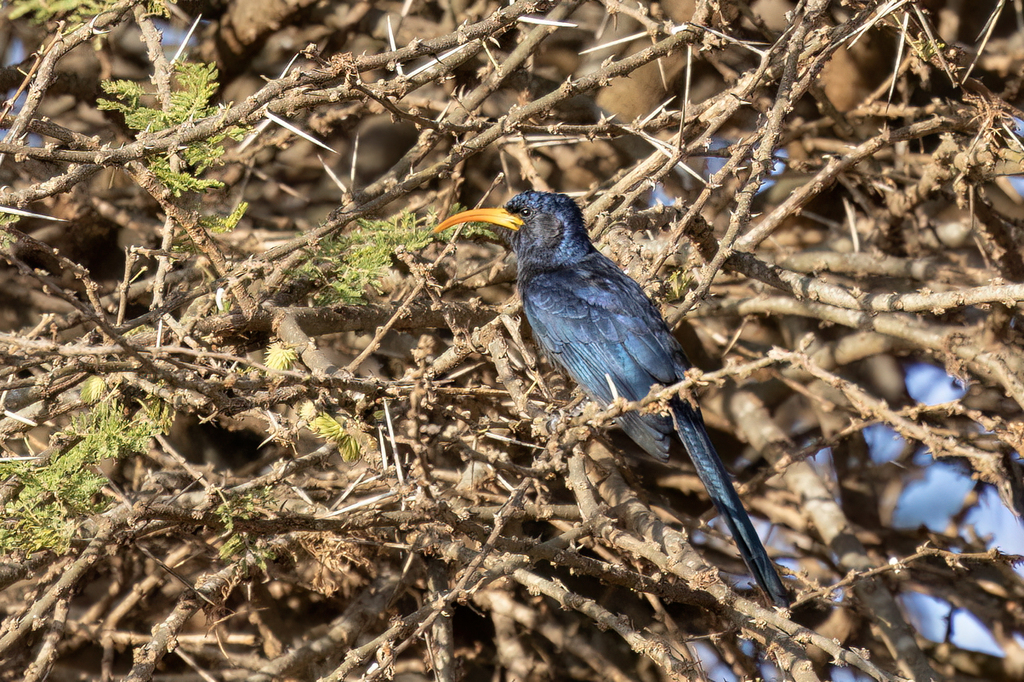
The Abyssinian scimitarbill (Rhinopomastus minor) is a species of bird in the family Phoeniculidae.
The term Abyssinia, is an old name for the region of Ethiopia, and scimitar refers to a curved sword, which its bill resembles. It is found in Djibouti, Ethiopia, Kenya, Somalia, South Sudan, Tanzania, and Uganda. The bird is non migratory, diurnal, and terrestrial. Their nests are sometimes parasitized by the greater honeyguide (Indicator indicator) which are favored by some because they can guide to beehives.
From the article Abyssinian scimitarbill on Wikipedia (CC BY-SA), quoted section by section
Description
The bird is all black with a blue-purple iridescence which covers their whole body and especially the back of the head. The bird's beak is bright orange to red and is characteristically curved and pointed. It is slightly longer than the length of its head and is built to probe into cracks and crevices for insects. It can be differentiated from other wood hoopoes by its all black legs and shorter tail, which is about the length of the bird's body excluding its head.
Sexual Dimorphism. The males coloring tends to be more blue, whereas the females have more brown tones especially in the head. Males also tend to be slightly larger than females. Their bill length is: Male; 3.33 cm; Female; 2.78 cm. Their tail length is: Male: 10.7 cm; Female; 9.5 cm. Their body mass is around 22-28g with the males being on the heavier end.
Range & habitat
The bird is found commonly in open bushed, and dry savanna habitats and is an uncommon resident in thorn scrubs in low altitudes below 1400m (an intermediate biome between a desert and tropical forest). There are two subspecies which occupy different ranges of Africa. The Rhinopomastus minor minor occurs on the eastern edge of Africa Ethiopia to Somalia and Kenya, and Rhinopomastus minor cabsanisi occurs further west in Sudan to Ethiopia, Kenya and Tanzania. See range map
Distribution. The species has a breeding range is around the equator with minimum to maximum latitudes of -9.01 to 11.78 degrees. The species has a combined total of around 20,000km2 of territorial range, although this area is largely fragmented. While the population is declining, it appears to be at a rate of only 5% over three generations and therefore the bird is considered to be of least concern.
Wikipedia: “Habitat and Distribution”
What it does
The bird is insectivorous and eats mostly live insects such as bees, beetles, larvae, caterpillars, ants, flies and wasps. They will also eat seeds and berries. While much research has been done on the species, it has been observed to nest in abandoned beehives, although it does not consume honey or other bee products.
Wikipedia: “Diet”
Listen
Looking for field recordings…
Where it lives
Recorded sightings
—
geo-referenced records in GBIF, from museums, herbaria and field observers.
Drag the globe to turn it. Dots are where records exist, not a range map; darker means more records.
In the stacks
Searching the stacks…
Every page naming Rhinopomastus minor in the Biodiversity Heritage Library →
This page is assembled live from iNaturalist, GBIF, Wikipedia, the Source Library and the Internet Archive. It is not yet part of the hand-edited codex. iNaturalist taxon 20956.